In the sun-drenched isle of Malta, where the sea whispers secrets to the sand, a financial farce unfolded with the elegance of a collapsing soufflé. StablR, the self-proclaimed bastion of stability, found itself in a pickle as an audacious attacker exploited its multisig configuration-a 1-of-3 threshold, no less-to mint millions of unbacked EURR and USDR tokens. The result? A depegging spectacle that would make even the most jaded cryptophile chuckle.
-
Key Farce-aways:
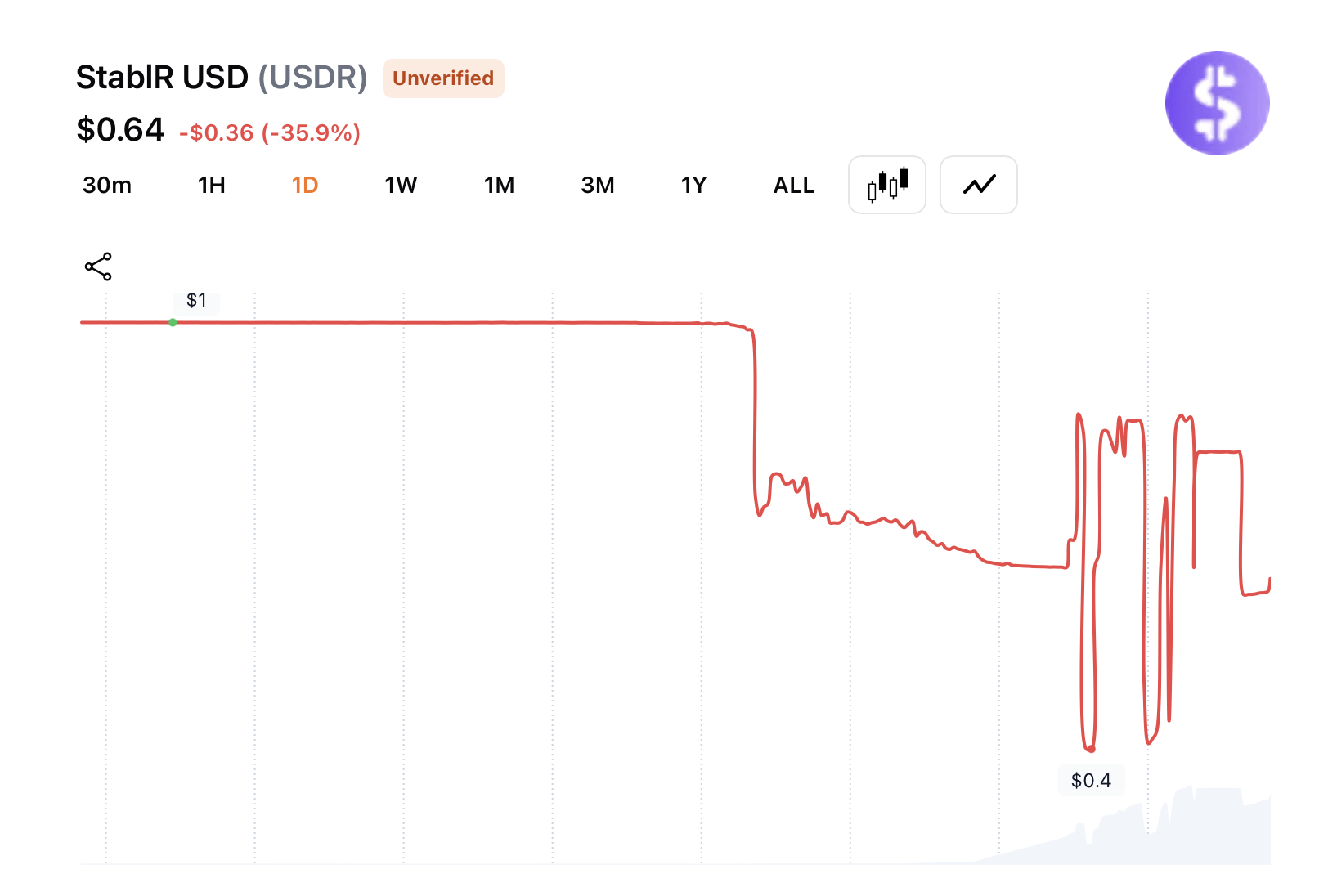
- EURR plummeted to $0.85, while USDR flirted with depths between $0.40 and $0.64 on May 24, as the attacker’s unbacked tokens flooded the market like a poorly timed monsoon.
- A single compromised private key-the digital equivalent of a forgotten house key-allowed the attacker to hijack minting controls, draining a tidy $2.8M in ETH.
- Onchain sleuths, ever vigilant, pointed to StablR’s laughably weak multisig setup as a governance risk that even the vaunted MiCA regulation could not prevent. Ah, the irony.
EURR and USDR: A Tale of Two Depegs
Reports suggest the breach was not a smart contract flaw-heaven forfend!-but rather a failure of key management. The attacker, with the finesse of a cat burglar, gained access to a single private key controlling the 1-of-3 multisig wallet. With this, they removed legitimate signers, added a controlled address, and minted tokens sans collateral, leaving StablR’s stablecoins as stable as a house of cards in a hurricane.
At 8:10 a.m. ET on Sunday, StablR took to X (formerly known as Twitter, for the uninitiated) to address the debacle: “Security update: We have identified an exploit affecting StablR and are actively working to contain it and minimize impact. Protecting our users and your funds is our top priority. We’ll share verified details and next steps as soon as possible.”
“A masterpiece of corporate reassurance,” one might say, “though somewhat lacking in substance.”
Onchain analysts estimated the attacker minted approximately 8.35 million USDR and 4.5 million EURR before dumping them on DEX platforms with liquidity thinner than a Nabokov plot. The extracted value? A modest 1,115 ETH, or roughly $2.8 million. Yet, the total unbacked token issuance may have reached a staggering $10.4 million-a sum that would make even Humbert Humbert blush.
The selling pressure was swift and merciless. EURR nosedived to $0.85, a 24% drop, while USDR fared worse, trading at $0.64-a 36% decline year-to-date. USDR even touched an intraday low of $0.40, a figure that would make any stablecoin enthusiast weep into their ledger.
StablR, ever the optimist, markets EURR as a euro-pegged stablecoin and USDR as a dollar-pegged token, both purportedly regulated under the European Union’s Markets in Crypto-Assets (MiCA) framework. The company, in its own words, bridges traditional finance and decentralized finance-a bridge, it seems, in dire need of repair.
Security firm Blockaid flagged the incident, labeling the 1-of-3 threshold a “key management and governance failure.” Observers, with a collective raised eyebrow, noted that a single compromised key should never hold the power to issue currency. Yet, StablR’s configuration allowed precisely that-a blunder as egregious as mistaking a Lolita for a mere nymphet.
“EURR issuance was controlled by a 1/3 multisig implementation (not Safe) whose signers the alleged attacker replaced,” one X account wrote on Sunday. “They then continued to transfer and mint new EURR to sell on secondary markets, leading to depegs. It is worth noting that StablR has previously stated they use Tether’s Hadron tokenisation platform to power EURR issuance.”
The individual added:
“If this is an exploit, it is the first of its kind for a MiCA compliant stablecoin. A debut as unfortunate as a poorly timed sneeze at a symphony.”
While StablR acknowledged the exploit through its official X accounts, no detailed technical postmortem or recovery timeline was available as of the time of writing. Community analysts on X debated loss estimates ranging from $2.8 million to $10.4 million-a variance as wide as the gap between expectation and reality in a Nabokov novel.
The incident follows a pattern seen across stablecoin issuers, where administrative control, rather than contract code, is the Achilles’ heel. Higher multisig thresholds, time-locks on minting functions, rate limits, and anomaly detection systems are standard mitigations-measures StablR, it seems, neglected with the carelessness of a forgotten bookmark.
The MiCA regulatory framework, designed to bring accountability to stablecoin issuers operating in Europe, appears to have fallen short. Regulators and auditors may now face pressure to address key management standards more directly-a task as daunting as deciphering a Nabokov footnote.
Holders of EURR and USDR are advised to monitor StablR’s official channels for updates on any planned burn of the unbacked supply, reserve replenishment, or compensation. Major U.S. dollar stablecoins, including USDT and USDC, remain unaffected-a small mercy in this financial farce.
The broader stablecoin market absorbed the event without significant contagion, but the StablR incident adds to a growing record of smaller, regionally focused issuers losing peg control through governance failures rather than code vulnerabilities. A cautionary tale, perhaps, for those who believe regulation alone can prevent human folly.
Read More
- Gold Rate Forecast
- APT PREDICTION. APT cryptocurrency
- SOL PREDICTION. SOL cryptocurrency
- USD CNY PREDICTION
- ZEC PREDICTION. ZEC cryptocurrency
- USD RUB PREDICTION
- BNB PREDICTION. BNB cryptocurrency
- USD JPY PREDICTION
- USD TRY PREDICTION
- Brent Oil Forecast
2026-05-24 16:27