Despite a generally challenging crypto market and investors being more careful with their money, promising new crypto projects continued to be a strong investment opportunity in the first three months of 2026.
In the first three months of the year, Gate listed 37 new cryptocurrencies, representing over 77% of all new projects added across leading exchanges. Most of these – 27 in total, or 73% of Gate’s new listings – were listed on Gate first. Additionally, 14 of the new listings were exclusive to Gate, making up 37.8% of the total.
Despite recent market ups and downs, Gate continued to list new projects at a reliable rate, consistently attracting promising ventures and providing users with opportunities for positive gains.
Overall Overview
In the first three months of 2026, a total of 48 new projects were launched on major cryptocurrency exchanges, including Gate and six others. This count is based on data from these seven platforms.
During the first quarter, Gate identified 37 projects, representing 77.1% coverage. This means Gate secured listings for over three-quarters of the new, high-quality projects that were being competed for by leading platforms.
As an analyst, I often emphasize to clients how crucial coverage is for any platform. Simply put, it dictates whether users can find a comprehensive selection of new market listings in one place. Even if a platform features a few successful projects, limited overall coverage can create the perception that key opportunities are missing, ultimately leaving users feeling like something’s not quite there.
With a coverage rate of 77.1% in the first quarter, Gate listed a significant portion of the most promising new projects, giving its users access to the majority of noteworthy new assets.
What really sets Gate apart isn’t just how much it covers, but *how* it’s organized.
In the first three months of the year, Gate listed 37 new assets. Most of these – 27, or 73% – were listed on Gate before any other exchange. Additionally, 14 of the listings were exclusive to Gate, making up 37.8% of the total. When looking at all major exchanges, Gate accounted for over half (56.3%) of the new project listings. This means that of the 48 new projects listed on major exchanges in Q1, more than half debuted on Gate.
When new projects first become available for trading, a large number choosing Gate shows the platform is highly appealing during that crucial launch phase. This indicates projects recognize Gate’s strong user base, ability to handle trading volume, efficient price setting, and wide market reach. Consistently attracting these initial listings also suggests Gate is competitive and successful in attracting promising projects.
Having unique listings shows a platform can offer real value and access desirable properties. Getting listings first proves a platform can work with top-tier properties, while *exclusive* listings demonstrate its ability to find deals others miss and make its own choices about what to offer.
Choosing projects for exclusive launch is particularly challenging when the market is down. Because these projects haven’t been vetted by other platforms, our platform takes on the risk of evaluating them early on. If we choose poorly, the project will likely perform badly after launch. But if an exclusive project succeeds, it shows we have both valuable connections and a strong ability to predict future success.
Looking at everything, we can describe Gate’s main strengths in the first quarter with three key points.
(1) Broad coverage, indicating continuous participation in top tier new supply;
A large number of projects are listed with us first, showing we’re good at securing high-quality opportunities as soon as they become available.
Having a significant number of exclusive listings proves the platform doesn’t just react to the market, but proactively finds and highlights unique properties before anyone else.
These three elements – broad coverage, being first to list items, and offering exclusive deals – are the core of Gate’s listing system, launched in the first quarter. A platform’s listing system can only be considered fully functional when all three of these are in place at the same time.
Post Listing Performance: Consistent Positive Return Coverage Across Short Term and 7 Day Windows
As a crypto investor, I don’t just look at *how many* projects a platform lists, but how well those projects *do* after they’re listed. What stood out to me about Gate in the first quarter was that the new projects they listed seemed to perform consistently over time – meaning they didn’t wildly fluctuate, and generally showed positive returns that stayed pretty stable. That’s a good sign to me – it suggests they’re doing a good job vetting projects.
Figure 1: Share of Gate New Listings With Price Increases Across Timeframes (5m–7d)
Looking at how prices changed after new projects were listed in the first quarter, over half (58.3%) saw an increase in price within the first 5 minutes. More than half (54.1%) continued to show gains after an hour, and around 55-57% still had positive returns after 24 hours, 3 days, and even a week. This indicates that Gate’s listed projects generally maintained stable gains over different time periods.
New projects often see a quick jump in price thanks to initial excitement and investment. But if these projects don’t have strong foundations or enough trading activity to support the price, that initial boost usually doesn’t last, and performance drops significantly within the first day.
Gate’s first-quarter data shows a different trend. Over various time periods – 5 minutes, 1 hour, 24 hours, and 3 days – more than half of the projects consistently saw price increases. This suggests that most projects didn’t follow the usual pattern of starting with high prices and then decreasing during the initial price discovery phase.
The 24-hour and 3-day marks are important benchmarks to consider. Most people starting new positions aren’t looking for very quick trades; instead, they tend to hold investments for a day, overnight, or over a few days.
For these users, seeing that over half of projects (56.8% after 24 hours and 54.1% after 3 days) continue to perform well suggests a more genuine trading environment. This shows that opportunities to profit from new listings on Gate aren’t just limited to the very beginning, but can last for a significant period after the initial launch.
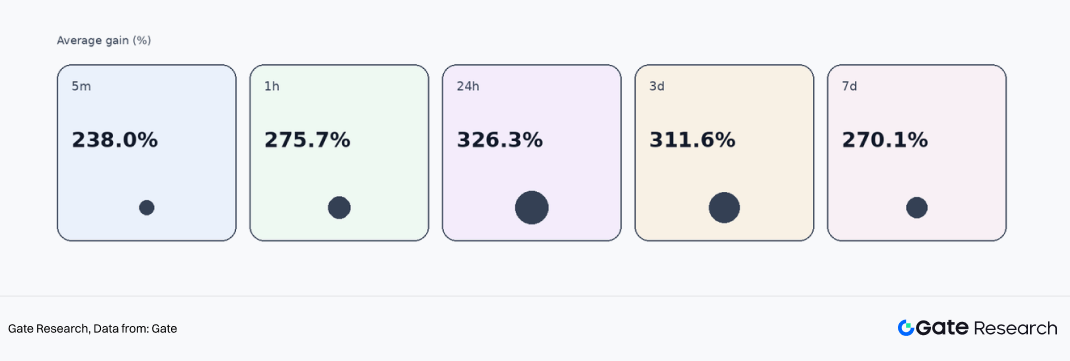
Looking at how much profit projects made when their prices went up gives us a better understanding of how sensitive those gains are to price changes. In the first quarter, projects that increased in price saw average gains of 238.0% over 5 minutes, 275.7% over 1 hour, 326.3% over 24 hours, 311.6% over 3 days, and 270.1% over 7 days.
This shows that when promising new projects launch on Gate, they can still see significant price increases if they gain early traction. Specifically, average gains within the first 24 hours and three days are around 300%, which suggests that even in a challenging market, strong projects can still generate substantial returns – but these gains are focused on a select group of well-chosen investments.
Figure 2: Average Gains of Rising Gate New Listings Across Timeframes (5m–7d)
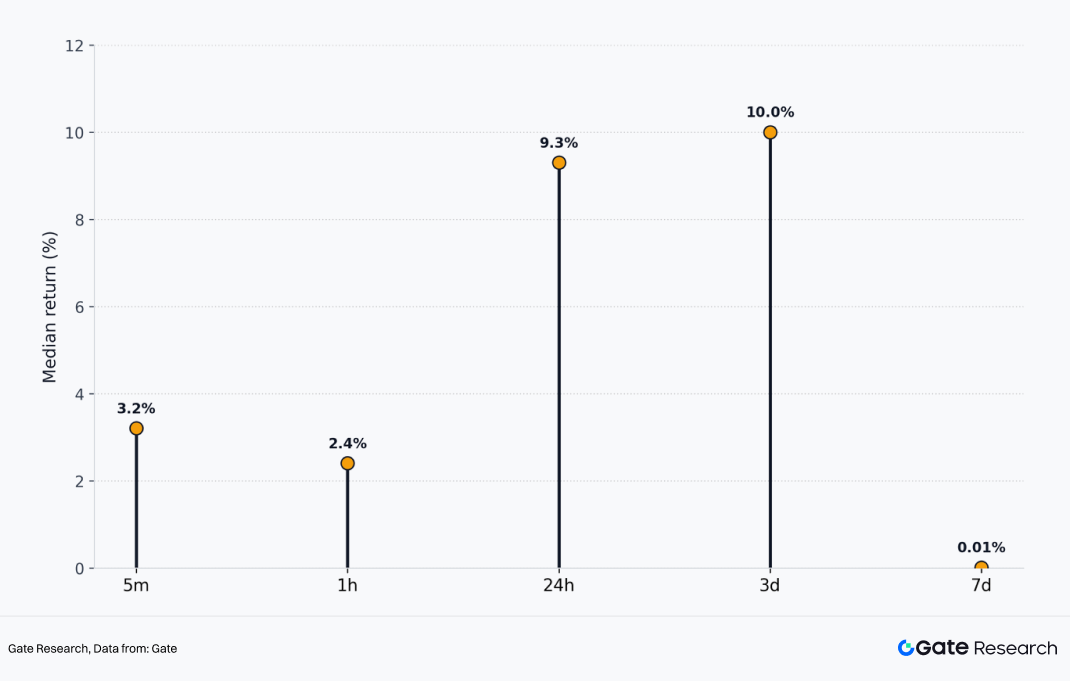
Simply looking at average gains isn’t always helpful because a few unusually high or low results can skew the overall picture. That’s why the median – the middle value – is often a better measure, as it gives a more typical sense of how most projects perform.
Newly launched projects saw average gains of 3.2% after 5 minutes, 2.4% after an hour, 9.3% after 24 hours, 10% after 3 days, and a slight 0.01% after 7 days. Even without considering projects with exceptionally high returns, most projects still showed positive gains after 24 hours and 3 days.
This shows that Gate’s featured projects generally performed well throughout the quarter. The positive results weren’t just due to a few exceptional projects skewing the average, but because most projects consistently showed promising returns shortly after being listed.
Figure 3: Median Price Increase of Gate New Listings Across Timeframes (5m–7d)
What really matters for most users isn’t finding a few projects with huge profits, but seeing a steady stream of new, reliable opportunities on the platform.
According to our findings, Gate consistently offered clear pricing in the first quarter, with its immediate listings showing promising returns within a 24-hour to 3-day timeframe.
The fact that the median price has remained relatively stable after seven days also shows that new listings mainly help with initial price setting, but this benefit doesn’t last forever.
As I’ve observed in my research, after about a week, the market really starts to separate the strong projects from the weaker ones, and the differences between them become quite clear. This means that new listings aren’t always good for long-term investments. Instead, I’ve found the best opportunities actually appear within the first 24 to 72 hours of a project launching, when the market seems more balanced and returns are more predictable.
First Listings and Non-First Listings: A Dual Track Structure
When evaluating a platform’s ability to list projects, people often concentrate on initial listings. However, a strong platform doesn’t just handle new projects well – it also allows diverse projects to establish and demonstrate how they will generate returns for users. Recent data from the first quarter shows that Gate excels in this area.
First Listings: Dominant in Quantity with Stronger Return Elasticity
As I’ve analyzed the data, Gate was a major player in bringing new projects to market in Q1. They hosted 27 first listings, which actually represented 73% of all new listings across the period. What this tells me is that Gate wasn’t just a place where projects went *after* launching elsewhere; they were heavily involved in the initial launch phase for most of these projects, directly supporting them as they entered the secondary market.
New listings often see a significant price increase. Our data shows that almost 46% of projects listed for the first time continued to rise in value after a week. For those that did increase, the average gains were substantial: 502.8% after one day, 440.7% after three days, and 364.3% after seven days.
This suggests that the main benefit of being listed on Gate initially isn’t just getting in early, but also the ability to gain traction and build positive price movement, starting with Gate as the launchpad.
Figure 4: Average Returns of Rising Gate Listings Across Holding Periods (1d, 3d, 7d)
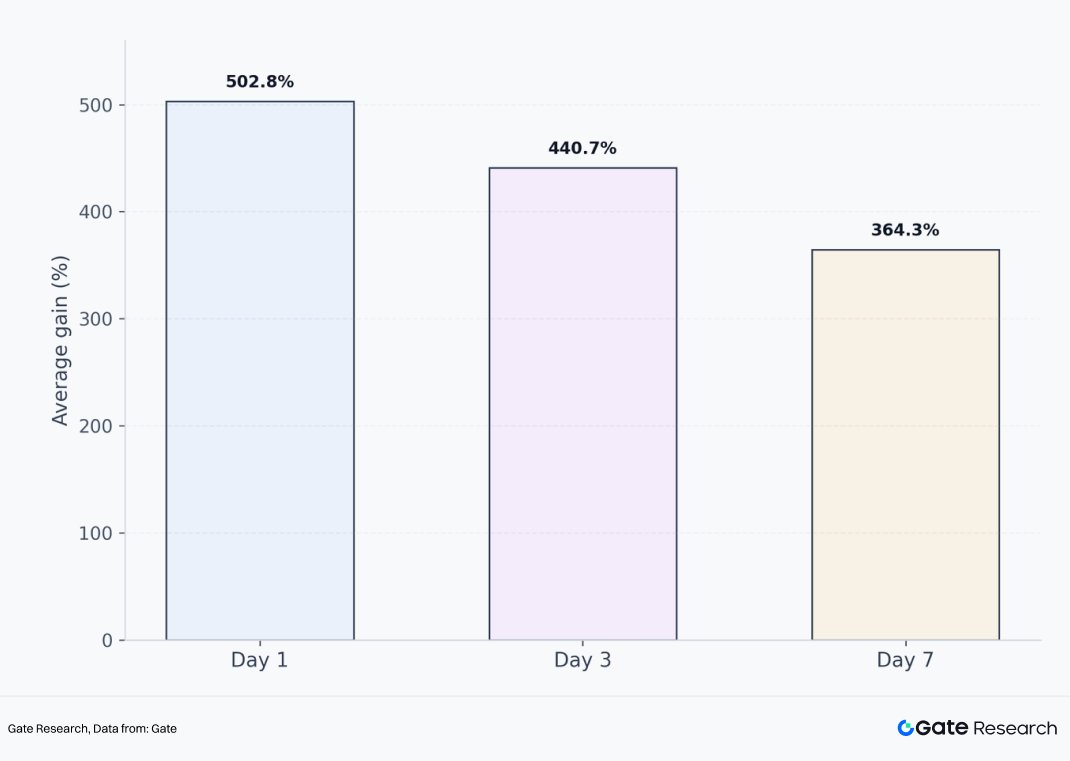
As I’ve been analyzing the returns, the high elasticity we’re seeing is really striking. Looking at projects listed first in Q1, a significant 7.4% actually saw gains of over 500%, and even exceeding 1,000% within just 24 hours. This strongly suggests that these initial listings on Gate.io are where you find the biggest, fastest opportunities for high returns.
While not all projects succeed, a strong initial launch that captures market interest, tells a compelling story, and generates traffic usually leads to a significant price increase.
The basic idea is simple: initial stock listings happen when a stock first becomes publicly traded. At this point, the price hasn’t settled, investors are still learning about the company, and a lot of money can flow in quickly.
Platforms that can attract promising projects early on are better positioned to offer users valuable and engaging initial investment opportunities. While early access can lead to potentially higher returns for users, it also carries increased risk due to market fluctuations and rapid price changes.
Non-First Listings: Smaller in Number but More Stable in Trend
In my research, I’ve noticed a shift with Gate’s listings. While initial listings were numerous, we only saw 10 non-first listings in the first quarter. That’s a smaller portion overall, but interestingly, these later projects seem to be delivering more consistent median returns than the initial ones.
Figure 5: Win Rate and Median Price Increase of Gate Non-Initial Listings Across Timeframes (5m–7d)
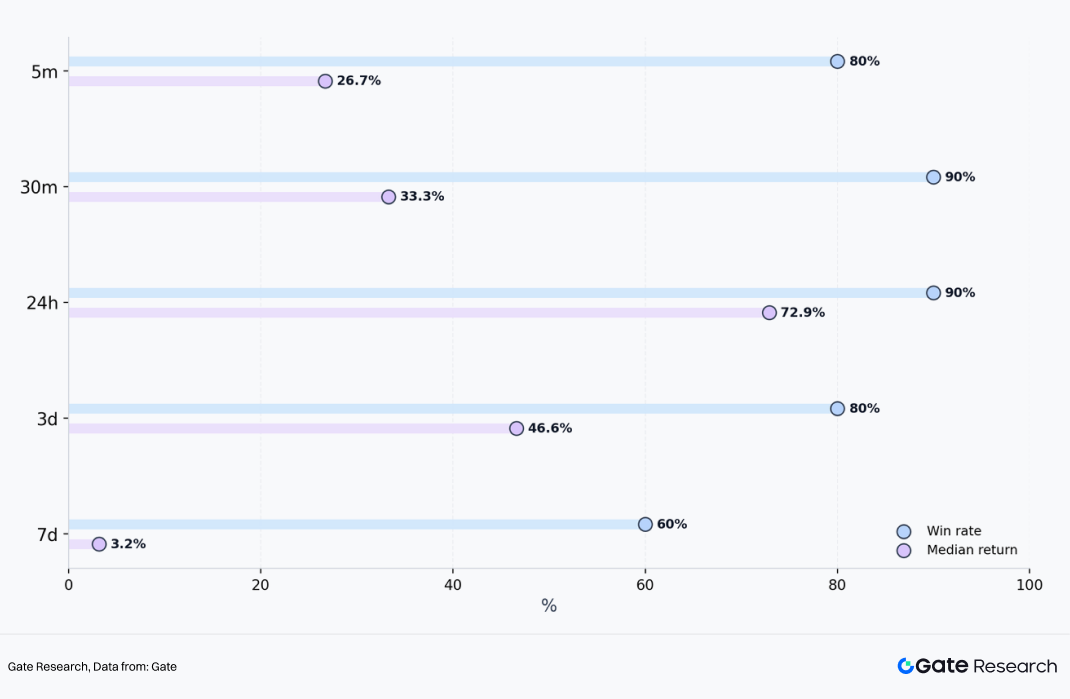
Analysis of listing data reveals that subsequent listings (those not listed first) saw price increases in 80% of cases after 5 minutes, rising to 90% after 30 minutes and 24 hours, then 80% after 3 days, and 60% after a week. The average price gains during these periods were +26.7%, +33.3%, +72.9%, +46.6%, and +3.2%, respectively. Notably, 40% of these projects experienced price increases of over 100% within the first 24 hours.
The data shows that while listings appearing later don’t start with as low a price as the first listing, they are more likely to successfully raise their prices when reviewed by Gate’s system.
Projects listed after the initial launch generally have already proven some interest in the market. This allows us to be more selective, looking closely at things like price, how engaged the community is, the project’s story, and how well it’s being adopted by the market. This extra vetting leads to more reliable investment opportunities compared to those listed first.
Gate’s approach to listing doesn’t depend just on initial listings to prove its value. It actually uses two strategies that work together: early listings offer greater flexibility and potential for increased profits, while subsequent listings provide more consistent, average returns.
One option favors a bolder, faster approach, while the other prioritizes a steadier, more reliable one. Having both allows the platform to cater to a wider range of users. This two-pronged strategy is a significant improvement over simply showing the initial search results.
Gate isn’t simply focused on having the most new projects launch first. They’re also skilled at identifying and promoting promising projects even after their initial launch, consistently delivering valuable opportunities to users.
Exclusive Listings: The Segment That Best Reflects Gate’s Proactive Judgment Capability
Initial listings show a platform can offer standard, good-quality projects, but *exclusive* listings demonstrate a platform’s ability to actively choose promising projects, secure necessary resources, and make smart decisions about the future. These exclusive offerings clearly highlight how the platform evaluates projects, manages risks, and delivers results.
During the first quarter, Gate listed 14 projects that were exclusive to their platform, representing over 37% of all new listings. This shows Gate actively sought out unique projects, rather than simply following what other exchanges were doing. These exclusive projects also performed well after launch, consistently demonstrating strong results.
Figure 6: Win Rate and Median Price Increase of Gate Exclusive Listings Across Timeframes (24h–7d)
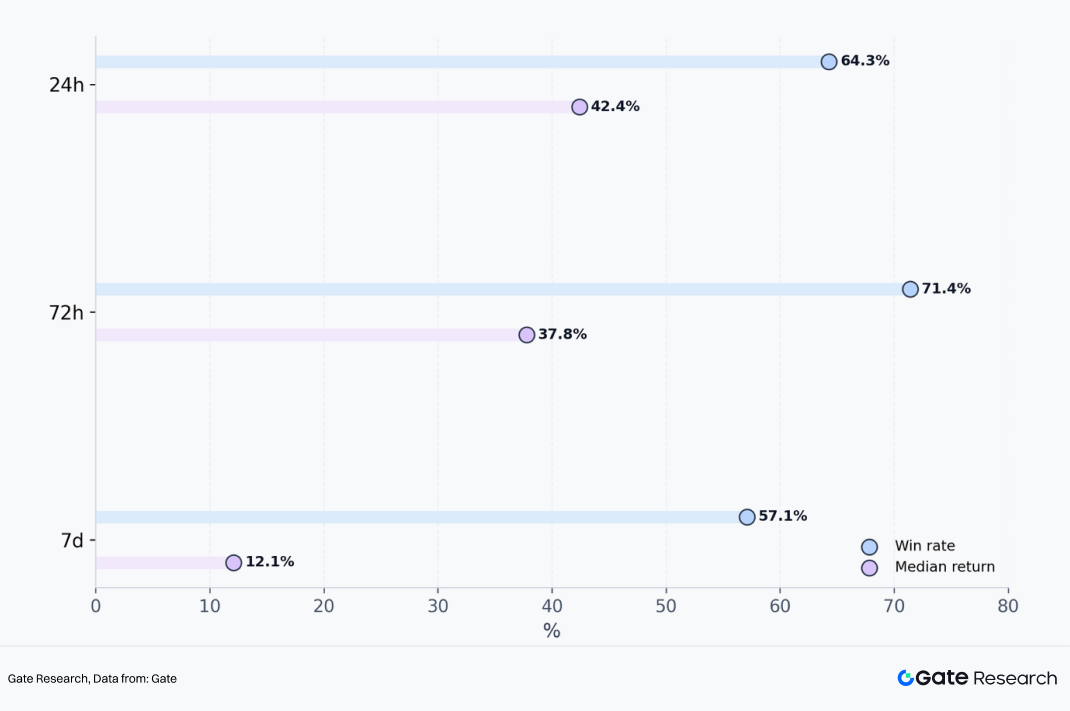
As a crypto investor, I’ve been looking closely at Gate’s exclusive listings, and the numbers are pretty encouraging. I’ve seen price increases of around 64%, 71%, and 57% within the first 24 hours, 72 hours, and 7 days after a project lists. The sweet spot seems to be around 72 hours – that’s where I’m seeing the biggest gains. What’s really interesting is that the price isn’t dropping off quickly after the initial hype. Instead, these projects seem to be consistently attracting investment and actually *keeping* their momentum going, which is a great sign.
Exclusive listings showed strong median returns: 42.4% within 24 hours, 37.8% within 72 hours, and 12.1% within 7 days. This means exclusive projects tend to have a high percentage of price increases and deliver significantly better overall returns compared to all listings. The consistent performance across different timeframes suggests these returns aren’t just due to a few exceptional projects, but that most exclusive listings consistently provide good results within the first week.
Looking closely at how well exclusive listings performed reveals some striking results. Within the first 30 days of being listed, over 20% of these projects consistently more than doubled in value. Between 3 and 7 days after listing, as many as 35.7% of exclusive projects saw gains exceeding 100%, which is much higher than the 15.4% seen with all new listings. Even after a full 30 days, 12.5% of exclusive projects still showed gains of over 500%, and some even exceeded 1,000%.
The data suggests that properties listed exclusively on Gate don’t just see initial price increases due to limited availability. They continue to attract buyers and establish fair market prices over time, increasing the likelihood of significant price growth.
Case Review
Looking at projects listed in the first quarter, Gate selected them in generally three ways. First, some projects received priority listing or early access, which was then confirmed by other platforms. Second, Gate occasionally featured projects exclusively that went on to perform well, showing its ability to identify promising ventures independently. Finally, Gate also focused on projects with compelling stories and strong community support, highlighting its understanding of trending topics and investor sentiment.
Solana Mobile (SKR): Early First Listing Execution on High Attention Projects
Solana Mobile is part of the growing DePIN trend and has seen impressive growth, with a peak increase of 2,459% since its initial launch and a 715% gain in the last 30 days. As the official phone from the Solana network combined with Web3 apps, it benefits from strong brand recognition, a dedicated community, and widespread distribution. Gate exchange listed the token alongside two other major exchanges and launched it a day before a competitor, demonstrating its ability to quickly respond to popular projects with high global interest in the first quarter.
Based on the SKR listing, Gate consistently gets early access to promising new projects – those with a lot of user interest, compelling stories, and high potential. This allows Gate users to invest before these projects become widely known. This demonstrates Gate’s strength in securing access to top-tier new opportunities.
CodexField (CODEX): A Representative High Return Exclusive Listing
CodexField is a leading content creation project listed on Gate in the first quarter of the year. It saw a remarkable price increase, peaking at 4,900% and still showing a 2,566% gain as of March 25th – all before similar projects were listed on B.
CodexField showcases Gate’s ability to identify promising projects. Gate Labs invested in the project before it launched, and Gate provided the first place to trade it, which led to significant gains for those involved.
As an analyst, I’ve observed that Gate excels at identifying promising projects early on – those that haven’t yet gained widespread attention but show real potential. We’re able to establish a strong foothold in these emerging markets and, leveraging our platform’s liquidity and extensive user base, actually drive those opportunities towards tangible success and verifiable market results.
Lobster: An Early Positioning Case in AI plus Meme Narratives
In the first quarter, combining Artificial Intelligence with meme-based projects proved to be a popular but unique strategy. While many of these projects had compelling stories, they didn’t last long, and some were good at gaining attention but didn’t lead to actual trading gains. Lobster, an AI/meme project, launched on Gate and saw a peak increase of 286% and a 164% gain in just one week. Another project, B Alpha, quickly followed, listing on Gate the next day after seeing Lobster’s positive performance. This demonstrates Gate’s ability to identify and launch promising, viral projects early on, and to help determine their initial price movements.
Overall, Gate’s performance in the first quarter wasn’t due to one specific type of project. Instead, success came from a mix of different sectors, styles, and themes. The platform can successfully launch both well-known projects that attract a lot of attention and smaller, up-and-coming ones with strong growth potential. It supports projects focused on technology and product development, as well as those driven by community and cultural trends. This variety demonstrates that Gate’s listing process is becoming more sophisticated.
Conclusion
Despite challenging market conditions in early 2026 – including general downward pressure, fewer opportunities, and increasingly varied project outcomes – Gate consistently delivered a strong stream of new listings and positive results after those listings went live.
Even when market conditions are tough, Gate consistently showed a good number of listings increasing in price over various periods, with average gains seen within 24 hours and 3 days. New listings performed well in different ways: initial listings reacted more strongly to price changes, subsequent listings had a higher chance of success, and exclusive listings were rarer and tended to perform better over the medium term. Gate’s success isn’t due to one or two features, but a well-designed, comprehensive system.
Gate offers users a comprehensive way to participate in early-stage projects. Those looking for potentially high returns can focus on new listings, while those prioritizing stability might prefer projects with a proven track record. Gate’s exclusive listings also give users early access to unique assets. For project teams, data from the first quarter shows Gate excels at providing initial trading support, managing liquidity, and establishing fair pricing.
Over the long run, exchanges compete based on their ability to consistently find, choose, and successfully launch promising projects, no matter the market conditions. Gate.io’s results from the first quarter show this clearly: even when the market is down, they consistently identify strong projects, make solid choices, and achieve positive outcomes.
Read More
- Gold Rate Forecast
- USD CNY PREDICTION
- Brent Oil Forecast
- SOL PREDICTION. SOL cryptocurrency
- CNY JPY PREDICTION
- Ripple’s CTO Offers XRP to Uncover AI ‘Slop’ – A Most Curious Game of Wits!
- OP PREDICTION. OP cryptocurrency
- Solana Sensation: Bit Mining’s 250% Stock Surge and the Great Crypto Shift
- Bybit Meets UBS: When Finance Wears a Blockchain Costume 🎭
- Crypto Cards vs. Stablecoins: Who’s Winning?
2026-04-03 17:19