In a twist as unexpected as a chess grandmaster’s sacrifice, Peter Steinberger, the maestro behind Openclaw, has elected to join the ranks of OpenAI, leaving his brainchild to claw its way into the wild as an independent foundation model. A move, one might say, as audacious as a lepidopterist’s pursuit of a rare specimen, all while the world of autonomous software holds its breath.
OpenAI Nets Steinberger: A Talent Coup or a Clever Feint?
Contrary to the whispers of the uninformed, OpenAI has not, in fact, devoured Openclaw whole. Instead, they have merely plucked its creator, Peter Steinberger, from the wild, leaving the project to metamorphose into an independent foundation, still basking in the glow of OpenAI’s patronage. A strategic retreat, or a masterstroke of corporate chess? Only time will tell.
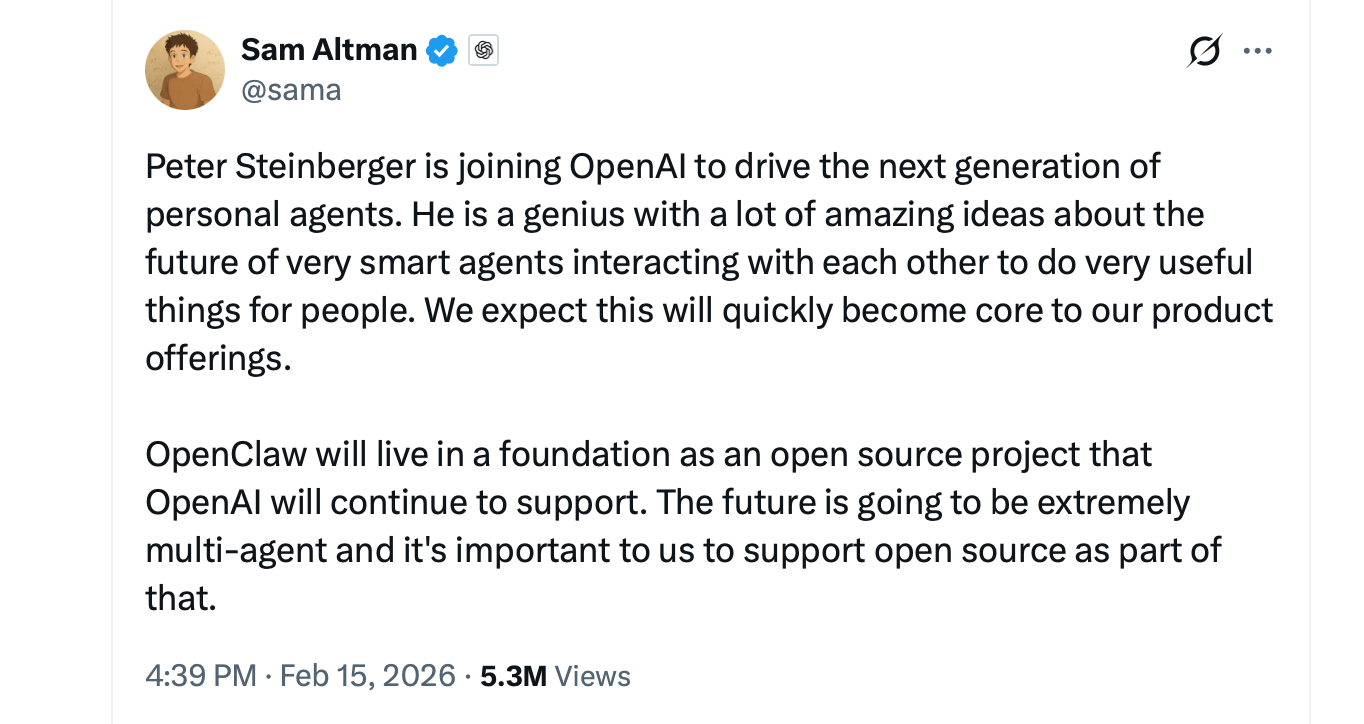
The announcement, unveiled on the 15th of February, 2026, by OpenAI’s own Sam Altman via the ephemeral medium of X, paints this as a harmonious alignment of talents rather than a predatory takeover. Financial details, as is often the case in such dalliances, remain shrouded in mystery. Openclaw, for its part, will retain its MIT license, a beacon of openness in a world increasingly enamored with proprietary secrets.
For a project that burst onto the scene in November 2025, amassing over 180,000 Github stars faster than a nymphomaniac at a singles mixer, this shift is nothing short of seismic. Openclaw’s allure lay in its ability to function as an autonomous AI agent, a digital butler for the modern age, integrating seamlessly with messaging platforms like Whatsapp, Telegram, Slack, and Discord, and managing tasks with a finesse that would make Jeeves blush.
At its core, Openclaw is a symphony of large language models (LLMs), from Anthropic’s Claude Opus to OpenAI’s GPT Codex, orchestrating a ballet of inbox management, shell commands, browser automation, and task scheduling via a “heartbeat” system that would make even the most diligent cardiologist envious. This proactive design sets it apart from the passive chatterboxes that dominate the AI landscape, positioning it as a true agent of change.
Yet, the path to greatness is rarely smooth. Openclaw endured rebranding fiascos, security scares, and financial hemorrhaging that would make even the most profligate aristocrat blanch. Steinberger, in a moment of candor during a Lex Fridman interview, revealed monthly losses between $10,000 and $20,000, a sum that would make a lesser man weep into his caviar.
The suitors, however, were many. Both OpenAI and Meta came calling, with Meta’s Mark Zuckerberg reportedly reaching out via Whatsapp, no less, to discuss model preferences and integration possibilities. Altman, ever the pragmatist, emphasized compute access and long-term alignment, a siren song that Steinberger found irresistible.
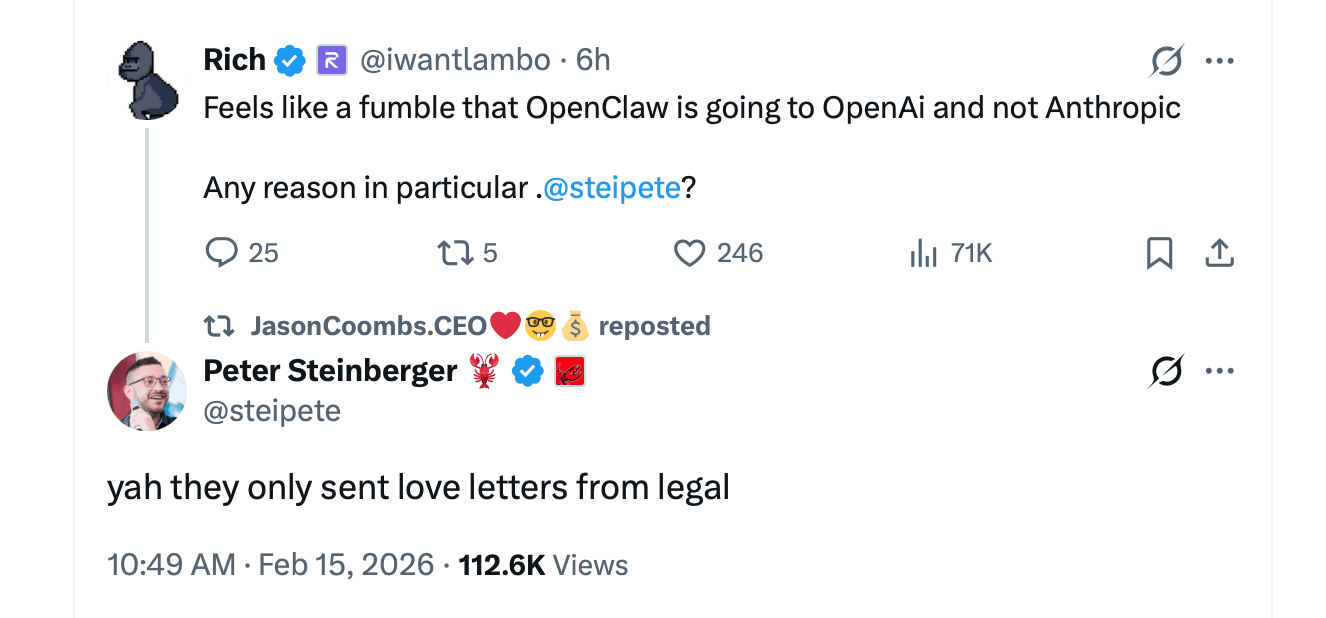
The community, as is its wont, has reacted with the predictability of a soap opera. Some see this as a validation, a chance to scale agentic systems within the mainstream. Others, more cynical, fear the dilution of Openclaw’s anarchic, community-first spirit, dubbing it “Closedclaw,” a moniker as biting as it is apt.
On the very same day Steinberger’s move was announced, Moonshot AI unveiled Kimi Claw, a browser-native, cloud-hosted implementation of the Openclaw framework, integrated directly into kimi.com. The timing, one suspects, was no accident.
Kimi Claw, running on Moonshot’s Kimi K2.5 model, offers persistent, 24/7 agent functionality in a managed environment, complete with 40GB of cloud storage, access to over 5,000 community skills, and real-time data integration. It even supports a “Bring Your Own Claw” model, a nod to the tinkerers and the self-reliant. Yet, this convenience comes at a cost: data residency, a thorny issue in an age of geopolitical tension.
By shifting Openclaw’s architecture into a hosted browser tab, Moonshot aims to eliminate the friction of local setup, a boon for the less technically inclined. Yet, critics note the trade-off: data privacy and geopolitical concerns, already whispered in the halls of Washington, loom large. A Chinese-hosted service, after all, is not without its complications.
In essence, these developments illustrate a broader strategic pivot in artificial intelligence (AI). The battle is no longer over model benchmarks but over distribution, ecosystem control, and the ownership of the layer that automates our digital lives. OpenAI bets on talent and multi-agent systems, Moonshot on cost efficiency and seamless hosting, while Openclaw’s foundation model sits between them, open, independent, and more central than ever.
The result is a three-way tension: open-source idealism, corporate scaling power, and geopolitics. If personal AI agents are indeed the next interface layer, the decisions of February 2026 may well be remembered as a turning point, a moment when the future was not just predicted but actively shaped.
FAQ 🤖
- What happened to OpenClaw?
OpenClaw was not acquired; it is becoming an independent foundation-backed open-source project with continued support from OpenAI. - Why is Peter Steinberger joining OpenAI?
He is joining to focus on advancing next-generation personal AI agents within OpenAI’s broader product ecosystem. - What is Kimi Claw?
Kimi Claw is a browser-native, cloud-hosted version of the OpenClaw framework launched by Moonshot AI on Feb. 15, 2026. - Why is the launch of Kimi Claw significant?
It provides a managed, scalable alternative to self-hosted agents while raising new data privacy and geopolitical considerations.
Read More
- Brent Oil Forecast
- Silver Rate Forecast
- Gold Rate Forecast
- Mnemonic Mishaps: South Korea’s Tax Agency Seeks Crypto Custodians with a Dash of Decorum
- US and Iran in Pakistan: Crypto’s Wild Ride on a Prayer and a Fragile Peace Deal!
- BTC PREDICTION. BTC cryptocurrency
- Stablecoins, RWAs, and the Crypto Industry’s Midlife Crisis
- XRP’s ETF Waltz: $1.2B Inflows, Yet Price Does the Limbo at $1.30
- Binance Suddenly Pours $2.4B in Stablecoins-Where Are All the Traders?
- Crypto’s Rollercoaster: Is Resilience Just a Mirage or the Start of Something New?
2026-02-16 12:07