Fidelity Digital Assets released a new report suggesting that institutional investors can no longer ignore bitcoin. While not every investor needs to buy it, they now need a good reason *not* to, as the traditional 60/40 investment strategy faces challenges. According to the report, published March 25th by Chris Kuiper, bitcoin’s potential role in investment portfolios is becoming too significant to overlook.
Fidelity’s new report takes a straightforward approach. It doesn’t ask *if* bitcoin is worth looking at, but rather *how much* investors currently hold and their reasons for that amount. While the firm’s analysts acknowledge that not investing in bitcoin is still a valid option, they now expect a solid justification for doing so.
Tiny Bitcoin Exposure, Big Portfolio Impact
The case for Bitcoin is initially based on its past performance. Fidelity reports that Bitcoin has been the best-performing asset in 11 out of the last 15 years, consistently delivering the highest returns – and the best returns relative to its risk – compared to other investments they analyzed. While acknowledging Bitcoin’s well-known price swings, the report points out that its risk-adjusted return metrics, like the Sharpe and Sortino ratios, still look good, especially when compared to the recent poor performance of bonds, even after accounting for inflation.
The paper then shifts the focus from theoretical debate to practical investment strategies. Fidelity highlights bitcoin’s limited supply, its tendency to perform independently of traditional investments like stocks and bonds, and how it reacts to changes in the money supply as reasons to consider it for a portfolio.
As a crypto investor, I found one claim in the report particularly interesting: over the last 15 years, changes in the global money supply (M2) seem to explain a huge chunk – 87%, to be exact – of Bitcoin’s price movements. Fidelity is careful to point out that just because two things move together doesn’t mean one *causes* the other, but it’s still a compelling observation. They also suggest Bitcoin and gold both get talked about as hedges against inflation, but they’re different enough that you could potentially hold both in a well-rounded investment portfolio – they complement each other rather than being replacements for one another.
For investors deciding where to put their money, the research on how Bitcoin affects a typical investment mix is key. Fidelity analyzed a standard portfolio of 60% US stocks and 40% US bonds and found that adding Bitcoin would have generally increased returns over time. While adding Bitcoin did increase risk, the report suggests the higher returns balanced that out, especially with small allocations of 1% to 3%, which significantly improved key risk-adjusted return measures like the Sharpe and Sortino ratios.
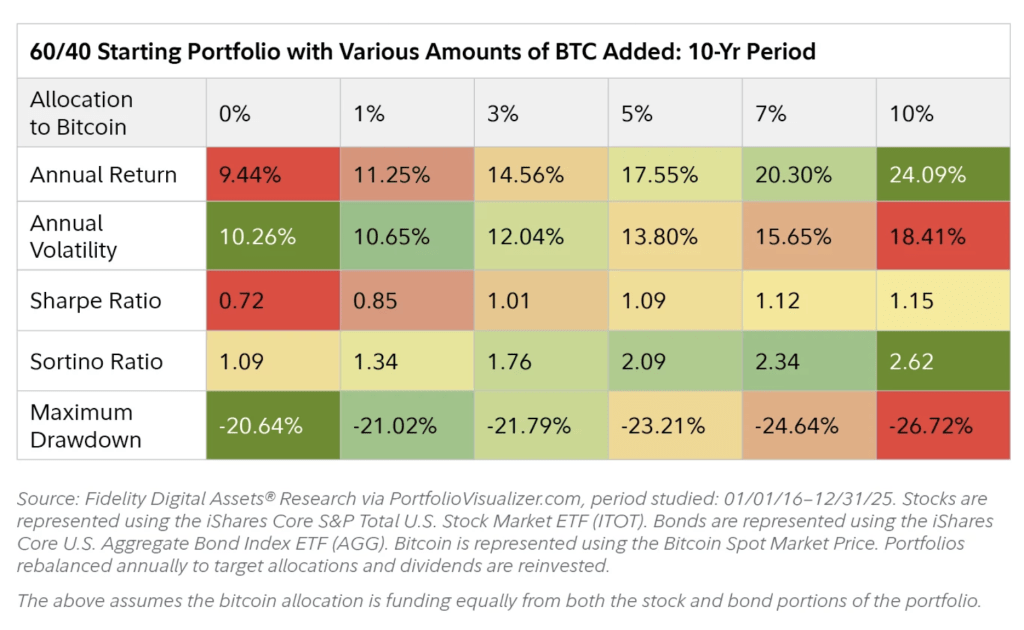
Fidelity reports that even though they added Bitcoin to their portfolios, the biggest losses weren’t as severe as some might expect. This is likely due to Bitcoin not always moving in the same direction as other investments, and because they regularly adjusted the portfolio to prevent Bitcoin from becoming too dominant.
As I dug deeper into Fidelity’s analysis, their projections became quite bullish. They ran a portfolio optimization exercise – basically, figuring out the best mix of assets – using what they considered fairly cautious estimates for Bitcoin. They assumed a 25% annual return for Bitcoin with 50% volatility, compared to 14.5% for stocks and just 2% for bonds. The surprising result? Their model showed an optimal portfolio with almost 9.4% allocated to Bitcoin, and zero allocation to bonds. It really highlights how seriously they’re considering Bitcoin as a potential asset class.
Using past yearly returns, a Kelly Criterion calculation suggested allocating 65% of a portfolio to Bitcoin, though Fidelity stresses this isn’t advice and that a more cautious approach would reduce that to 10%. The key takeaway isn’t that institutions should follow these exact percentages, but rather that Bitcoin’s potential for high rewards compared to its risks could support larger investments than many people initially think.
This is where the report directly questions the traditional 60/40 investment strategy. Fidelity explains that the success of these portfolios over the past decade benefited from forty years of decreasing interest rates, increasing stock prices, and consistent government support for lending.
As a crypto investor, I’m always thinking about what’s going to keep this bull run going, and this report is making me think critically. It’s basically saying the good times with bonds might not last – we could see some big drops, and bonds and stocks might start moving in the same direction, which isn’t great. Plus, with so much debt out there, we might end up with returns that don’t even beat inflation. On the stock side, things are looking expensive, and the market seems to be assuming everything will go perfectly. While things like AI and businesses that don’t need a lot of capital are helping profits, it feels like there’s not much room for error right now.
The report doesn’t recommend a specific amount of bitcoin to hold, but its main point is clear: Fidelity isn’t suggesting bitcoin should replace traditional investments or be used as a guaranteed fix for economic downturns. Instead, it argues that with bonds potentially offering less stability and stock prices already high, even a small investment in bitcoin could significantly improve overall returns.
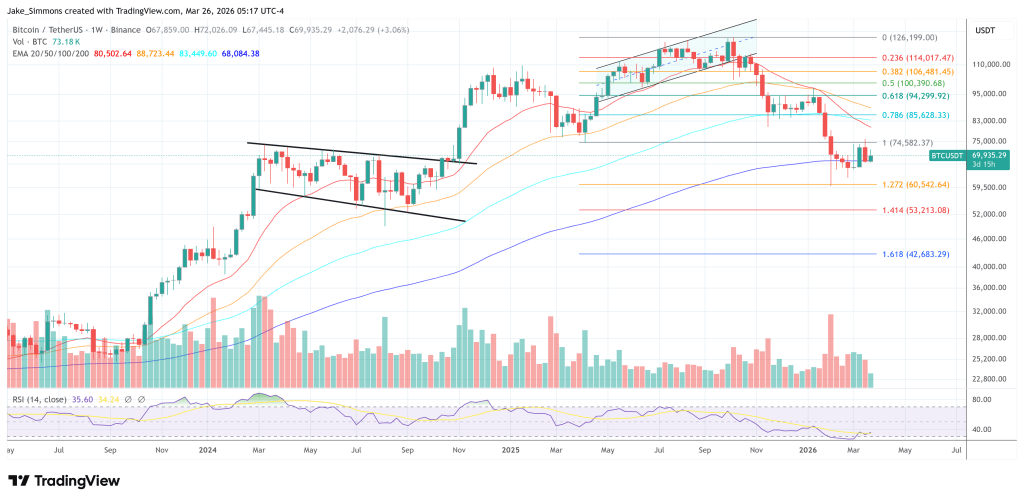
At press time; BTC traded at $69,935.
Read More
- Unlock Exclusive Access to OpenGradient’s AI Token Launch on Binance and PancakeSwap!
- PENGU Price Soars 30% After SEC’s ETF Filing Acknowledgement: Is This the Next Big Thing? 🚀🐧
- Bitcoin vs. Ethereum: The Tale of Two Cryptocurrencies 🪙⚔️
- XRP to the Moon? 🚀 AI Says $4.40, Analysts Scream $6! 🤑
- HYPE PREDICTION. HYPE cryptocurrency
- Ripple Wades Through UK Regulators: The Promised Land or Just a Mirage? 🚀🔒
- Silver Rate Forecast
- Ethereum’s Wild Ride: Bulls Stampede as Metrics Hit Record Highs 🚀🐂
- ATOM PREDICTION. ATOM cryptocurrency
- Shiba Inu Price Crash: The Saga You Won’t Believe
2026-03-26 16:43