Ah, the European Central Bank (ECB), that bastion of financial sagacity, has deigned to inform us that the digital euro is not a harbinger of doom for banks, but rather a gilded life preserver in the tempestuous sea of big tech and stablecoins. How quaintly reassuring.
In a blog post so joint it could only be authored by Executive Board member Piero Cipollone and Supervisory Board Vice-Chair Frank Elderson, these financial luminaries have painted the digital euro as the banking sector’s last, best hope. A competitive tool, they say, as if banks were knights errant in a digital crusade.
European Banks: A Tale of Woe and Foreign Dependence
The ECB’s dynamic duo sketches a portrait of European banking so dire, one might mistake it for a tragicomedy. Two-thirds of euro area card transactions, they lament, are processed by non-European card schemes. In some countries, the reliance is so absolute, one wonders if they’ve mistaken financial sovereignty for a quaint folk tale.
Thirteen out of 21 euro area nations, it seems, are entirely at the mercy of international card schemes or mobile solutions for in-store payments. And e-commerce? A domestic solution with wide acceptance is as rare as a unicorn in a boardroom. Meanwhile, stablecoins loom like a financial Götterdämmerung, threatening to siphon retail deposits and leave banks as desiccated as a Nabokovian metaphor.
Cipollone and Elderson, with the precision of surgeons diagnosing a terminal case, outline the banks’ triple loss:
- International card schemes: fees vanish like a mist in the morning.
- Big tech mobile payments: fees and data slip through their fingers like sand.
- Stablecoins: fees, data, and retail deposits-all lost in a digital abyss.
The Digital Euro: A Panacea or a Placebo?
The ECB, in its infinite wisdom, has designed the digital euro to place banks at the center of its distribution model. Banks, those venerable institutions, will manage digital euro accounts, retaining customer relationships and creditworthiness data-a consolation prize for their lost fees and dignity.
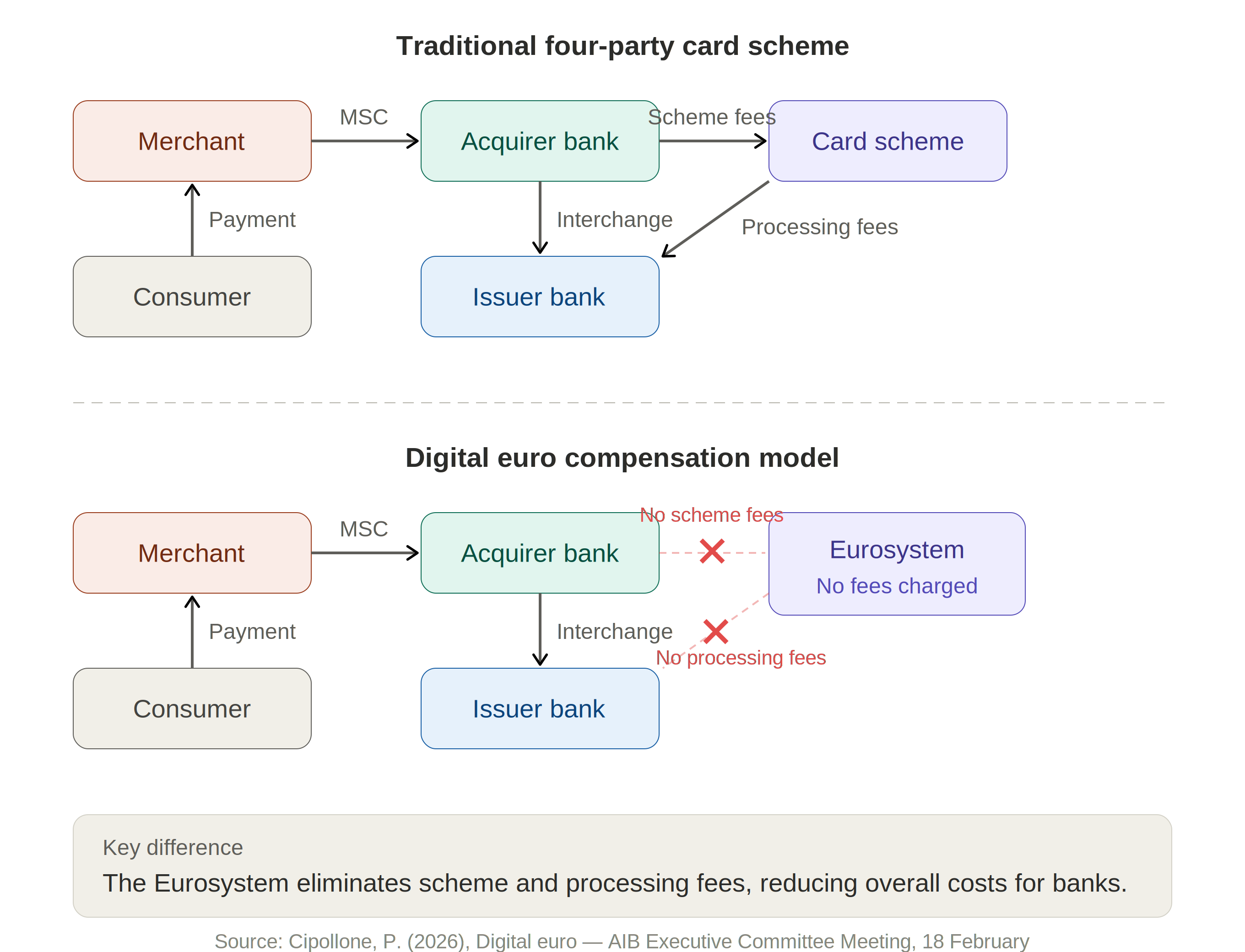
On the revenue front, the Eurosystem promises to eliminate scheme and processing fees, compensating banks through a model so ingenious it was included in the European Commission’s proposed digital euro regulation. Co-badging, too, is touted as a key advantage, allowing European debit cards to pair with the digital euro for pan-European acceptance. No more reliance on foreign card networks, they assure us, with the gravitas of a soothsayer predicting the end of days.
The cost? A mere €4 billion to €5.8 billion, or roughly €1 billion to €1.44 billion per year over four years. A pittance, they say, representing about one-fifth of the costs projected by external studies and a mere 3.4% of significant banks’ annual IT upgrade budgets. How generous of them.
2027: The Year of the Digital Euro Pilot
The Eurosystem, ever the optimist, plans to launch a pilot exercise in 2027 to test the digital euro’s infrastructure in the unforgiving arena of real-world conditions. If EU lawmakers adopt the regulation in 2026, initial transactions could commence as early as mid-2027, with the full system potentially ready for first issuance in 2029. A timeline so ambitious, one might suspect it was drafted under the influence of a particularly potent espresso.
Participating banks, we are told, will help shape implementation choices, including integration approaches and cost management strategies. A democratic gesture, no doubt, though one wonders if the banks will feel more like collaborators or sacrificial lambs.
Financial stability concerns? The ECB waves them away with the assurance of a magician pulling a rabbit from a hat. Holding limits for individuals, a ban on corporate holdings, and the absence of interest on digital euro balances will prevent destabilizing deposit outflows. How very reassuring.
Whether European banks will embrace the digital euro as an opportunity or resist it as a burden remains to be seen. Much, it seems, depends on the alacrity with which the EU Parliament finalizes the regulation. Until then, we are left to ponder the fate of these financial institutions, caught between the Scylla of big tech and the Charybdis of stablecoins, with the digital euro as their only lifeboat. Will they sail to safety, or will they sink into the annals of financial history? Only time-and the ECB-will tell.
Read More
- Unlock Exclusive Access to OpenGradient’s AI Token Launch on Binance and PancakeSwap!
- Silver Rate Forecast
- PENGU Price Soars 30% After SEC’s ETF Filing Acknowledgement: Is This the Next Big Thing? 🚀🐧
- HYPE PREDICTION. HYPE cryptocurrency
- Ethereum’s Wild Ride: Bulls Stampede as Metrics Hit Record Highs 🚀🐂
- XRP to the Moon? 🚀 AI Says $4.40, Analysts Scream $6! 🤑
- Ripple Wades Through UK Regulators: The Promised Land or Just a Mirage? 🚀🔒
- Bitcoin vs. Ethereum: The Tale of Two Cryptocurrencies 🪙⚔️
- BTC Takes a Tumble, ETH Sighs: The Week the Crypto Circus Rolled In
- ATOM PREDICTION. ATOM cryptocurrency
2026-03-27 17:53