Gold, that shiny little rascal, decided to take a tumble this week, dropping to $4,623 per ounce. Why, you ask? Well, it seems the U.S. Bureau of Labor Statistics had a bit of a surprise up their sleeve, reporting 178,000 new jobs in March 2026. That’s like finding an extra sock in the dryer-unexpected and oddly satisfying. Naturally, this cooled the Fed’s rate-cut fever, leaving gold feeling a bit… unloved.
Key Takeaways (or as we like to call them, the shiny bits):
- Gold slipped to $4,623.93/oz after March’s jobs report showed 178,000 new positions-far more than the 59,000 predicted. Turns out, the economy’s not as lazy as we thought.
- Silver, the plucky sidekick, held above $73.75/oz, thanks to its industrial fans in AI, solar, and electronics. Someone’s got to keep the robots running, after all.
- Gold lost 15-19% from its early-March highs as Operation Epic Fury’s safe-haven glow faded faster than a Discworld wizard’s spell.
U.S.-Iran War: Not Even a Shiny Distraction for Gold
The March jobs report flipped the script, reversing February’s loss of 133,000 jobs. Analysts, as usual, were off by a country mile, predicting only 59,000 to 60,000 new positions. The unemployment rate dipped to 4.3%, with health care, construction, and transportation leading the charge. Meanwhile, the U.S. dollar puffed out its chest, and Treasury yields climbed, leaving poor gold feeling like a non-yielding wallflower at a party.
The metal, once trading near $4,700, took a nosedive after the report, as traders scrambled to reassess their rate-cut dreams. By Sunday, April 5, spot quotes had gold lingering near $4,624, looking as glum as a troll on a sunny day.
Silver, however, held its ground above $73.75/oz, with $70 acting as its trusty support level. Its resilience? Blame it on industrial demand from AI data centers, solar farms, and electronics factories. Even as monetary demand softened, silver’s industrial fans kept it afloat, though its volatility made it more of a rollercoaster than a steady steed.
Good Friday shuttered physical markets, but spot and futures markets stayed open just long enough to absorb the post-NFP drama before the weekend. Because, you know, the show must go on.
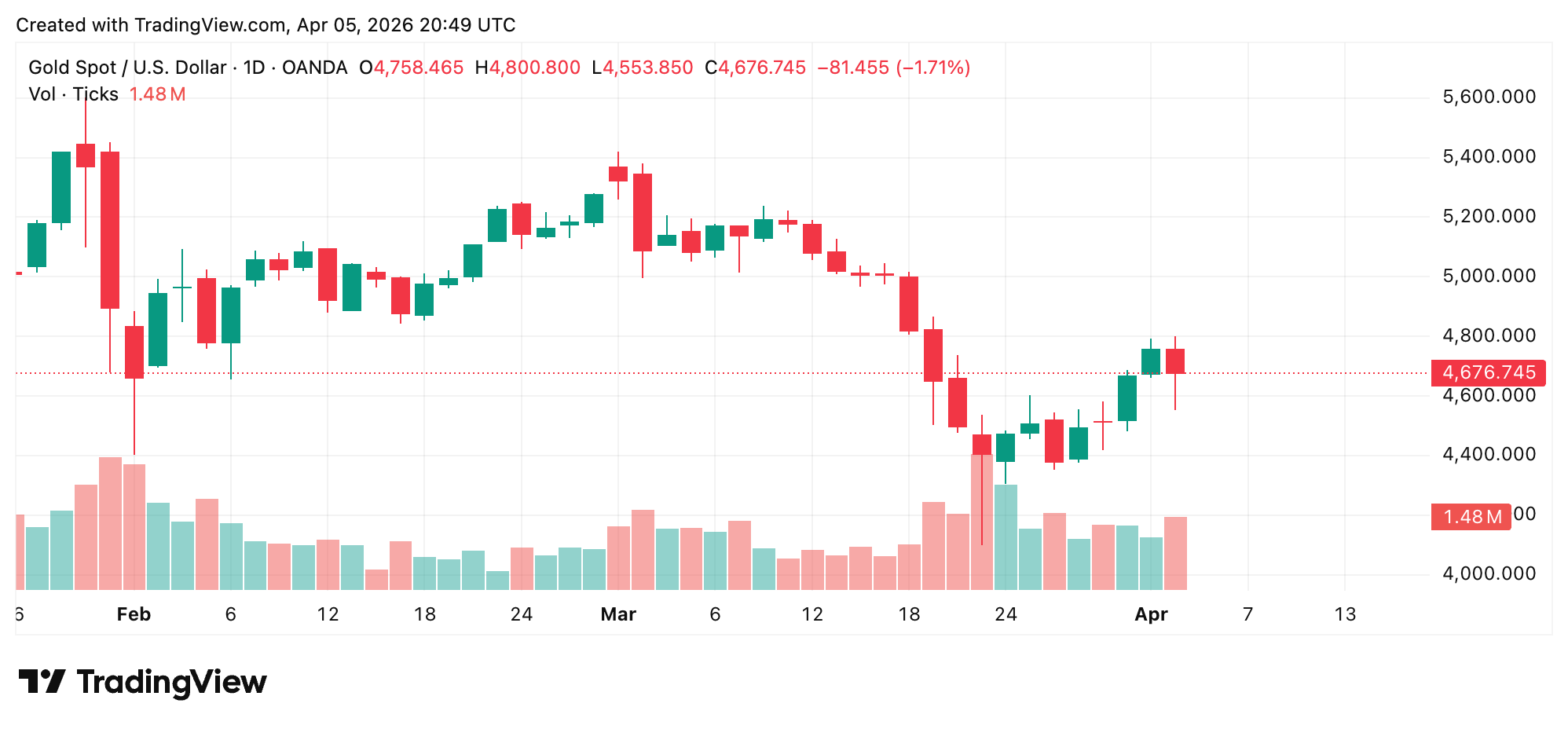
Now, let’s talk about the U.S.-Israel-Iran war, which kicked off on February 28, 2026, with Operation Epic Fury. The U.S. and Israel launched strikes on Iranian military sites, nuclear facilities, and even Supreme Leader Ali Khamenei. Iran retaliated with missiles and drones, disrupting oil flows through the Strait of Hormuz. Gold, ever the drama queen, briefly spiked to $5,423/oz, only to tumble back down as the dollar strengthened and inflation fears loomed.
By mid-March, gold had shed 15-19% from its early-March highs, trading between $4,900 and $5,000 before sliding further. Its all-time high of $5,595 to $5,608 in late January 2026 now feels like a distant memory. Current levels near $4,624 are a stark reminder that even shiny things can lose their luster.
The war’s impact on gold? A mixed bag. Geopolitical jitters brought buyers in, but the same conflict drove oil prices up and stoked inflation fears, dampening the rate-cut hopes gold had been clinging to. Some investors fled to the dollar, the ultimate safe-haven, while central banks continued their gold-buying spree, though not enough to offset the selling pressure.
Peter Schiff, ever the optimist, sees gold’s dip as temporary. Commenting on Vice President JD Vance’s potential 2028 presidential skip, Schiff quipped that 2032 could be his year, funded by the gold gains he’s been predicting for decades. “Things will be so bad in 2032 that I may have to run myself,” he said. “Given how high gold will likely be by then, I should be able to self-fund.” Well, if anyone can turn a gold dip into a presidential bid, it’s Peter Schiff.
“Things will be so bad in 2032 that I may have to run myself. Given how high gold will likely be by then I should be able to self fund.”
Looking ahead, gold traders will keep one eye on the Fed, the other on the USD index, and a third (if they had one) on inflation data. April futures contracts (GCJ26) are mirroring spot dynamics, with resistance at $4,700 to $4,800 and support at recent lows. Silver, meanwhile, aims for $75 to $80/oz if AI-driven demand holds up. ETFs could give it an extra boost, but only if the stars align.
Gold’s next move? It hinges on whether the Fed changes its tune or if fresh Middle East tensions revive its safe-haven appeal. Until then, it’s just another shiny object in a world full of distractions.
Read More
- ZEC PREDICTION. ZEC cryptocurrency
- Gold Rate Forecast
- WLD PREDICTION. WLD cryptocurrency
- Brent Oil Forecast
- BTC PREDICTION. BTC cryptocurrency
- USD CNY PREDICTION
- USD RUB PREDICTION
- NEAR PREDICTION. NEAR cryptocurrency
- USD TRY PREDICTION
- EUR CNY PREDICTION
2026-04-06 00:57