
What to know:
- Bitcoin’s price has stayed in a relatively tight range around $65,000 to $73,000 during six weeks of war, but that stability masks a market increasingly dependent on a small group of mandated institutional buyers.
- Strategy, U.S. spot bitcoin ETFs and a few other institutional channels now provide most of the sustained buying, while whales, mid-tier holders, miners and even Bhutan’s sovereign holdings have been selling or sharply slowing accumulation.
- The recent ceasefire sparked a sharp rally and signs of renewed U.S. demand, but the underlying question is whether concentrated institutional inflows can continue to absorb discretionary selling and eventually push bitcoin beyond its $73,000 ceiling.
After six weeks of conflict, the bitcoin market is clearly divided. On one side are institutional investors who continue to buy, no matter what’s happening. On the other side is everyone else, who is currently selling.
Despite ongoing challenges – including negative news, significant liquidations, and the lowest market confidence since the 2022 downturn – the cryptocurrency market appears stable, with Bitcoin trading between $65,000 and $73,000 for the past five weeks. However, beneath this surface stability, key indicators suggest the market is becoming more constrained, which could have implications for future performance.
Here is who is on each side and what their behavior tells us about where conviction actually sits.
The mandated buyers
Right now, almost all the consistent demand for Bitcoin comes from just three sources. These aren’t speculative purchases based on price predictions; they’re buying Bitcoin because it’s essential for how their businesses operate.
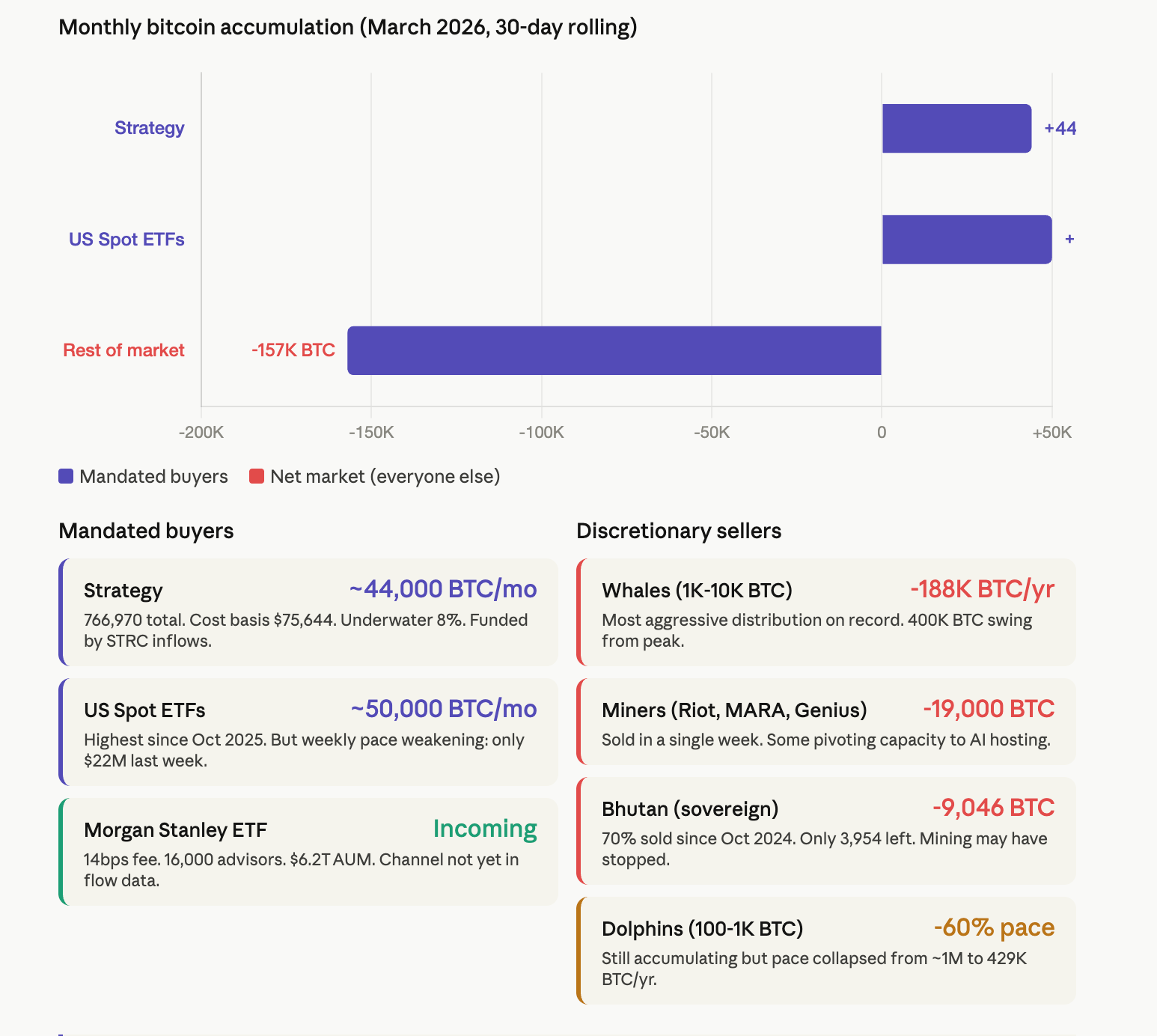
The company has been actively buying Bitcoin. On April 5th, they announced a purchase of 4,871 BTC for around $329.9 million, averaging $67,718 per Bitcoin.
We currently hold 766,970 Bitcoin, purchased for a total of $58.02 billion. The average purchase price is $75,644 per Bitcoin. With current prices, this investment is down about 8%, but we are continuing to buy Bitcoin at lower prices, which gradually lowers the price we need to reach to break even.
According to a recent CoinDesk report, Strategy held around 44,000 BTC in its reserves throughout March.
Strategy’s preferred equity product, STRC, recently attracted significant investment – hundreds of millions of dollars – particularly around the time dividends were paid out. This funding allows Strategy to continue purchasing more of the equity. However, if investor demand for STRC slows down, Strategy will likely reduce its buying activity.
As a crypto investor, I’m really encouraged by what I’m seeing with the new spot Bitcoin ETFs. Just last month, they bought up around 50,000 Bitcoin – that’s the most they’ve acquired in a single month since October 2025. It shows strong demand and is a really positive sign for Bitcoin’s future.
However, overall ETF data suggests a more cautious outlook. CoinShares reported just $22 million in inflows for U.S. spot bitcoin ETFs last week, compared to $107 million globally for all bitcoin ETPs. A significant portion of these inflows came from Switzerland, with Swiss-listed products attracting $157 million – representing 70% of the $224 million total global inflow.
While the established system is still functioning, activity within it is decreasing and becoming more focused, with a noticeable slowdown each week.
Bitmine Immersion Technologies is mainly focused on Ethereum, but it follows a similar pattern to what we’ve seen elsewhere.
Last week, the company purchased 71,252 ETH, marking its biggest weekly buy since December 2025. They now have a total of 4.8 million tokens, currently valued at around $10 billion.
This week, Tom Lee, the chairman of a financial firm, predicted the stock market had reached its lowest point. Interestingly, his company was simultaneously investing hundreds of millions of dollars in the very stocks he was publicly promoting.
The discretionary sellers
Everyone with a choice is running for the exit.
Large Bitcoin holders, often called ‘whales’ – those with 1,000 to 10,000 BTC – have switched from buying to selling. Over the past year, their Bitcoin holdings have dropped by 188,000 BTC, a dramatic shift from a previous increase of around 200,000 BTC seen during last year’s market peak. CryptoQuant notes this represents a significant and unusually rapid sell-off by major Bitcoin owners. The continued decline in a 365-day average suggests this isn’t a temporary reaction to a specific event, but a more fundamental change in their investment strategy.
Investors holding between 100 and 1,000 Bitcoin are still adding to their holdings, but they’re doing so at a much slower rate than before. Since October 2025, their annual purchases have dropped by over 60%, from almost 1 million BTC to 429,000 BTC. While they haven’t started selling yet, the current trend suggests they may begin to do so in the future.
Publicly traded bitcoin mining companies are selling off their bitcoin holdings. Earlier this month, Riot Platforms, MARA Holdings, and Genius Group collectively reported selling over 19,000 BTC from their reserves in just one week.
Bitcoin mining companies are under pressure due to high prices for bitcoin – nearing $70,000 – increased mining difficulty, and rising electricity costs. Companies like Core Scientific, Iris Energy, and Hut 8 are responding by shifting their resources to providing hosting for artificial intelligence, which offers more stable, contracted revenue compared to the unpredictable income from mining.
Bhutan, the first country to invest in Bitcoin using energy from its hydroelectric power, has been selling off its Bitcoin holdings since October 2024. It’s gone from owning around 13,000 BTC to just 3,954. This week, Bhutan moved another 319.7 BTC to wallets connected to cryptocurrency exchanges. It’s been over a year since Bhutan received a Bitcoin inflow worth more than $100,000, which suggests their mining operation may have ceased. Currently, Strategy, a company, buys more Bitcoin each week than Bhutan now holds.
The sentiment gap
There’s a surprisingly large difference between what buyers who are required to purchase are doing, and how the rest of the market is behaving – it’s a situation we haven’t seen in a long time.
For over a month, the Fear and Greed Index remained stuck between 8 and 14, indicating a prolonged period of extreme fear not seen since the market’s low point in 2022. The index only moved above 10 this week following the announcement of a ceasefire.
Last weekend, social media sentiment turned notably negative, with five posts expressing bearish views for every four optimistic ones – the most pessimistic trend seen since the start of the conflict, according to data from Santiment.
Despite the selling pressure, ETFs were consistently purchasing 50,000 Bitcoin each month, while Strategy bought 44,000. This strong buying activity prevented the price from falling below $65,000. Essentially, consistent, required purchases offset the Bitcoin being sold by those making optional choices. The key question now is whether this pattern can continue.
What the ceasefire changed and what it didn’t
The announcement of a ceasefire on Tuesday caused a significant jump in the price of bitcoin, climbing over $72,000 – the largest daily increase in over a month. This also led to $427 million worth of short positions being closed. Interest in Bitcoin and Ethereum futures increased by $2.1 billion and $2.2 billion respectively in the last 24 hours, and the increase was driven by new buying, not just the closing of losing short bets.
Coinbase Premium, a measure of trading activity, recently showed positive numbers for both Bitcoin and Ether – something it hasn’t done since they reached their peak prices in October. This suggests that U.S. buyers are starting to show renewed interest, and could be the first evidence of this since the start of the conflict.
The ceasefire hasn’t addressed the underlying issues. Whether this leads to a lasting change depends on if the current two-week truce holds, and if the investment patterns that supported prices during the conflict can break through the $73,000 resistance level, which has repeatedly stopped price increases since late February.
Overall, the data shows that fewer and fewer people are buying Bitcoin, a trend that’s been happening for several months.
Only a few players are consistently buying, mainly strategic investors, ETFs, and, to a smaller degree, Morgan Stanley’s new distribution channel. Most others are either selling their holdings, reducing their activity, or exiting the market altogether.

Bhutan has sold 70% of its bitcoin in 18 months. It may have stopped BTC mining too.
9 hours ago

Federal judge blocks Arizona from bringing criminal charges against Kalshi
12 hours ago

Star Xu calls CZ a ‘liar’ as founders of world’s largest crypto exchanges argue over past allegations
20 hours ago

The magic word for digital assets adoption and success: choice
20 hours ago
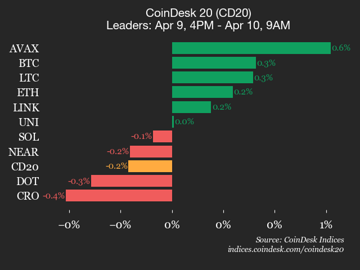
CoinDesk 20 performance update: Hedera (HBAR) drops 1.9%, leading index lower
23 hours ago

Trump-backed WLFI token drops 12% to record lows after team defends multi-million lending position
23 hours ago

Binance offers UAE staff temporary relocation as Middle East conflict disrupts region
23 hours ago

Bitcoin gains after core CPI rose a less-than-forecast 0.2% in March.
23 hours ago

HSBC and Standard Chartered-led group land Hong Kong’s first stablecoin licenses
Apr 10, 2026

David Bailey’s bitcoin holder Nakamoto is trying to stay on Nasdaq with a reverse stock split
Apr 10, 2026
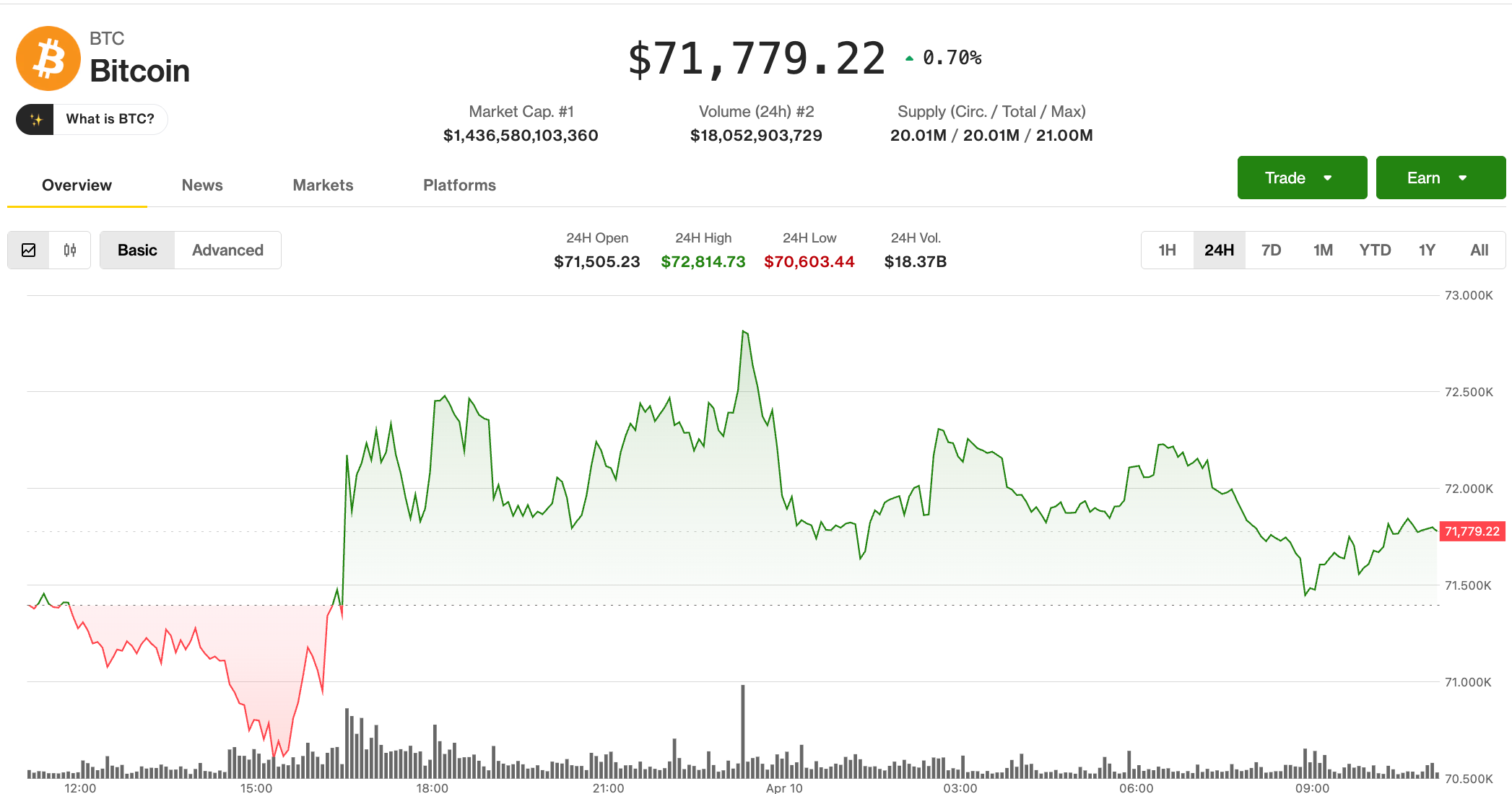
Bitcoin holds steady as inflation data looms, bittensor drama unfolds
Apr 10, 2026
Institutions’ bitcoin positioning lacks conviction; CPI, Iran talks might help
Apr 10, 2026
In this article
 BTCBTC$72,960.70◢0.96%
Read More
- Gold Rate Forecast
- EUR USD PREDICTION
- EUR CNY PREDICTION
- BTC PREDICTION. BTC cryptocurrency
- WLD PREDICTION. WLD cryptocurrency
- Silver Rate Forecast
- GBP CNY PREDICTION
- OKB PREDICTION. OKB cryptocurrency
- USD JPY PREDICTION
- USD NZD PREDICTION
2026-04-11 15:17