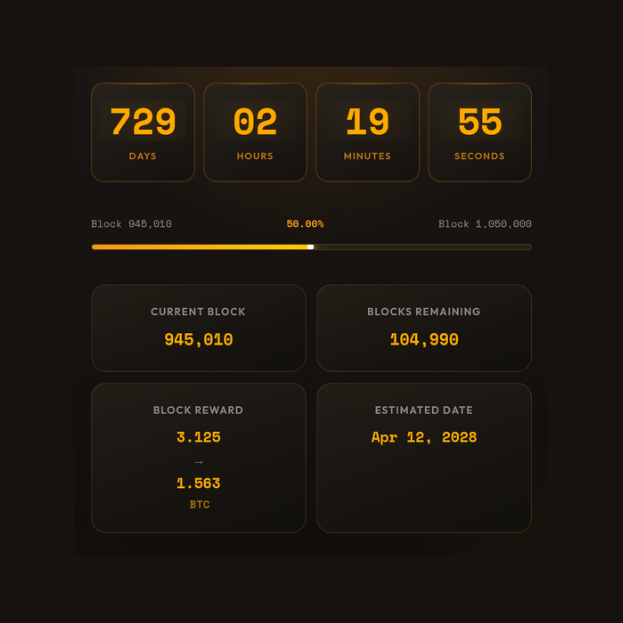
We’re halfway through the countdown to Bitcoin’s next halving event. There are about 105,000 blocks left until the reward for mining new blocks is reduced by half.
The Bitcoin network is currently about halfway through a process that started in April 2024. This process, called a halving, will reduce the reward miners receive for creating new blocks. Around April 2028, when Bitcoin reaches block 1,050,000, the reward will decrease from 3.125 to 1.5625 Bitcoin per block.
What the Bitcoin Halving Milestone Means for Supply
Bitcoin has a built-in mechanism that slows down the creation of new coins over time. Currently, about 450 new Bitcoins are created each day by miners. After the next halving event, expected around 2028, this will be cut in half, resulting in approximately 225 new Bitcoins entering circulation daily.
Bitcoin’s rules automatically reduce the number of new bitcoins created roughly every four years. This happens at set intervals, specifically every 210,000 blocks, and is a key reason why Bitcoin is seen as a valuable and limited digital resource.
Around 19.7 million Bitcoin have already been created, with a total limit of 21 million. Because of this, the events called ‘halvings’ – which reduce the rate of new Bitcoin creation – are becoming more and more important. It’s estimated that over 98% of all Bitcoin will be in circulation by 2030.
Historical Bitcoin Halving Price Performance
Historically, the price of Bitcoin has tended to rise after a halving event, but these gains haven’t been as large in recent cycles. Because of this pattern, investors pay close attention to each halving.
Bitcoin has undergone several ‘halving’ events, where the reward for mining new blocks is cut in half. The first one was in November 2012, reducing the reward from 50 to 25 Bitcoins. Subsequent halvings occurred in July 2016 (to 12.5 BTC), May 2020 (to 6.25 BTC), and most recently in April 2024, which lowered the reward to 3.125 BTC.
Historically, Bitcoin’s biggest price increases have happened between 12 and 18 months after its halving events. However, what happened in the past isn’t a promise of future performance, and each new cycle has its own unique market factors.
This Cycle Is Different Due to ETF Demand
The next four years (2024-2028) will be different from past Bitcoin halving periods. This is largely due to the new spot Bitcoin ETFs in the United States, which currently hold over 1.3 million BTC – around $92 billion worth.
Unlike previous market situations, there’s now strong, consistent buying pressure from institutions. These investors, like financial advisors, pension funds, and family offices, typically invest for the long term and include Bitcoin as part of their overall investment strategy, creating a solid base of support.
Strategy is continuing to buy Bitcoin faster than new coins are being created through mining. They currently hold more than 780,000 BTC and purchase more each month than miners generate.
With fewer new coins entering the market and continued strong interest from large investors, we could see price increases similar to those that have happened after previous ‘halving’ events. Essentially, limited supply combined with consistent demand could push prices higher.
Two Years Until the Next Bitcoin Halving
We’re halfway to the next Bitcoin halving, which is expected in about two years. The precise date isn’t fixed and will depend on how quickly new blocks are mined.
As an analyst, I’m currently tracking the next Bitcoin halving, and the most likely timeframe appears to be April 2028. However, different data sources give slightly different predictions, ranging from March to May. It’s important to remember that Bitcoin is designed to create a new block roughly every 10 minutes, but the actual time it takes can fluctuate.
The upcoming halving will reduce the amount of cryptocurrency miners earn for each block they process. To stay profitable after this reduction, mining companies need to keep finding ways to lower their expenses, like using better equipment and securing lower electricity rates.
The upcoming halving highlights Bitcoin’s predictable money supply. Unlike traditional currencies, which can be printed at any time by central banks, Bitcoin has a set schedule for releasing new coins, and everyone knows it in advance.
Read More
- Gold Rate Forecast
- Silver Rate Forecast
- Brent Oil Forecast
- USD CNY PREDICTION
- Stablecoins: The Sky Isn’t Falling, But Banks Might Be Whining
- EUR NZD PREDICTION
- Bitcoin’s 20-Million Milestone: Energy or Bust!
- ICE Throws $600M at Polymarket: A Farce or Fortune?
- ENA PREDICTION. ENA cryptocurrency
- Why Cardano Bulls Are Practicing Their Victory Dance Right Now!
2026-04-15 01:56