Recent analysis of the XRP Ledger reveals that Ripple’s escrow accounts, along with other multi-signature wallets, may be vulnerable to future quantum computing threats. These wallets collectively hold over 36% of all XRP (36.60 billion), but aren’t automatically protected unless proper security measures are taken to manage the private keys.
What The Numbers Show
XRPL validator Vet analyzed every account on the XRP Ledger—over 7.8 million in total—and found that 23.16 billion XRP is currently held in wallets protected against potential quantum computing attacks.
This represents 27% of all accounts, about 2.13 million wallets. These wallets are secure for one of two reasons: either they’ve never been used to make a transaction, keeping their information private, or the owners proactively updated their security keys and turned off master keys for added protection. Over 24% of the accounts fall into the first, unused category, while a more security-conscious 2.65% actively rotated their keys.
The idea is simple: when a digital wallet approves a transaction, its public key is recorded on the blockchain. A powerful enough quantum computer could potentially use that public key to figure out the wallet’s private key. However, wallets that haven’t been used to sign any transactions aren’t at risk.
We thoroughly investigated all 7.8 million XRP accounts to identify potential security risks, specifically focusing on inactive accounts that could be vulnerable to attacks.
Genesis XRP accounts, similar to the earliest Bitcoin accounts from the Satoshi era, hold a small fraction – just 0.02% – of all XRP, and this XRP is currently inactive but accessible.
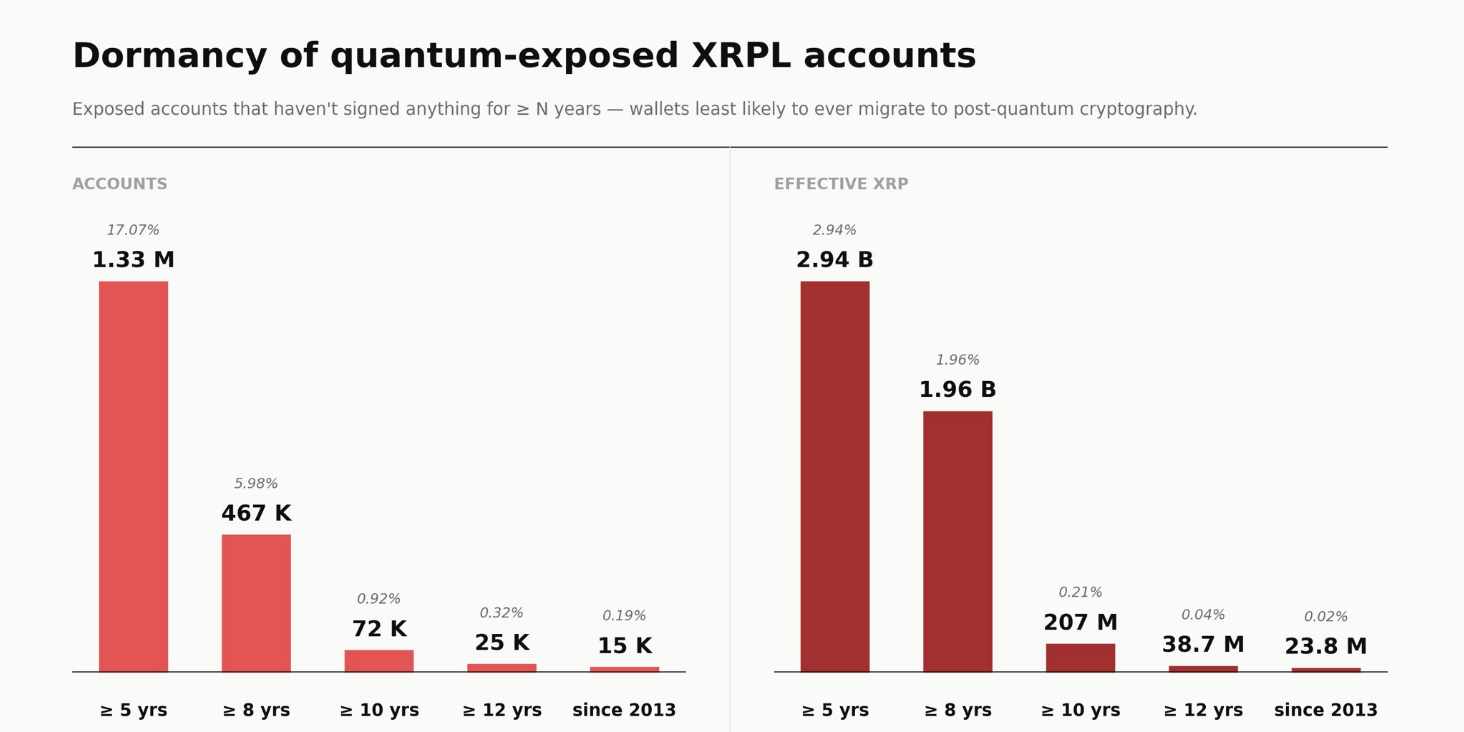
Exposed supply increases as dormancy thresholds are lowered.…
— Vet (@Vet_X0) April 29, 2026
Dormant Accounts Raise Hard Questions
However, a significant amount of XRP – 76.82 billion – held in 5.6 million accounts is potentially at risk. Fortunately, Vet pointed out that most of this – 96% – is owned by active users who can move their XRP to more secure locations if needed.
A bigger challenge lies with inactive XRP wallets. Wallets that haven’t been used in five years or more hold 2.94% of all XRP, representing 3.83% of the XRP currently in circulation. However, wallets with no activity since before 2014 only hold a very small fraction – just 0.02% – of the total XRP supply.

The group currently consists of only 14,710 accounts, significantly fewer than the 1.33 million accounts that have been inactive for five years or more. As an example, the expert noted that Bitcoin has a similar situation – about 5% of all Bitcoins are held by the creator, Satoshi Nakamoto, and may never be spent.
It’s a mystery why so many digital wallets have been left unused. People may have lost access to their accounts, simply forgotten about them, or faced life changes that led them to stop using them. This lack of clear answers is what makes these inactive wallets the biggest challenge when considering the risks of quantum computing.
A 2028 Deadline Already In Motion
The XRP Ledger currently relies on Ed25519 and secp256k1 for its security. While these methods are secure now, the development of quantum computing could potentially make them vulnerable in the future.
Ripple plans to fully protect its network from the future threat of quantum computing by 2028. They’ve already begun testing new systems and will roll out updates to the main network in the coming phases.
To permanently solve the problem of vulnerable wallets, developers are planning to use a new type of encryption that’s resistant to quantum computing. This will allow users to move their funds to more secure addresses.
If you can still get into your account, that’s great. But if you’ve lost your login information or are locked out for any other reason, this information could be exposed forever.
Read More
- Silver Rate Forecast
- Gold Rate Forecast
- Brent Oil Forecast
- USD CNY PREDICTION
- DOGE PREDICTION. DOGE cryptocurrency
- GBP USD PREDICTION
- USD TRY PREDICTION
- USD MYR PREDICTION
- Why Crypto Firms Still Can’t Break Up With Bitcoin 😂💸
- ADA PREDICTION. ADA cryptocurrency
2026-05-01 13:36