A new proposal suggests burning more SOL – the cryptocurrency used on the Solana network – by adding a small fee to every transaction. Created by a developer known as cavemanloverboy, this change could potentially make Solana deflationary when the network is very busy, meaning the total supply of SOL could decrease over time.
-
Key Takeaways:
- Cavemanloverboy proposed SIMD-547 on Saturday, spiking some fees to curb SOL asset inflation.
- Zensei notes SIMD-547 could boost daily SOL burn to 64,800 tokens, sparking a deflationary market.
- Michael Hubbard criticized SIMD-547 to protect new Solana institutional and AI use cases.
Proposed Solana Tokenomics Might Make SOL Deflationary
Solana developer cavemanloverboy has introduced a proposal to improve the tokenomics of SOL, the base asset, and reduce current inflation levels.
Solana Improvement Document 547 (SIMD-547), introduced on Saturday, proposes including a new base fee depending on the nature of the transaction to be burned. Under the new scheme, market makers and users who pay a priority rate to execute their movements faster will be less affected, while users who pay lower fees will see their costs rise to 600% in some cases.
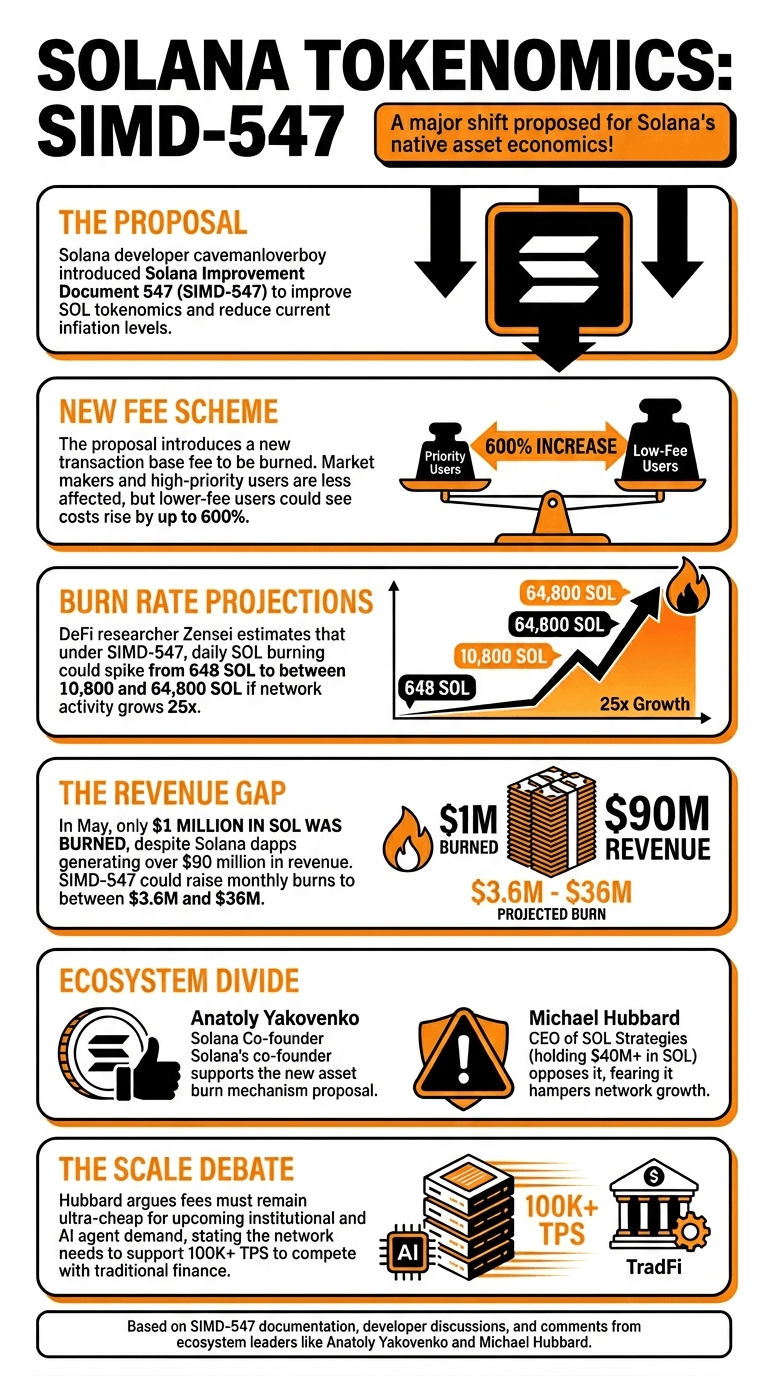
Cavemanloverboy states that these changes seek to establish SOL as a better asset for gaining exposure to network activity, given that the current level of fee burning is “incredibly tiny and insignificant.”
This increase, according to some, might make Solana’s network issuance deflationary during periods of high activity levels. Solana deFi researcher Zensei states that the proposal would increase daily SOL burning from 648 SOL to between 10,800 and 64,800 SOL. Nonetheless, for this to happen, activity would have to rise to 25x, per estimations.
On social media, cavemanloverboy pointed out that only $1 million in SOL was burned in May, even with Solana dapps generating over $90 million in revenue. If this new proposal gets approved, this number could rise to between $3.6 and $36 million.
While the proposal has the support of Anatoly Yakovenko, co-founder of Solana, other figures of the Solana ecosystem are more critical of it.
Michael Hubbard, CEO of SOL Strategies, a publicly traded Canadian company that holds over $40 million in SOL, stressed that SIMD-547 could hamper the network’s ability to support new use cases.
Hubbard argues for lower transaction fees, explaining that more complex activity is happening and that major companies and institutions haven’t fully adopted blockchain technology yet.
“We need to be able to support 100k+ tps that are a rounding error to users of the network, otherwise we cannot compete with tradfi databases or even other networks,” he concluded.
Read More
- USD CNY PREDICTION
- Silver Rate Forecast
- Gold Rate Forecast
- EUR HKD PREDICTION
- USD THB PREDICTION
- CNY JPY PREDICTION
- USD RUB PREDICTION
- GBP EUR PREDICTION
- USD AUD PREDICTION
- Gogol’s Tale: Templeton’s Crypto Circus Marches On!
2026-06-02 06:57