A new report from Bitfinex Securities points out how tokenization can update and simplify business in Venezuela. It could also open up investing opportunities for both companies struggling to raise money and investors who typically can’t access markets controlled by big financial firms.
-
Key Takeaways:
- Bitfinex says tokenization could help Venezuelan firms raise $50M+ despite a market with only 40 listings.
- Aaron Olmos sees tokenization attracting global capital in 2026, boosting Venezuela’s recovery.
- Jose Grasso Vecchio says tokenized assets need compliance first; regulation is the next hurdle.
In its Securities Latin America Market Inclusion Report, Bitfinex Securities has highlighted the tokenization opportunities arising in Venezuela after the arrest of President Nicolas Maduro in January.
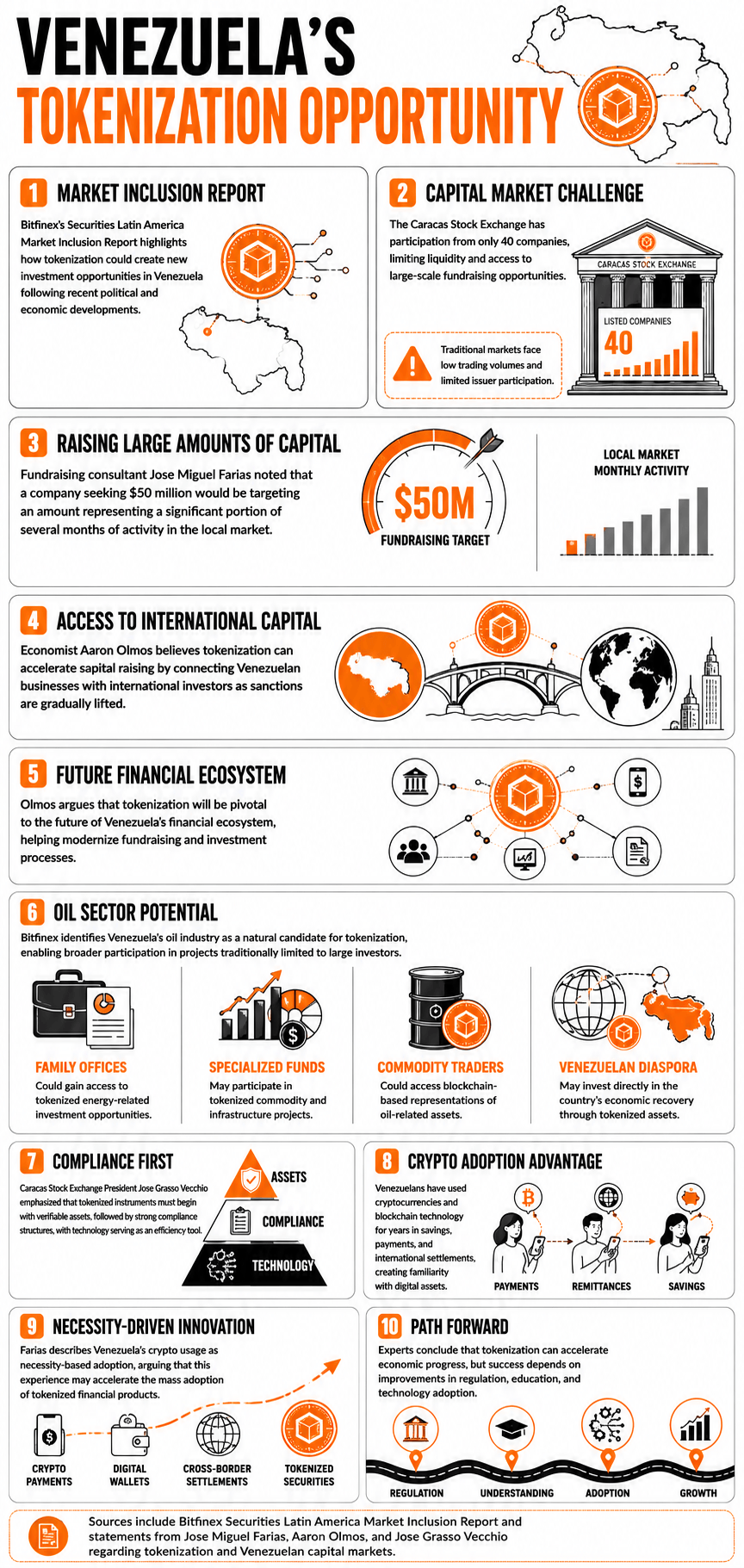
Experts believe this technology could strengthen existing stock markets, such as the one in Caracas, and help businesses raise substantial funds by connecting them to international investors. This would allow them to avoid the limited trading activity and restrictions currently found within the local market, which only includes around 40 companies.
Fundraising consultant Jose Miguel Farias explained that companies seeking substantial investments – between $30 and $50 million – are typically targeting an amount that makes up a large portion of the total funding activity within their local market over a period of several months.
As an analyst following Venezuela’s economic situation, I believe tokenization could significantly speed up fundraising efforts. It potentially allows access to international investment as sanctions are eased. In fact, I see it as a crucial development – truly pivotal for the future of their financial system.
Bitfinex pointed to the oil sector as a natural choice for tokenization, paving the way for family offices, specialized funds, commodity traders, and Venezuelans abroad to participate in the renaissance and mobilize capital toward it, simultaneously democratizing investments traditionally restricted to large capital holders.
Despite recent developments, Jose Grasso Vecchio, President of the Caracas Stock Exchange, emphasized that any digital asset based on Venezuelan holdings should prioritize a clear and confirmed underlying asset, followed by a strong system of regulatory compliance. Technology, he added, should simply be used to improve efficiency.
Venezuelans might have an edge over other markets, as they have been using cryptocurrency and blockchain technology for years in savings, payments, and international settlements.
Farias claims that the natural inclusion of crypto assets in Venezuelan daily lives constitutes necessity-based adoption and that it might help towards the massification of tokenization processes in financial markets.
While breaking down data into tokens can significantly speed up development, it’s not enough on its own. The country also needs to improve its knowledge of, rules for, and use of these technologies, he stated.
Read More
- USD CNY PREDICTION
- Silver Rate Forecast
- EUR HKD PREDICTION
- Gold Rate Forecast
- USD THB PREDICTION
- USD AUD PREDICTION
- CNY JPY PREDICTION
- USD RUB PREDICTION
- GBP EUR PREDICTION
- EUR USD PREDICTION
2026-06-13 06:58