In the labyrinthine corridors of New York’s legal maze, a spectacle unfolds-a farce, if you will, where shadows dance and numbers collide. Timechainindex.com’s Sani, with a flourish of digital ink, unveiled a tale on the platform once known as X: three phantoms, cloaked in anonymity, dare to claim the crown jewels of the crypto realm-3.8 million BTC, a hoard valued at $293 billion, slumbering in wallets whispered to belong to the elusive Satoshi Nakamoto.
-
Key Takeaways:
- Sani, the herald of this digital odyssey, first sounded the alarm on Noah Doe’s audacious lawsuit, targeting 39,069 wallets in a BTC treasure hunt.
- Galaxy Research’s Alex Thorn, with a wry smile, dismantles the $10-per-address valuation, a figure so absurd it borders on poetry.
- A default judgment looms by June 2026, though the courts, one hopes, will not be swayed by such legal theatrics.
Galaxy Research’s Thorn: A Satirical Scalpel on the $10 Bitcoin Farce
Alex Thorn, the sage of Galaxy Research, confirmed Sani’s proclamation and added his own stroke of irony. His firm, ever vigilant, has tracked this folly since autumn’s chill, now “comprehensively unpacking” a lawsuit where three ghosts seek a court’s blessing for ~3.8M BTC, including coins long mythologized as Satoshi’s legacy.
The case, filed in the shadows of March 11, 2026, and expanded on May 1, names 39,069 “John Doe” defendants-a roster of addresses as phantom-like as the plaintiffs themselves. The latter, identified only as “Noah Doe” and two Wyoming LLCs (ABC and XYZ, naturally), remain veiled, their true identities as elusive as the private keys they covet.
Noah Doe, our protagonist, claims to have wielded a “proprietary algorithm” to unearth these dormant bitcoin addresses. With a flourish, he delivered USB drives to the NYPD’s 17th Precinct, declaring them “found property.” Yet, he neither grasped the private keys nor touched the treasure, instead invoking New York’s lost-and-found statute-a legal sleight of hand.
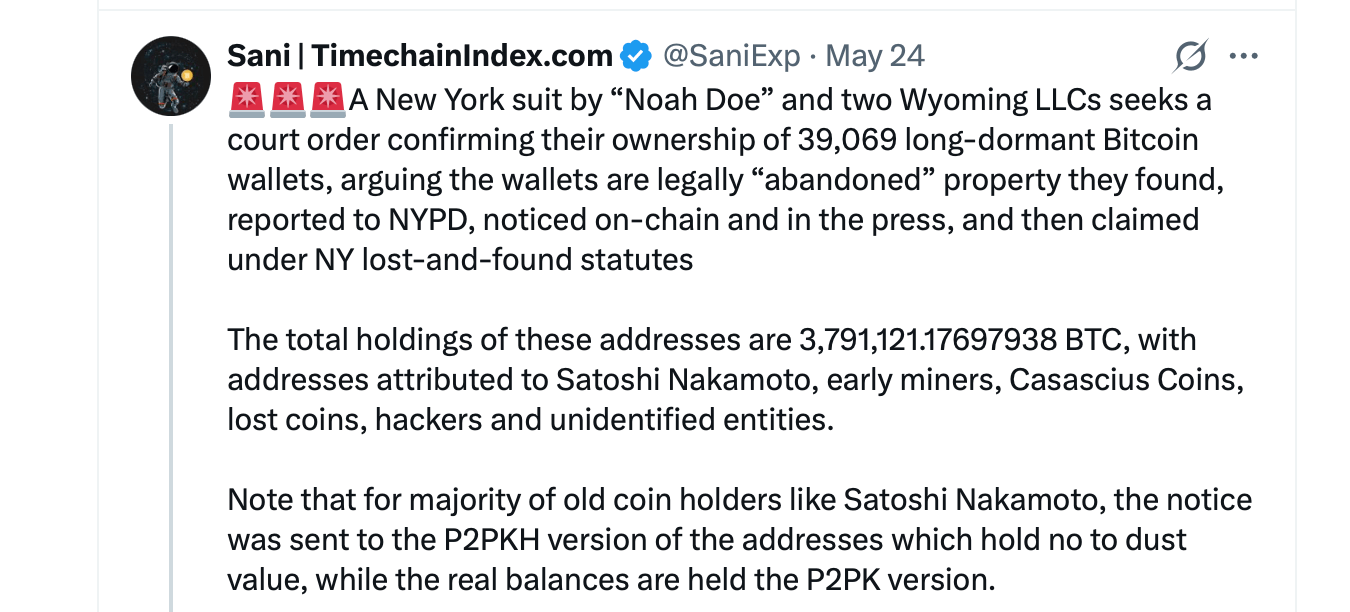
The legal argument pivots on a single, ludicrous number: each address, an unnamed expert declares, is worth under $10. This triggers a legal shortcut, vesting title in the finder after a mere year. Thorn, with surgical precision, exposes the absurdity: the addresses hold $293.5 billion, a gap of nine orders of magnitude-a chasm so vast it defies satire.
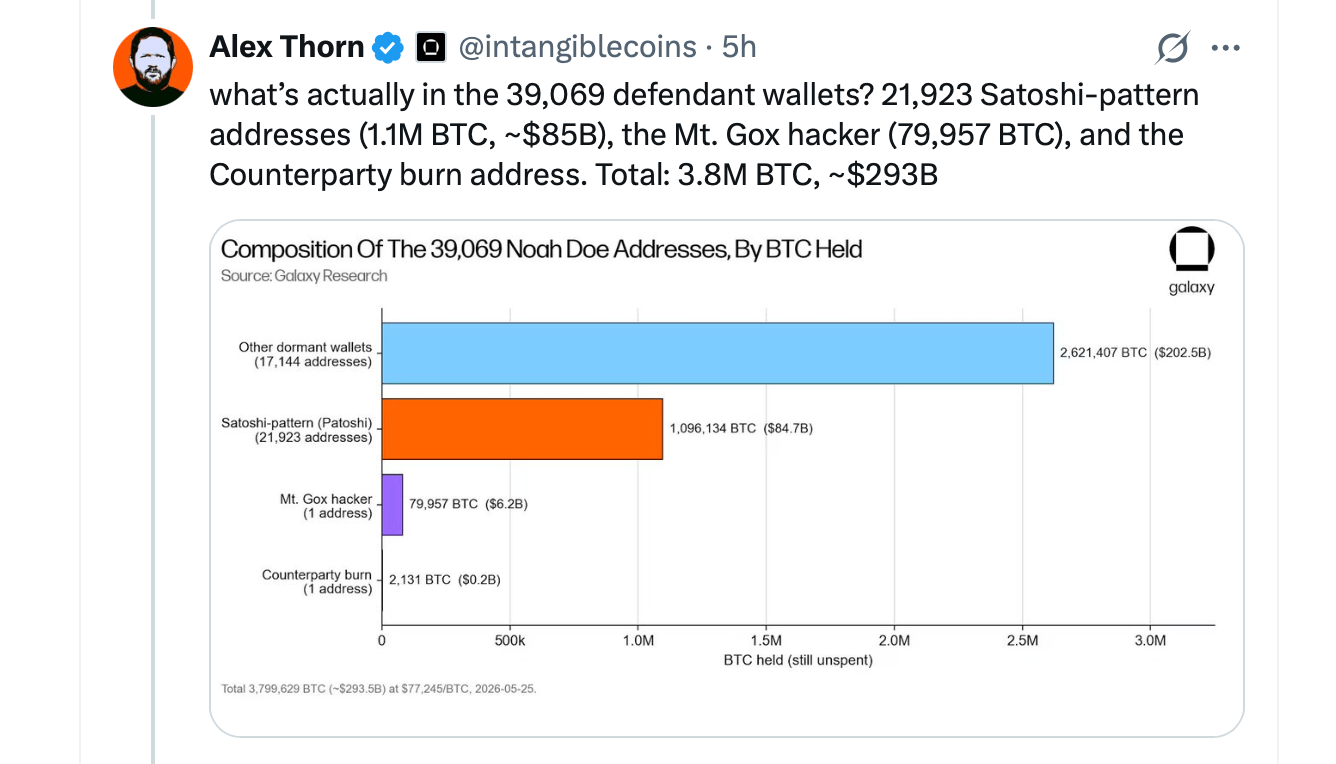
The defendants, a motley crew, complicate matters further. John Doe #1 holds the spoils of the Mt. Gox heist, contested by investigators. John Doe #104 guards the Counterparty burn address, a wallet as unspendable as a stone. And 21,923 addresses bear the “Patoshi” nonce pattern, tied to Satoshi’s ghostly hand. None fit the mold of abandoned property, yet here they are, ensnared in this legal charade.
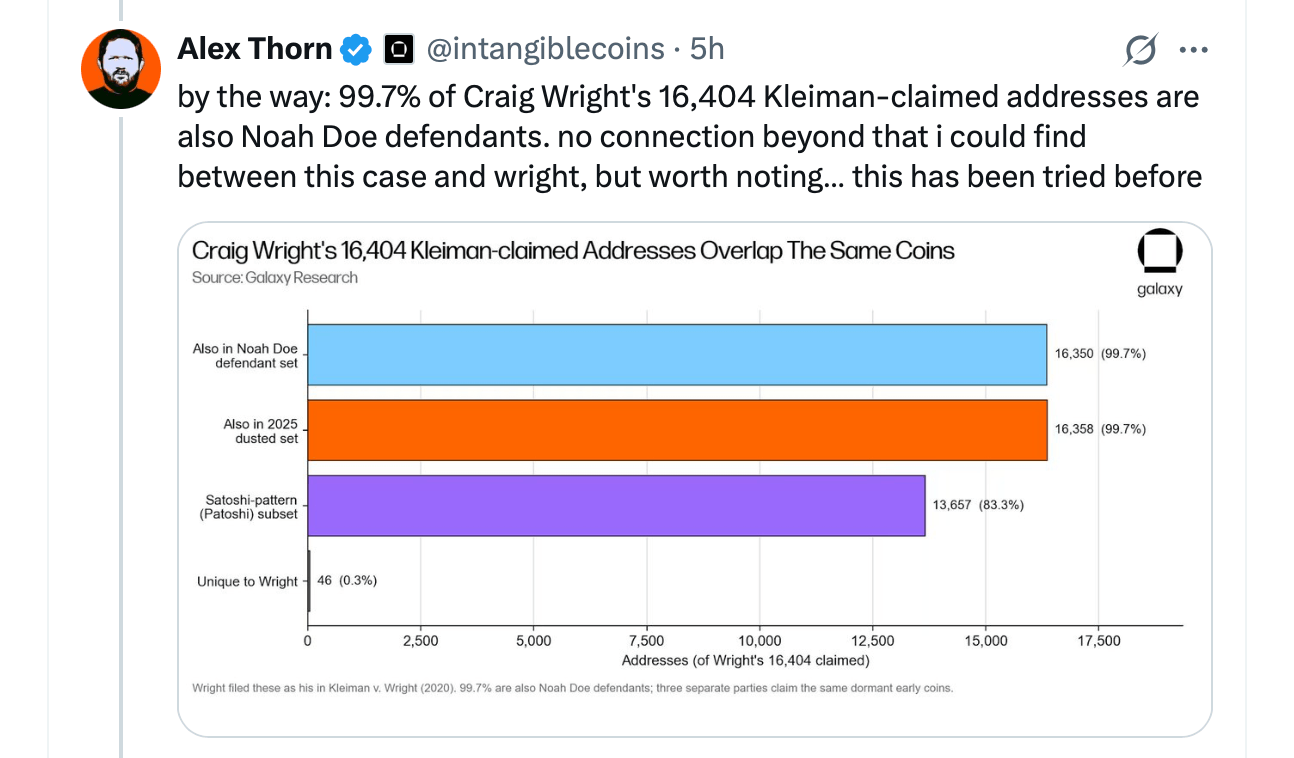
Craig Wright’s shadow looms, too. His farcical claim to be Satoshi, rejected by courts, overlaps with 99.7% of the addresses in this case. Yet, no direct link to Wright has been forged-a coincidence, perhaps, or a twist in this absurdist drama.
To serve the 39,069 defendants, the plaintiffs turned to the blockchain, sending OP_RETURN messages with a link to the pleadings. Galaxy Research verified the operation, noting the irony: each address received 546 satoshis, a pittance, alongside the message: “COURT-ORDERED LEGAL NOTICE: https://www.ilawconotices.com/153119-2026.” Whether this constitutes valid service remains an open question, a riddle wrapped in digital enigma.
The affidavit of service, signed by one “Carlos J. Voltron,” adds another layer of farce. Galaxy Research found no trace of this blockchain engineer, save for a 2008 satirical piece in The Onion. If Voltron’s identity remains unverified, the entire judgment could crumble-a house of cards built on digital sand.
Plaintiffs’ counsel, David D. Lin, shields his clients from public scrutiny, citing “wrench attacks” and kidnapping risks. Yet, the relief they seek would force the true Bitcoin holders into the light, a paradox as sharp as a thorn.
Even if the plaintiffs triumph, they would not gain the private keys. Instead, they would wield a legal document, a “cloud on title,” that could freeze assets on centralized exchanges. Thorn notes the true value lies in this leverage, not in direct access to the coins-a pyrrhic victory, if ever there was one.
A default judgment is expected by late June 2026, though Thorn doubts the court will rubber-stamp such a novel, high-stakes claim. The affidavit’s questionable validity provides ample reason for a hearing, a final act in this legal tragicomedy.
Read More
- WLD PREDICTION. WLD cryptocurrency
- EUR CNY PREDICTION
- Brent Oil Forecast
- BTC PREDICTION. BTC cryptocurrency
- Gold Rate Forecast
- ZEC PREDICTION. ZEC cryptocurrency
- BNB PREDICTION. BNB cryptocurrency
- USD TRY PREDICTION
- NEAR PREDICTION. NEAR cryptocurrency
- SOL PREDICTION. SOL cryptocurrency
2026-05-28 20:58