Bitcoin has edged past the 945,000 blocks milestone, darling, which is basically the chic midway point to the next Halving. Here’s how many blocks are left for the suspense to unravel.
Bitcoin Halving Will Occur At Block Height 1,050,000
The “Halving” is this wonderfully preordained moment on the Bitcoin network when the block subsidy gets halved. It’s a recurring ritual, every 210,000 blocks-or roughly every four years. The last one happened in 2024, which, if you follow my diary, was less a milestone and more a small catastrophe with glitter.
Why did Satoshi bother coding this into the blockchain’s bible? The block subsidy is the miners’ salary for adding a new block to the chain. It happens to be the only way new BTC enters circulation, so you can basically call it the production line for the asset-minus the union complaints.
If this reward stayed constant, miners would keep flooding the market with the same number of coins, which could have a depressing effect on value over time. With the Halving in place, however, the production rate of the cryptocurrency keeps shrinking, thus making new tokens scarcer. This is the reason the pseudonymous creator drafted the policy: to curb the inflation of the asset, or at least pretend to.
As mentioned earlier, the Halving occurs every 210,000 blocks. The next event, which will be the fifth Halving on the network, will occur at block height 1,050,000. As the countdown from NiceHash shows, Bitcoin is sitting at around 946,000 blocks right now, meaning that it’s over halfway through the 210,000-block journey to the next event.
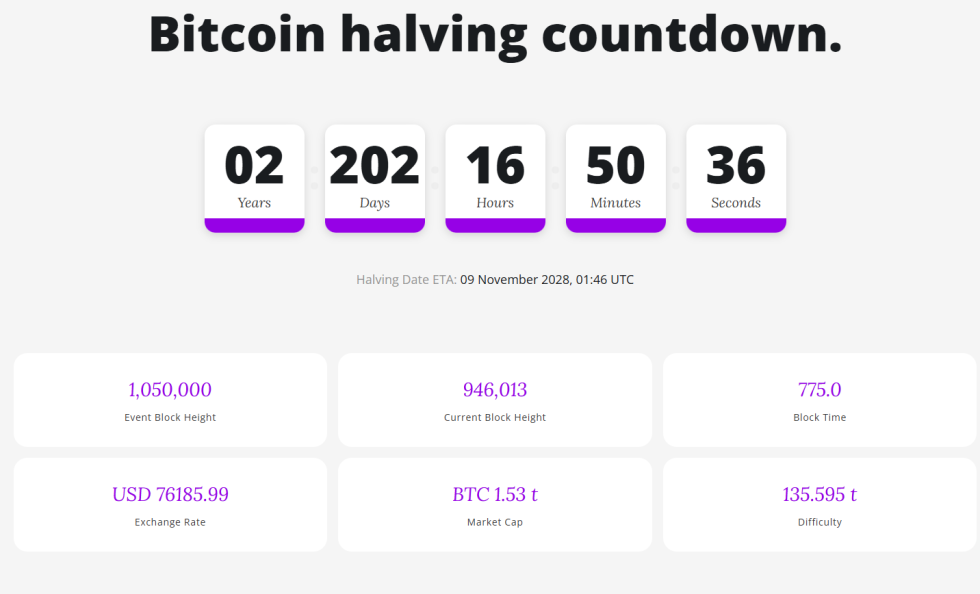
Initially, Bitcoin started out with a block subsidy of 50 BTC. After four Halving events, the reward’s value stands at 3.125 BTC today. The next Halving event, which is currently estimated to occur in November 2028, will further slash the block subsidy to 1.5625 BTC.
While the Halving is periodic, there won’t be an infinite number of instances of this event. This is due to the fact that Satoshi also put a cap on the cryptocurrency’s supply. Once miners have introduced 21 million tokens into circulation, they won’t be handed out block subsidies anymore. Past that point, Halvings would naturally lose all meaning-and the party would be over, like a book club that finishes the last crumbly biscuit and forgets to report it.
The fact that there is a supply cap is a troublesome fact for miners, as they earn the majority of their income via the block subsidy. With each Halving that occurs en route to this endpoint, miners’ BTC revenue shrinks, and they have to count on the cryptocurrency’s price going up over time to sustain their USD income. It’s basically the financial equivalent of hoping the waiter will bring more cream when your coffee cools down.
While this has worked so far, in the long run, miners will have to hope for transaction fees to grow in size enough to provide them with sufficient income on their own. For now, they are still very much dependent on the block subsidy.
BTC Price
At the time of writing, Bitcoin is floating around $76,800, up more than 3% in the last seven days.

Read More
- Brent Oil Forecast
- Silver Rate Forecast
- Gold Rate Forecast
- Trump’s Oil Fantasy: Seize, Profit, and Declare Victory in the Straits of Hormuz
- USD TRY PREDICTION
- HYPE PREDICTION. HYPE cryptocurrency
- You Won’t Believe 35% of Crypto Users Lost Their Wealth to Simple Human Error!
- BTC PREDICTION. BTC cryptocurrency
- Solana\’s Slump: Will Traders Wait Forever for a Catalyst?”‘, ‘reasoning_content’: None, ‘name’: None, ‘tool_calls’: None}, ‘finish_reason’: ‘stop’, ‘logprobs’: None}], ‘usage’: {‘prompt_tokens’: 733, ‘total_tokens’: 750, ‘completion_tokens’: 17, ‘estimate
- ECB Backs EU Crypto Supervision: Binance and Coinbase Face ESMA Oversight
2026-04-22 02:11