Bitcoin rose 5% on Monday, showing strength even as global markets reacted negatively to the growing conflict in the Middle East.
Equities Tumble Amid Geopolitical Conflict
On Monday, March 2, bitcoin ( BTC) briefly breached the $70,000 mark, signaling a potential return to its “digital gold” status. After plummeting to an intraday low of approximately $65,150, BTC launched a rally to $70,111 around 11:00 a.m. EST—a surge of $5,000 in under two hours. Although it later retreated below the $69,500 threshold, the leading cryptocurrency remained up 5% over the last 24 hours.
Bitcoin’s resilient price action stood in stark contrast to global equities, which crumbled as investors reacted to escalating hostilities between the U.S. and Israel on one side, and Iran on the other. In Asia, the Nikkei, which hit record highs in late February, closed 1.35% lower. South Korea’s KOSPI fell 1%, while the Hang Seng dropped over 570 points (2.14%). India’s Sensex also finished in the red.
In Europe, key indices closed lower across the board, reflecting widespread anxiety over the conflict’s trajectory. In U.S. markets, the Nasdaq Composite, which mirrored bitcoin’s movements for much of February, opened with a sharp drop before paring losses to sit 0.5% higher at the time of writing. At the time of writing, the S&P 500 and Dow Jones remained largely flat after reversing steep opening losses.
The Hormuz Factor and Inflation
While the cryptocurrency market initially bore the brunt of the Feb. 28 panic, the contagion spread to traditional equities on Monday. The catalyst was a violent spike in energy futures; as oil and natural gas prices surged, investors preemptively sold off stocks in anticipation of squeezed corporate margins and diminished consumer spending.
This risk-off sentiment was further intensified by reports that major maritime carriers are rerouting vessels away from the Strait of Hormuz. As a primary artery for global energy transit, any disruption there creates a supply-side shock that reignites dormant inflation fears.
In this high- inflation, high-uncertainty environment, the narrative is shifting. While equities struggle under the weight of rising input costs, the market is pivoting toward hard assets. In the past, such systemic instability favoured bitcoin and other store-of-value assets, as they offer a hedge against the fiat-currency debasement often triggered by energy-driven inflationary cycles.
Even though markets tried to calm down, the biggest concern continues to be the possibility of the conflict spreading. A strong warning from Saudi Arabia and the UAE, promising retaliation for Iranian attacks, has increased tensions and raised the risk of a wider war that could involve major economies in the Gulf region.
Energy Policy and the Central Bank Dilemma
Experts are concerned that if the current conflict continues, oil prices could rise above $100 a barrel. If that happens, the U.S. government would probably release oil from its emergency reserves to help keep prices stable. Although OPEC has offered to increase production to offset shipping problems, significant issues with global supply chains remain a major worry.
Analysts at Bitunix caution that sustained energy inflation could fundamentally derail current interest rate trajectories, forcing central banks to rethink their “soft landing” narratives as inflation expectations are recalibrated upward.
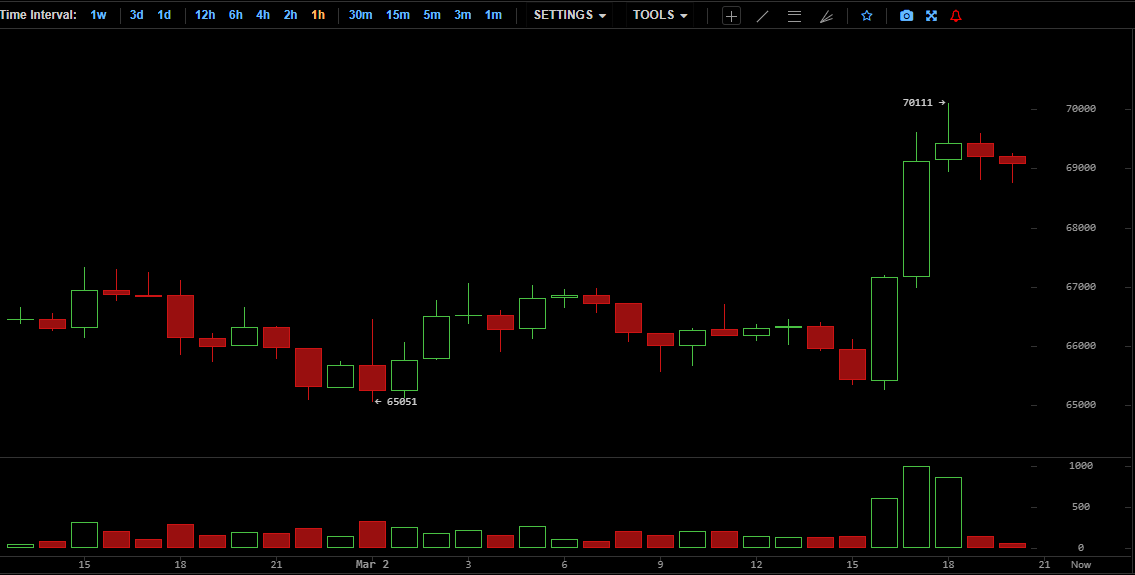
In the immediate term, global capital is rotating rapidly into traditional bastions of safety: gold and the U.S. Dollar. However, for bitcoin, the coming days represent a historic crossroad for its reputation as a safe-haven asset.
“ BTC faces a dense concentration of short positions between 67,800 and 69,500, with substantial support in the 64,000–65,000 range,” noted Bitunix analysts. “If the conflict intensifies and safe-haven demand rises, breaking through the overhead liquidation zone will determine if the market truly redefines BTC as digital gold. Conversely, a pullback toward 64,000 would reinforce its status as a high- volatility risk asset.”
FAQ ❓
- Why did bitcoin surge while Wall Street struggled? BTC rallied 5% even as Nasdaq and S&P 500 swung on energy inflation fears.
- How did Asian markets react to the conflict? Japan’s Nikkei, Korea’s KOSPI, and Hong Kong’s Hang Seng all closed lower.
- What was the impact on European equities? Major indices fell broadly as investors braced for escalation in the Gulf.
- Does this strengthen bitcoin’s digital gold narrative? Analysts say safe-haven demand could redefine BTC amid inflation and war risks.
Read More
- EUR PHP PREDICTION
- USD JPY PREDICTION
- USD MYR PREDICTION
- EUR RUB PREDICTION
- ETH Price Stalls at $3K Amid $19M ETF Exodus!
- Binance & Trump’s USD1: A Stablecoin Love Story 💸✨
- BTC PREDICTION. BTC cryptocurrency
- EUR USD PREDICTION
- ETH PREDICTION. ETH cryptocurrency
- Gold Rate Forecast
2026-03-02 22:46