As an analyst, I’ve been closely watching the situation with Iran. Last Monday, March 23rd, President Trump announced a temporary, five-day halt to potential strikes on Iranian energy facilities. The market reaction was significant: US stocks jumped by $1.7 trillion, oil prices fell sharply – around 15% – and Bitcoin surged, breaking through the $70,000 mark. I can now report that this pause has been extended, and will remain in effect until April 6th.
Iran dismissed these reports as false, and Israel quickly acted against the temporary halt. The financial benefits seen from these talks disappeared almost immediately. This raises the question: were Donald Trump’s discussions with Iran genuine, or were they simply a tactic to boost the financial markets so that major investors could profit?
According to the Washington Post, the United States is preparing for a possible ground invasion of Iran that could last as long as two months. This involves the deployment of thousands of American soldiers to the Middle East, potentially marking a significant escalation in the ongoing conflict.
— The Kobeissi Letter (@KobeissiLetter) March 29, 2026
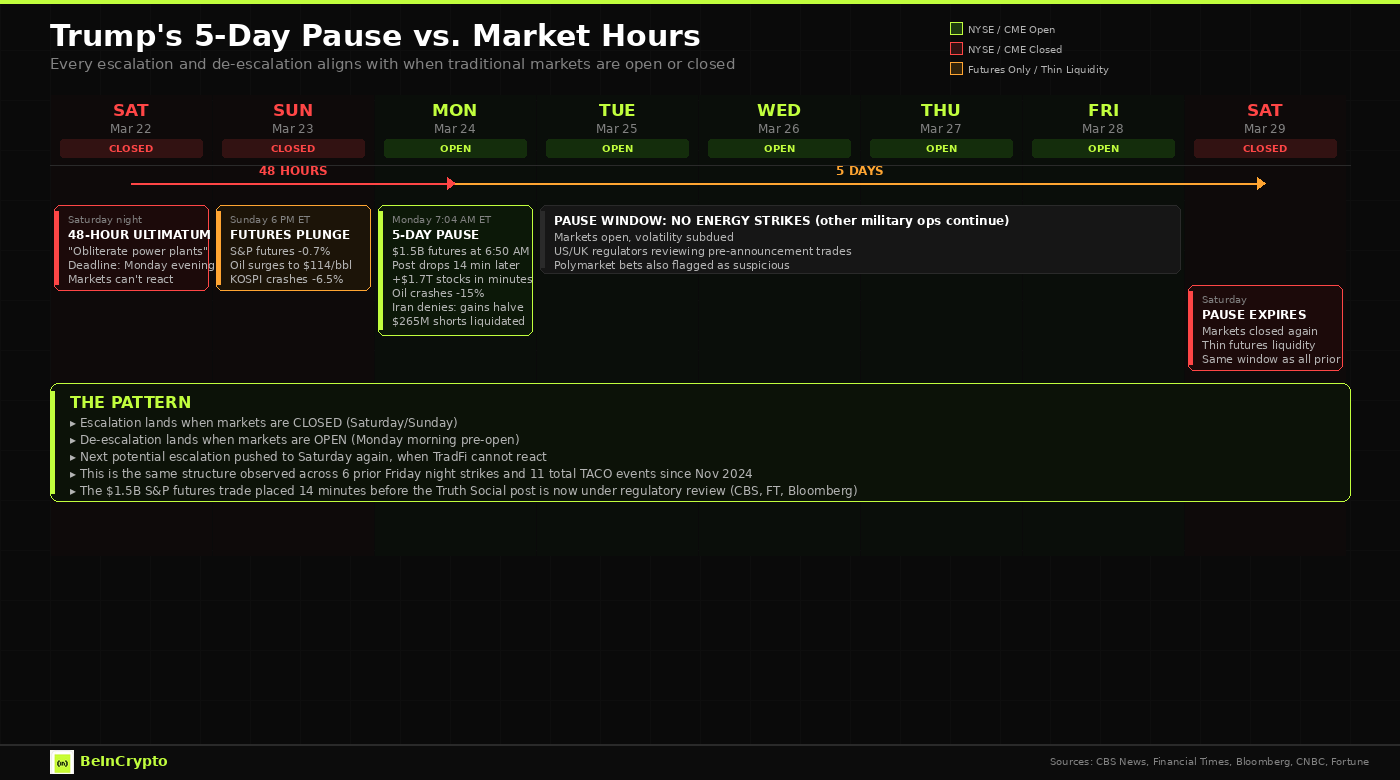
How Trump’s Pause Lines Up With Market Hours
Beginning on Saturday, March 22nd, Trump issued a threat on his social media platform, Truth Social, stating that Iran has 48 hours to reopen the Strait of Hormuz, or its power plants will be targeted.
That deadline was set to expire Monday evening, with traditional markets fully open and exposed.
Rather than taking action, former President Trump announced on Monday morning that he had “very good and productive conversations” with Tehran. He stated that any strikes on energy infrastructure would be delayed for five days.
Donald J. Trump Truth Social Post 07:23 AM EST 03.23.26
— Commentary Donald J. Trump Posts From Truth Social (@TrumpDailyPosts) March 23, 2026
The 5-day window expired Saturday, March 28. Not a random day.
- Equity markets are closed
- Futures liquidity is thin
- Institutional desks are offline.
If tensions increase again, it will happen during a period of low trading volume, similar to what we’ve seen before every significant market downturn since mid-2025 during the Trump administration.
Someone Traded Before the Post
Trading activity increased before the official announcement. Between 6:49 and 6:50 a.m. Eastern Time, about 6,200 futures contracts for Brent and WTI crude oil were traded, representing $580 million in value.
Bloomberg data, as reported by the Financial Times, shows that trading volume for that minute averaged around 700 contracts over the previous five trading days.
Simultaneously, someone bought $1.5 billion worth of S&P 500 futures, which immediately caused the index to rise by 0.3%. Just fourteen minutes after that, a post from Donald Trump appeared. By 7:10 a.m. Eastern Time, the S&P 500 had increased in value by approximately $2 trillion.
Could this be the most perfectly timed trade of 2026? This morning at 6:50 AM Eastern Time, someone purchased $1.5 billion worth of S&P 500 futures contracts. The size of this purchase immediately boosted the index by 0.3%. Just fourteen minutes later, at 7:04 AM ET, Donald Trump made an announcement…
— The Kobeissi Letter (@KobeissiLetter) March 23, 2026
U.S. and UK regulators are reportedly reviewing the data. No charges have been filed.
CBS News reported that a large, unusual increase in trading activity just before the post warrants further scrutiny, potentially an investigation, according to Stephen Piepgrass, a futures trading expert at the law firm Troutman Pepper Locke.
Iran Says It Never Happened
Tehran firmly rejected the reports, with the Parliament Speaker, Mohammad Bagher Ghalibaf, dismissing them as false information designed to disrupt financial and oil trading.
There have been no talks with the United States. False information is being spread to influence financial and oil markets, and to try and resolve the difficult situation the US and Israel are facing.
— محمدباقر قالیباف | MB Ghalibaf (@mb_ghalibaf) March 23, 2026
The Foreign Ministry stated this was a tactic to manipulate energy prices and create a delay for future attacks. While officials confirmed they received messages through third parties, they emphasized that no direct talks took place.
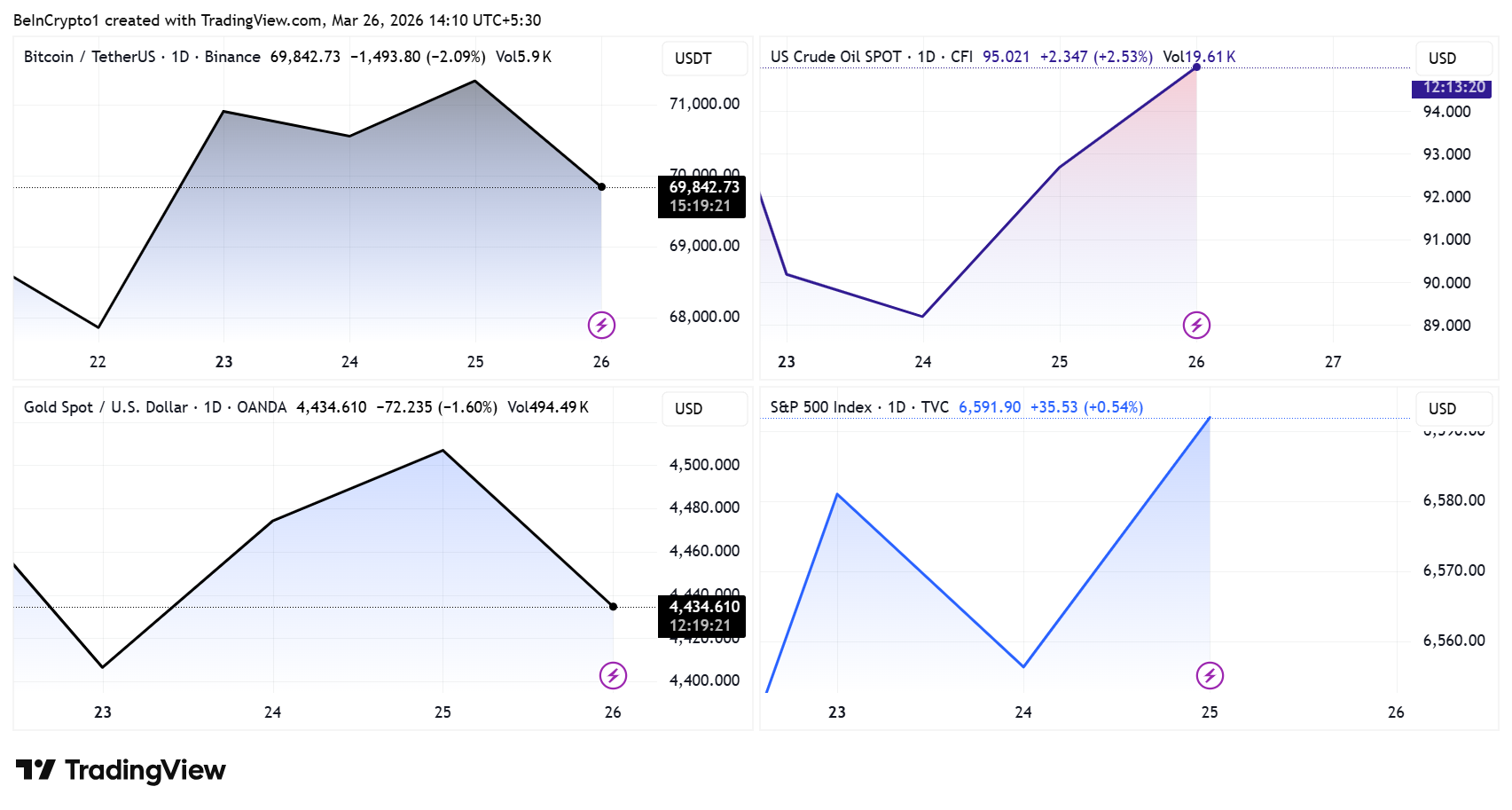
When the report was denied, markets quickly changed direction. Oil prices rose again, while stocks lost about half of their earlier gains. Bitcoin briefly went above $70,000 before falling back, resulting in $265 million worth of cryptocurrency short positions being closed within just 15 minutes.
This Has Happened 11 Times Since November 2024
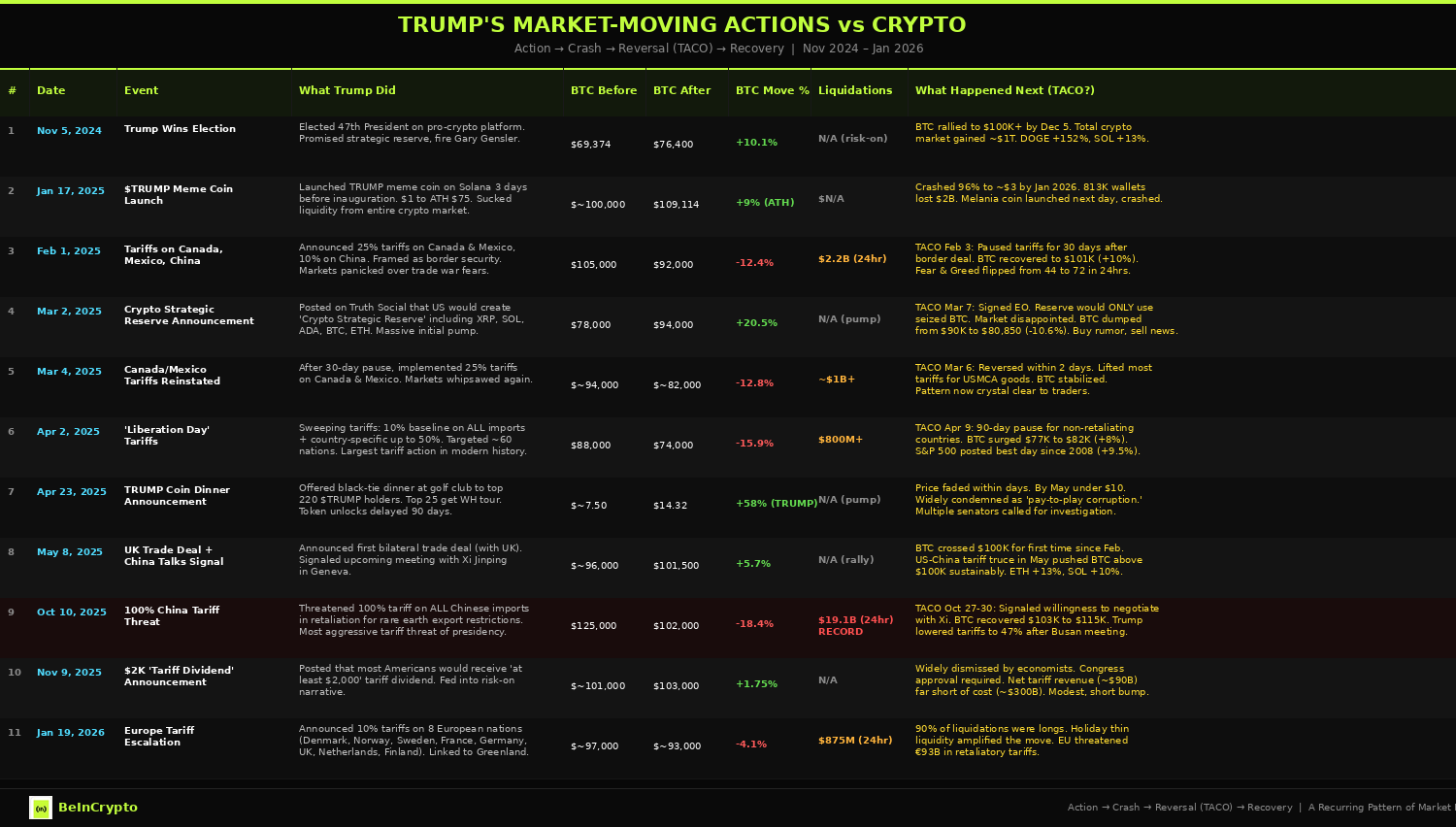
This isn’t the first time Donald Trump’s statements have impacted the market. Since November 2024, BeInCrypto has identified 11 announcements from Trump that caused significant market fluctuations. Traders have even nicknamed this pattern ‘TACO’ – representing a cycle of initial action, a subsequent crash, a bounce back, and eventual recovery.
- Liberation Day tariffs were announced on April 2, 2025, at 4:30 p.m. ET, after markets closed. Trump posted “BE COOL! THIS IS A GREAT TIME TO BUY!!” the next morning, minutes after opening. A 90-day pause followed, producing a 9.5% rally in the S&P 500.
- On October 10, 2025, a 100% tariff threat on China dropped on a Friday, 20 minutes after close. BTC fell 18.4%. Crypto liquidations hit $19.1 billion in 24 hours.
Between June 2025 and February 2026, six confirmed attacks happened in a similar pattern. BeInCrypto discovered that each attack occurred roughly 60 hours after the previous one, suggesting a recurring cycle.
The situation with Iran is unfolding in a predictable pattern. Rather than sudden announcements followed by retractions, the process now involves delivering an ultimatum on Saturday and then offering some relief on Monday. We can expect the next period of increased tension to begin on another Saturday.
What the Experts See
Political scientist Richard Heydarian, speaking on the BeInCrypto podcast, cautioned that the economic fallout from the conflict could reach trillions of dollars, and that it’s difficult to predict what former President Trump will do next.
Richard Heydarian explained to BeInCrypto that while Donald Trump’s overall goals are clear – maintaining American dominance – his methods for achieving them are completely unpredictable. We understand *what* he wants, but not *how* he’ll go about getting it in today’s complicated global landscape.
Stanford economist Mordecai Kurz, in a discussion on the BeInCrypto podcast, explained that the issue stems from a fundamental problem: a few powerful private entities have too much control, leaving everyday people vulnerable.
Kurz believes the current level of concentrated wealth and power in the United States is unsustainable. He argues that young people will only thrive if technology and government policies are focused on benefiting everyone, not just a select few.
The deadline for a key decision is Saturday. If recent trends continue, any major news will likely come out when markets are closed and trading is slow.
Across 11 documented events and 16 months, the pattern has not broken once.
Read More
- Brent Oil Forecast
- CNY JPY PREDICTION
- Silver Rate Forecast
- Gold Rate Forecast
- EUR AUD PREDICTION
- Gamblers, Missiles, and a Dash of Folly: A Tale of Modern Woes
- XRP PREDICTION. XRP cryptocurrency
- Fed’s Big Move! Crypto’s Fate Unveiled!
- Whispers of the Digital Aristocracy: A $47.5M Secret Unveiled
- USD VND PREDICTION
2026-03-29 16:48