Crude oil prices are slingin’ around $92 at press time. Still well above pre-conflict levels but down 31% from the $119 peak hit on March 8. This analysis tracks Brent crude futures because they more accurately reflect the international oil price during Middle East-centered geopolitical events.
The war-driven rally pushed oil to its highest levels since 2022, but four signals now suggest the upside may be exhausting. Plus, Iran has recently released a set of requirements for a ceasefire, which could dent the war premium further.
BREAKING: Iran announces their requirements for a potential ceasefire with the US and Israel.
Requirements include:
1. “Recognizing Iran’s legitimate rights”
2. “Iran receives a payment of reparations”
3. “Firm international guarantees against future aggression”
– The Kobeissi Letter (@KobeissiLetter) March 11, 2026
Record Reserve Release and Rising Iran Exports Challenge the Supply Panic
The International Energy Agency (IEA) approved a 400 million-barrel emergency release of oil reserves this week, the largest in its history, to stabilize prices.
IEA ANNOUNCES 400M-BARREL RELEASE, TIMING UNCLEAR
The International Energy Agency says 400 million barrels could be released, but details on pace and timing are missing. In 2022, the U.S. peaked at about 1 million barrels/day for a month.
This may be the first time the world…
– *Walter Bloomberg (@DeItaone) March 11, 2026
Japan, which holds roughly 440 million barrels in stockpiles covering 204 days of imports, may also tap its reserves independently.
BREAKING: Japan’s prime minister says could start releasing from strategic oil reserve as soon as 16th of March
– The Spectator Index (@spectatorindex) March 11, 2026
Meanwhile, Iran’s oil exports have actually risen by 100,000 barrels per day since the war began, reaching 2.1 million barrels per day. China continues absorbing large volumes.
BREAKING: Iran is exporting more oil through the Strait of Hormuz now than before the war started, per WSJ.
Iran’s oil exports have risen by 100,000 barrels per day since the war began, to 2.1 million barrels per day.
China is also buying large amounts of Iranian oil.
– The Kobeissi Letter (@KobeissiLetter) March 11, 2026
Strait of Hormuz traffic is slowly resuming, with 13.7 million barrels passing through since late February, though most commercial shipping remains blocked due to ongoing missile and drone threats. However, despite these ongoing supply threats, the price action itself is telling a different story.
On the 8-hour chart, the Relative Strength Index, or RSI, a momentum indicator, is flashing a bearish divergence. Oil prices made a higher high between March 3 and March 10, but the RSI printed a lower high.
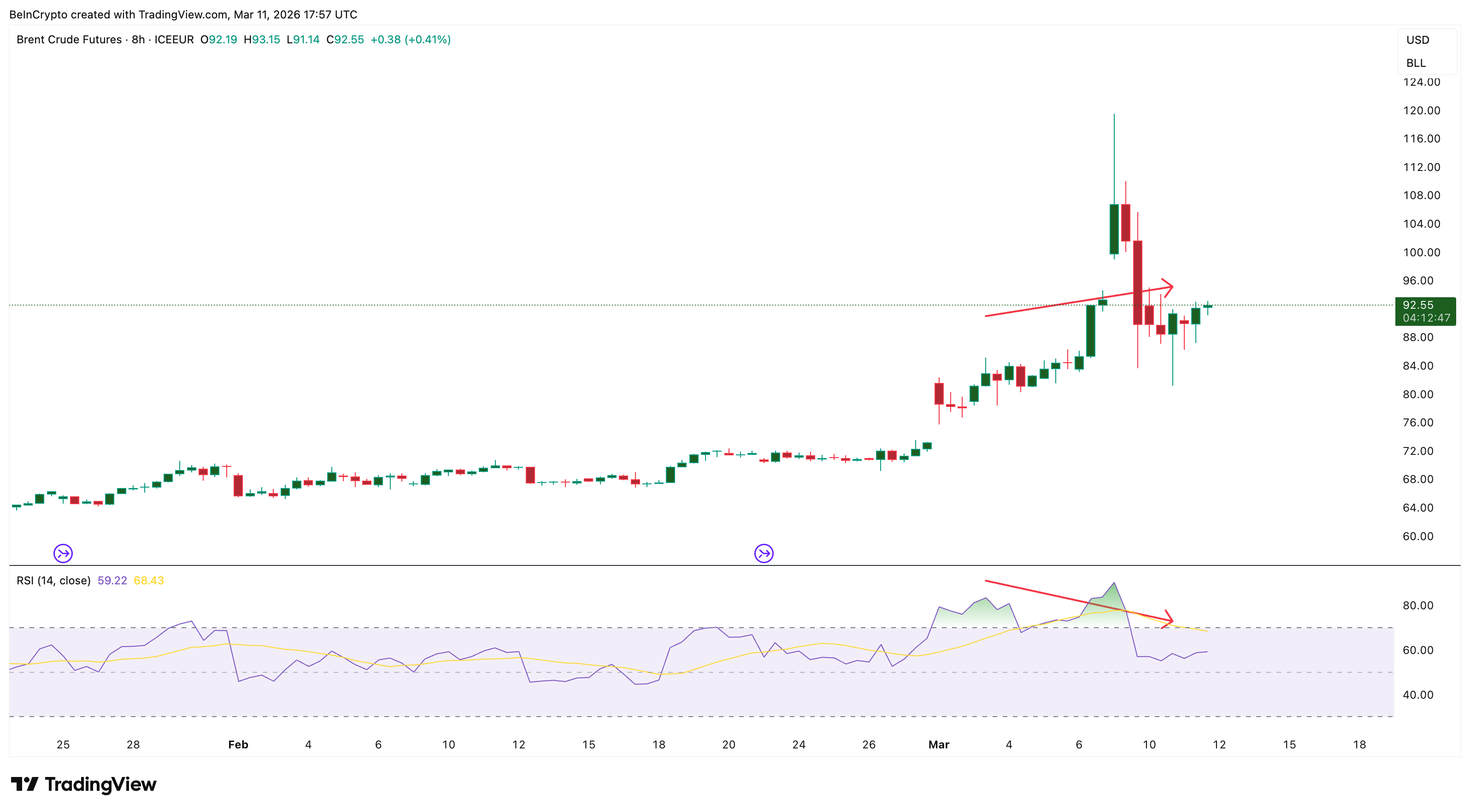
When prices rise, but momentum weakens, it typically signals an approaching reversal. This divergence also appears within a larger bearish structure forming on the chart, discussed in the final section.
Urgency for Oil Delivery is Easing
That weakening momentum is confirmed by the futures curve, which measures how delivery months are priced relative to one another.
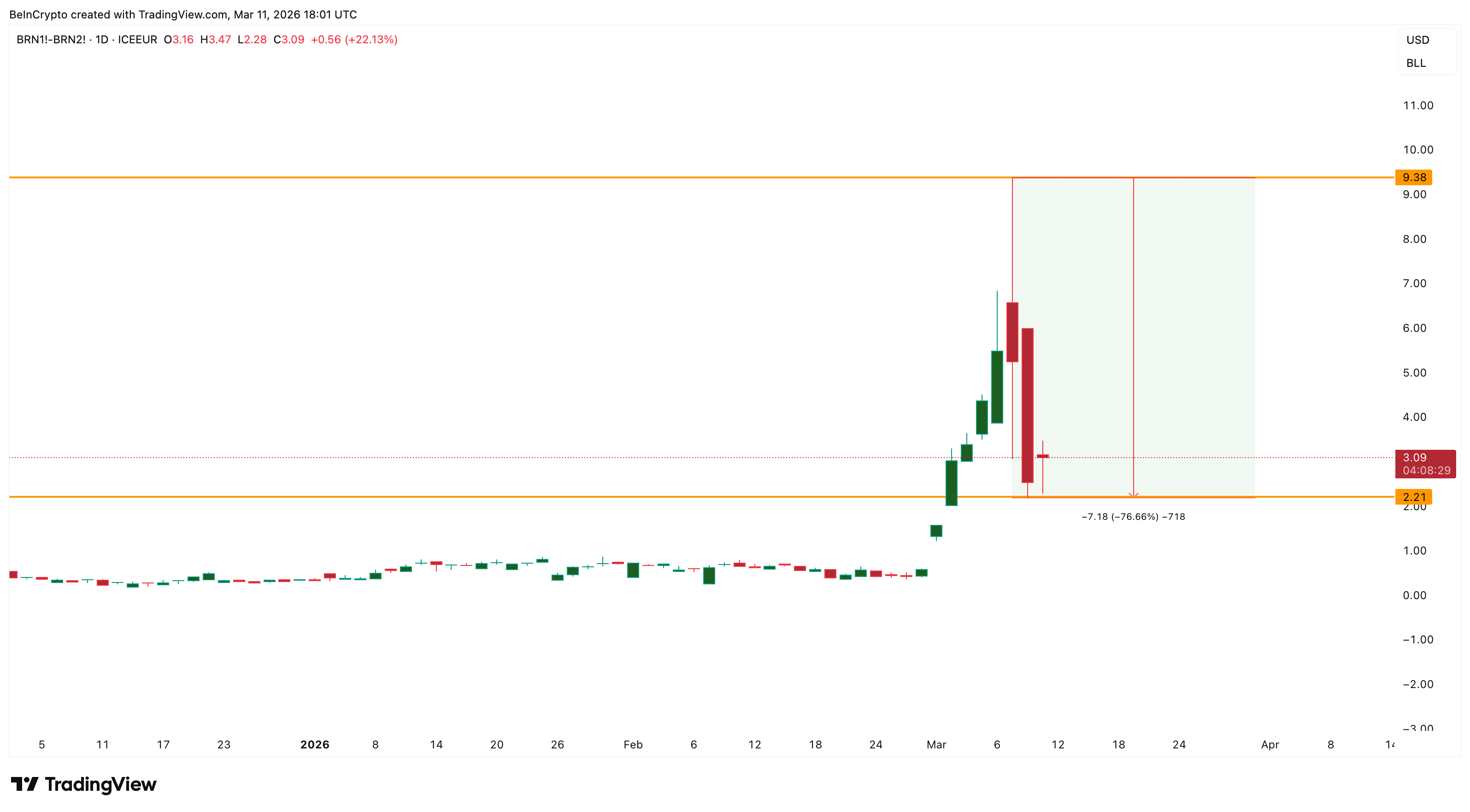
The gap between the front-month and second-month Brent contracts (BRN1! minus BRN2!) peaked at $9.38 around March 8. When this spread is positive, it means buyers are paying a premium for immediate oil delivery over next month’s delivery, a condition called backwardation that reflects supply panic.
Since that peak, the spread has collapsed roughly 76% to around $3.09. Some urgency remains, but the rapid decline shows the scramble for immediate barrels is easing fast.
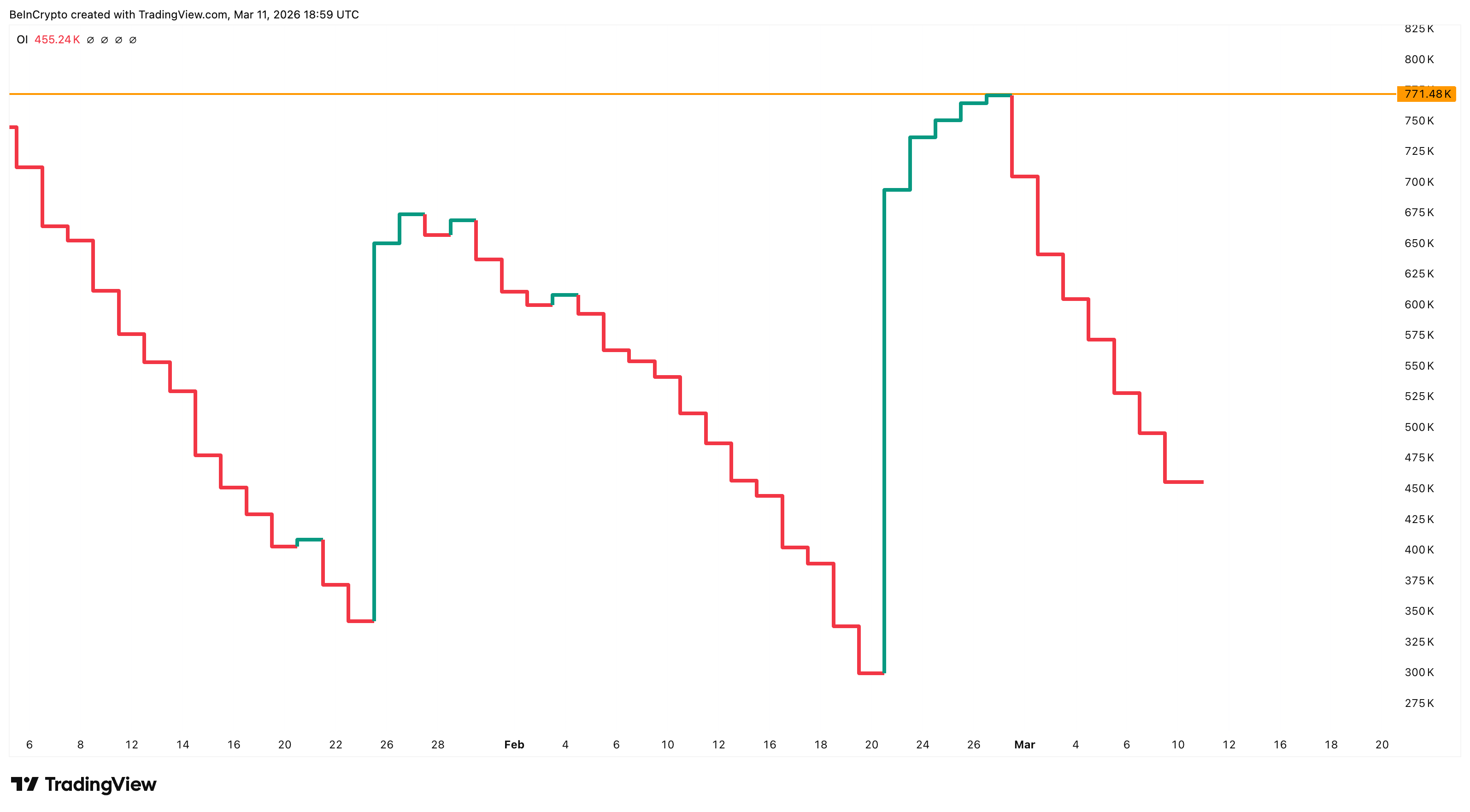
Supporting this, the total number of active Brent futures contracts has dropped to around 455,000 from over 771,000 at press time.
Rising prices while market participation shrinks usually mean the rally is fueled by traders closing old bearish bets rather than new buyers entering, a pattern that tends to run out of steam quickly.
Yet the options market tells a more cautious story. The premium traders pay for bullish oil bets over bearish ones has hit a four-year high, surpassing levels seen during the 2022 Russia-Ukraine crisis.
Oil options markets are still pricing in upside risk:
The 1-month call-put skew on WTI Crude oil futures is up to ~30, the highest in at least 4 years.
This means investors are paying a historic premium for bets on higher oil prices over bets on lower prices.
The call-put skew…
– The Kobeissi Letter (@KobeissiLetter) March 11, 2026
This gap between fading futures conviction and elevated options hedging suggests some participants are still bracing for a worst-case Hormuz shutdown, even as the broader market cools.
Dollar’s Bullish Channel Supports Oil Prices for Now but Carries Reversal Risk
The weakening futures conviction connects directly to the macro picture, where the US dollar is adding another layer of complexity.
The US Dollar Index (DXY), which tracks the dollar’s strength against a basket of major currencies. It is trading near 99.23 inside a rising channel. The $99.68 resistance has been tested and rejected twice, on March 3 and March 8.
Normally, a stronger dollar hurts oil because crude is priced in dollars globally, making it costlier for other countries to buy. But during supply crises like the current conflict, this flips.
Rising oil prices force every importing nation to buy more dollars to pay for crude, pushing the currency higher alongside oil rather than against it.
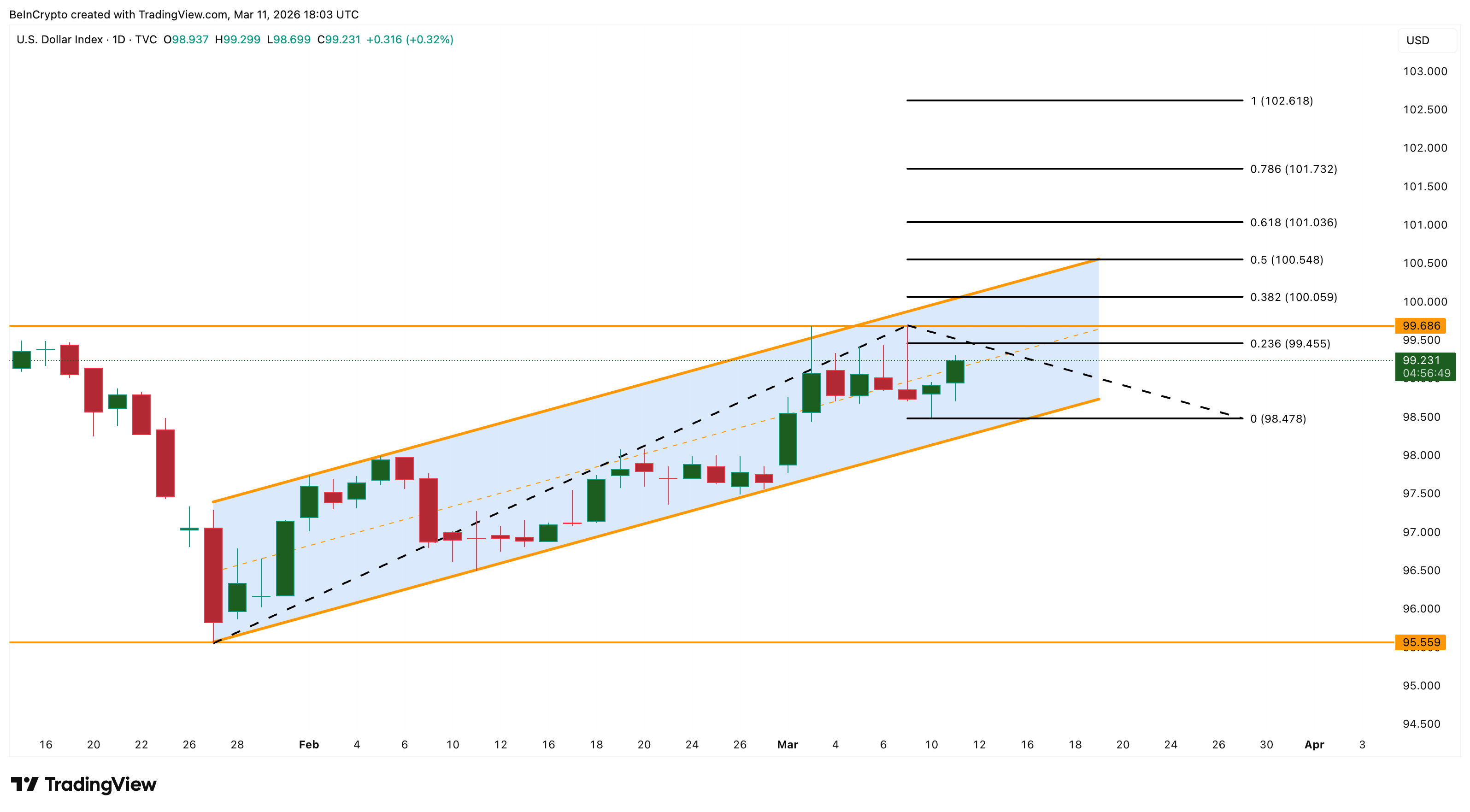
This petrodollar-driven co-movement lasts only as long as the war premium stays active. If de-escalation progresses, as Donald Trump has teased, both oil and the dollar could correct together.
BREAKING: The US has asked Israel to stop its strikes on Iranian energy infrastructure, particularly oil assets, per Axios.
Details include:
1. President Trump aims to “cooperate” with Iran’s oil sector after the war
2. The request marks the first time the Trump…
– The Kobeissi Letter (@KobeissiLetter) March 10, 2026
A DXY breakout above $100 would signal that markets expect sustained oil-driven inflation and fewer Federal Reserve rate cuts this year. That scenario supports oil briefly but eventually weighs on global demand, circling back as a headwind.
Bearish Pattern Targets $55 for the Oil Price
The fading momentum, collapsing backwardation, shrinking participation, and a dollar poised to flip from support to risk all converge on the 8-hour chart, where a head-and-shoulders pattern is taking shape.
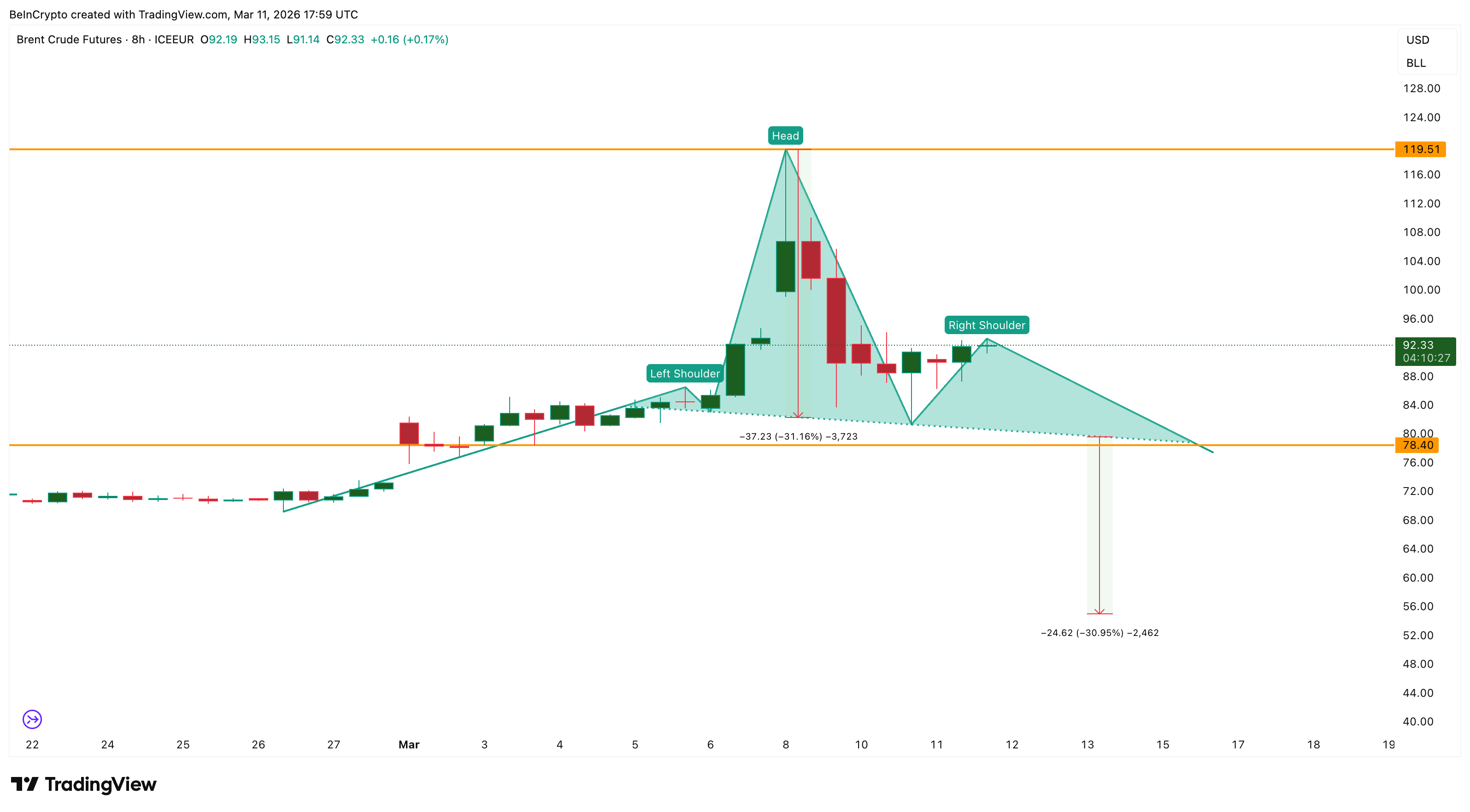
The head sits at $119, and the right shoulder is developing around $93 to $95. The neckline, the support connecting the lows between the shoulders, aligns with the $78 zone.
A confirmed break below $78 would validate the pattern. That would open the oil price path toward $73, then $67, with the full measured move target near $55, a roughly 31% decline from the neckline.
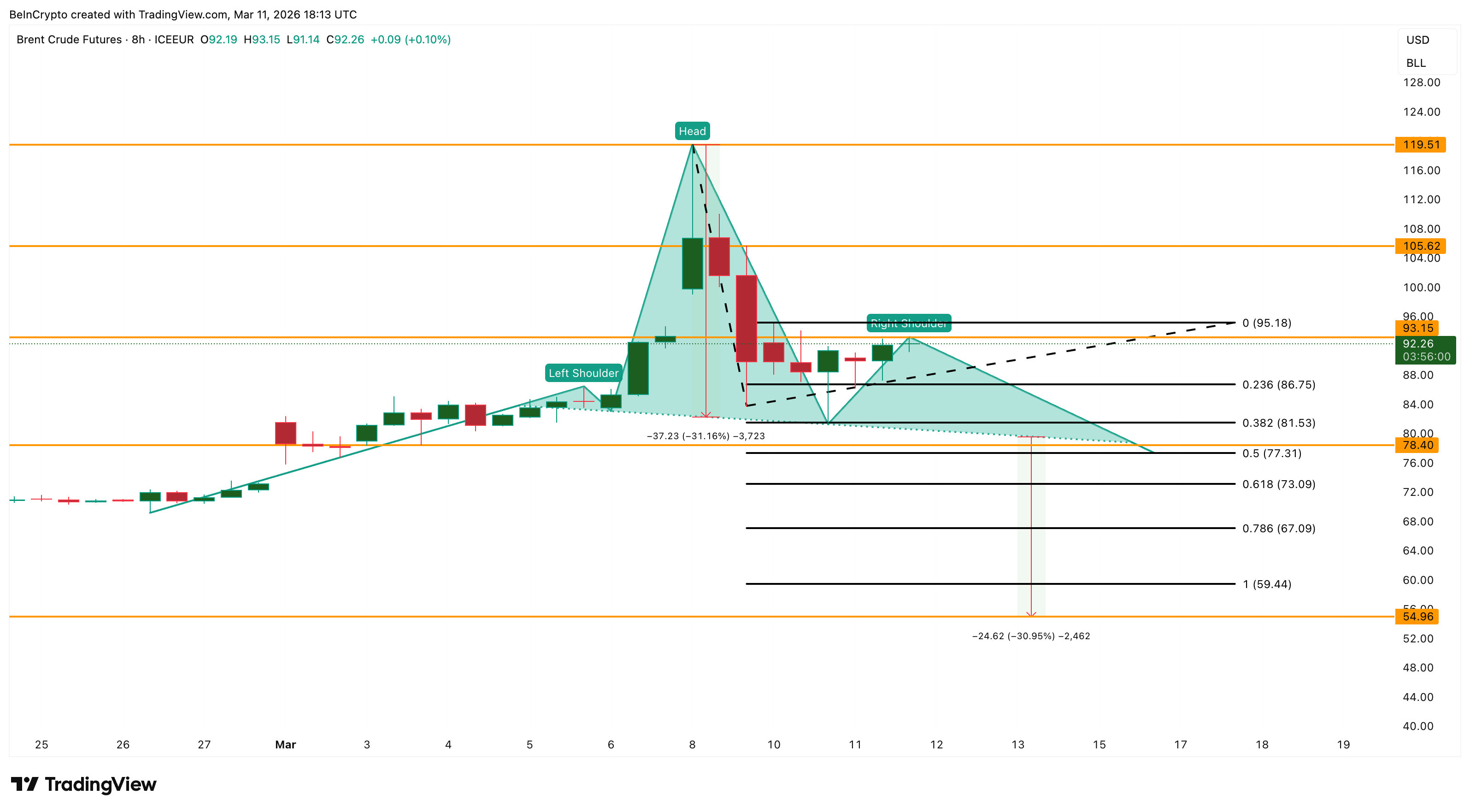
On the upside, a push above $93-$95 would weaken the bearish setup. A sustained move above $105 would invalidate it entirely.
However, retesting $119 looks unlikely given the de-escalation signals and the structural deterioration across backwardation, momentum, and participation covered above. More so with the ceasefire conditions released by Iran.
It could only happen if things between the US and Iran go from bad to worse.
The $78 neckline and $95 right shoulder cap define the range. A decisive break in either direction sets the tone for the next oil price move.
Read More
- Brent Oil Forecast
- Gold Rate Forecast
- Silver Rate Forecast
- GBP CNY PREDICTION
- Kraken’s Jesse Powell Dodges Legal Storm with Style 🌀⚖️
- Bitcoin: Is the Bubble Finally…Deflating? 📉
- Solana’s Plunge: A Tale of Memecoins, Rewards, and Falling Revenues 🚀💸
- Stablecoin Saga: Korea’s Rules Delayed 😮
- Canada’s Banks Are Finally Cool Now, Thanks to Crypto ETFs!
- USD VND PREDICTION
2026-03-11 23:22