So, the Robinhood stock price has bounced back like a rubber chicken at a galactic buffet, soaring nearly 23% since its February 5 low near $71. On the surface, this looks like a triumphant return for HOOD, the plucky little stock that could. The company also just posted its best financial year on record, which is about as surprising as finding a towel in your pocket when you need one.
But, as any hitchhiker worth their salt knows, the bigger picture is often as confusing as a Vogon poem. Weak crypto activity, fading money flows, and rising technical risks suggest this rebound might be as fleeting as a conversation with Zaphod Beeblebrox. For now, downside pressure remains the dominant force, like a persistent space flea in your ear.
Earnings Strength and Crypto Drag: A Galactic Tug-of-War
Robinhood delivered a financial performance in 2025 that was about as strong as a Heart of Gold‘s Improbability Drive. Full-year revenue reached about $4.5 billion, up more than 50% year over year. Net income hit nearly $1.9 billion. Q4 revenue rose 27%, and earnings per share beat expectations. Options trading, interest income, and Gold subscriptions all grew sharply, proving that Robinhood is no longer just a one-trick pony in the meme stock circus.
These numbers show that the core business is improving, like a Guide that’s finally been updated. Robinhood is no longer dependent only on meme stocks and crypto trading. It is becoming more diversified and more stable, though still not as stable as a well-anchored spaceship.
The company also launched the public testnet for Robinhood Chain, an Ethereum Layer 2 network built on Arbitrum. It aims to support tokenized stocks, 24/7 trading, and DeFi tools. This is a long-term growth move, not a short-term price driver, much like the search for the Ultimate Question to Life, the Universe, and Everything.
But crypto remains a problem, like a malfunctioning Infinite Improbability Drive. Crypto revenue fell 38% year over year to about $221 million. This drop was linked to Bitcoin’s pullback and weaker trading volumes. Because crypto still contributes a large share of activity, the slowdown hurt total revenue. Q4 sales missed analyst estimates by roughly $50 million, which is enough to make even a Vogon accountant frown.
ROBINHOOD Q4’25 EARNINGS HIGHLIGHTS
🔹 Revenue: $1.28B (Est. $1.35B) 🔴; +27% YoY
🔹 EPS: $0.66 (Est. $0.63) 🟢; vs. $1.01 YoY
🔹 Adj. EBITDA: $761M (Est. $833.2M) 🔴; +24% YoY
🔹 Crypto Revenue: $221M (Est. $242M) 🔴; -38% YoY
🔹 Transaction-Based Revenue: $776M (Est. $791.6M)…– Wall St Engine (@wallstengine) February 10, 2026
Markets focused on that miss, like a Magrathean focusing on the imperfections in a custom-made planet. After earnings, the stock fell around 7% in extended trading. This showed that investors still see crypto as a major risk, even if the rest of the news was as positive as a Pan Galactic Gargle Blaster.
Post that underwhelming crypto-specific performance, the Robinhood stock price seems to have rekindled the fears associated with a bearish pattern break, much like the fear of encountering a Ravenous Bugblatter Beast of Traal.
HOOD price broke below the falling channel on February 2, triggering a near 30% breakdown. While $71 offered support, the crypto-led weakness could soon attempt to push the prices down, like a space freighter with a faulty hyperdrive.
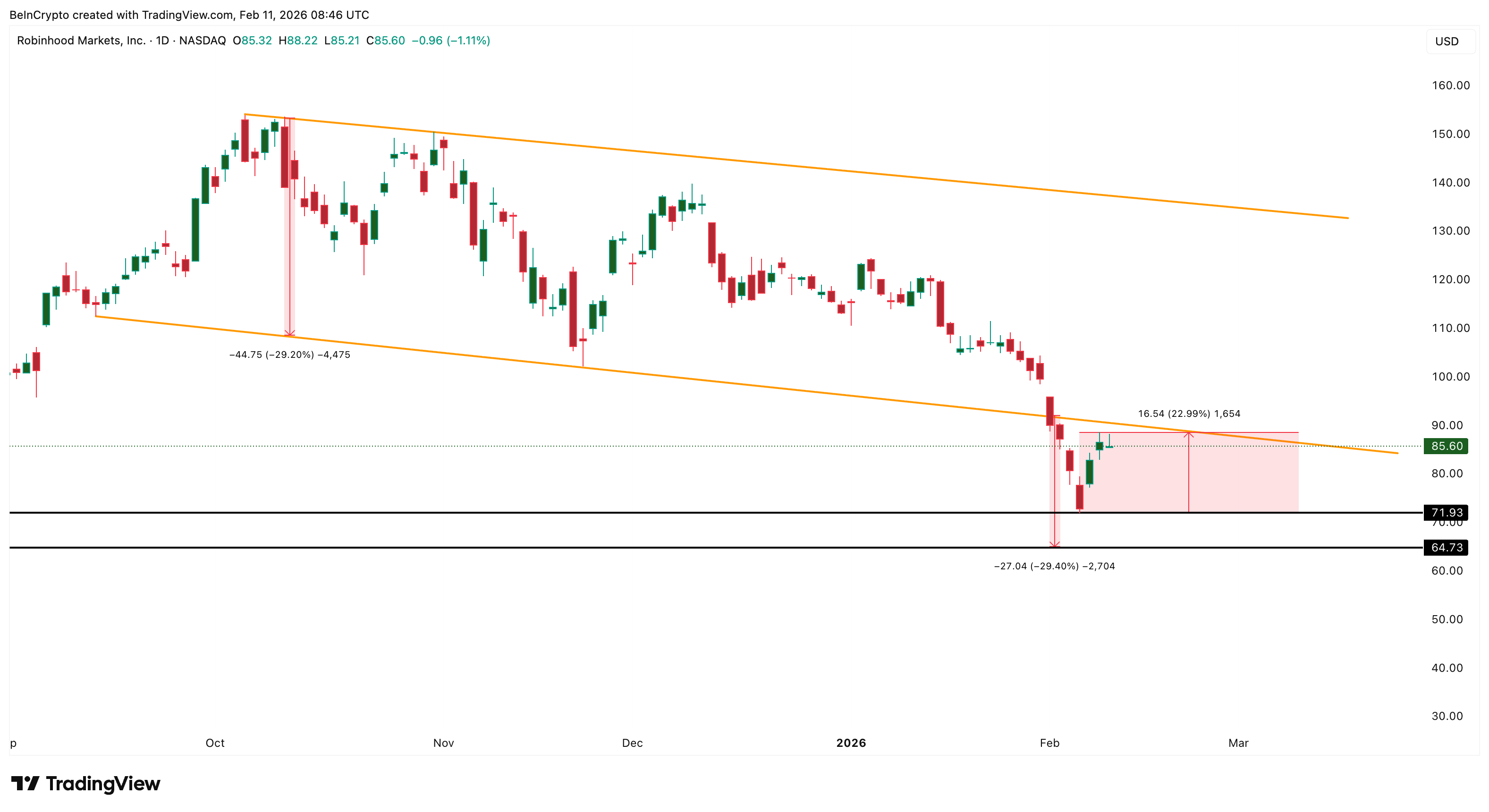
That is why the rebound since February 5 looks as fragile as a glass of wine in the hands of a nervous android. It is happening inside a broader downtrend, not a new uptrend.
Weak Money Flow and Death Cross Risk: The Universe Says “Don’t Panic”
Price action alone does not explain everything, much like how a single page of the Guide can’t explain the entire universe. Money flow indicators show that big investors remain cautious, like a group of Betelgeusians at a party.
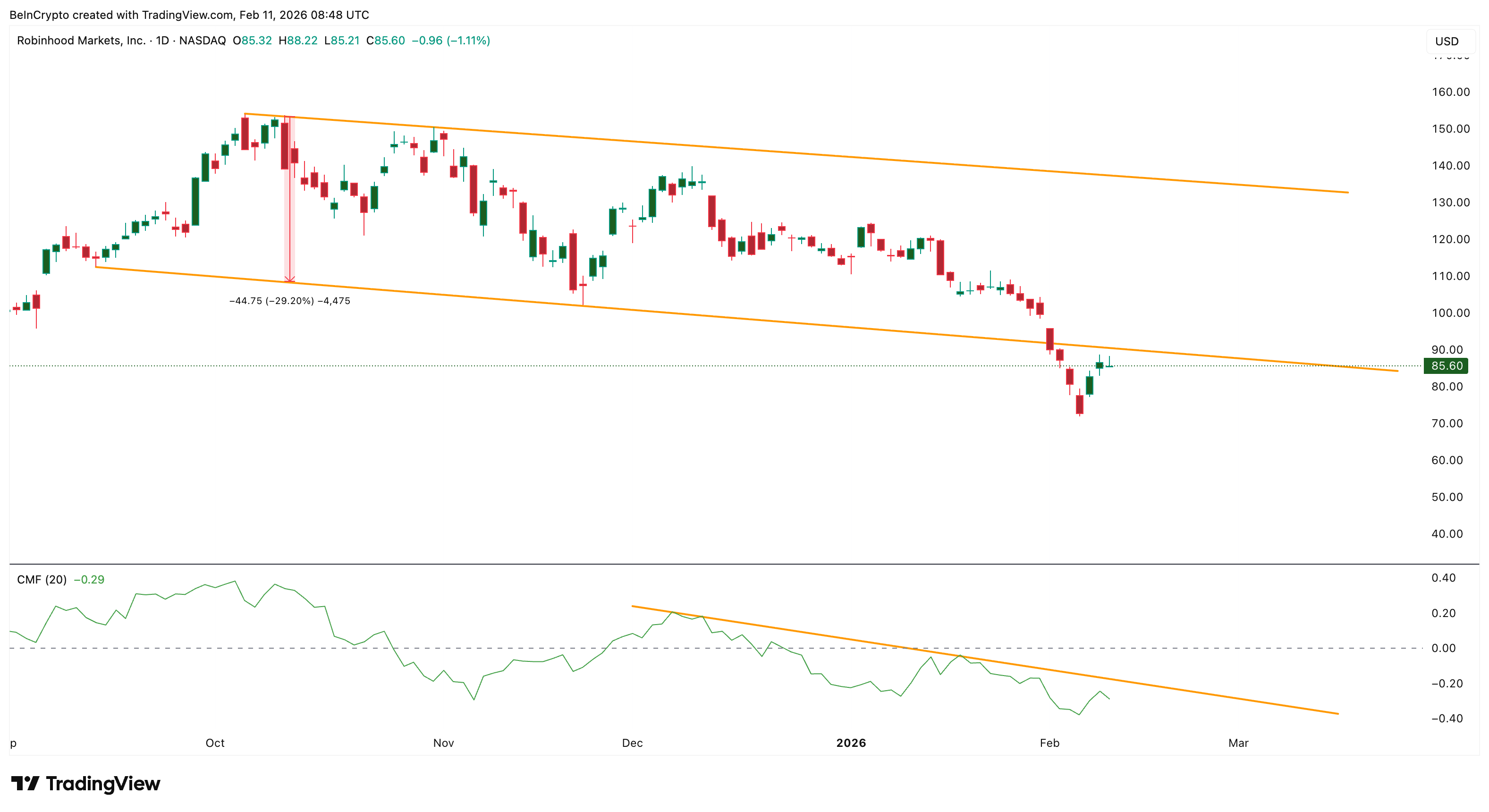
One key tool is Chaikin Money Flow, or CMF. CMF combines price and volume to show whether large players are buying or selling. When it stays above zero, institutions are usually accumulating. When it stays below, they are exiting or staying away, much like how one might avoid a party hosted by the Vogons.
Right now, Robinhood’s CMF remains negative, like a review of Vogon poetry.
Even during the 23% rebound, CMF failed to reclaim the zero line. It also stayed below its falling trendline. This means that the rally lacked strong big-wallet backing, much like a spaceship lacking a competent pilot.
Want more insights like this? Sign up for Editor Harsh Notariya’s Daily Crypto Newsletter here, and maybe you’ll finally understand why 42 is the answer.
That makes rebounds unstable, like a hovercraft on a bumpy road. Moving averages add another warning, like a siren on a space ambulance.
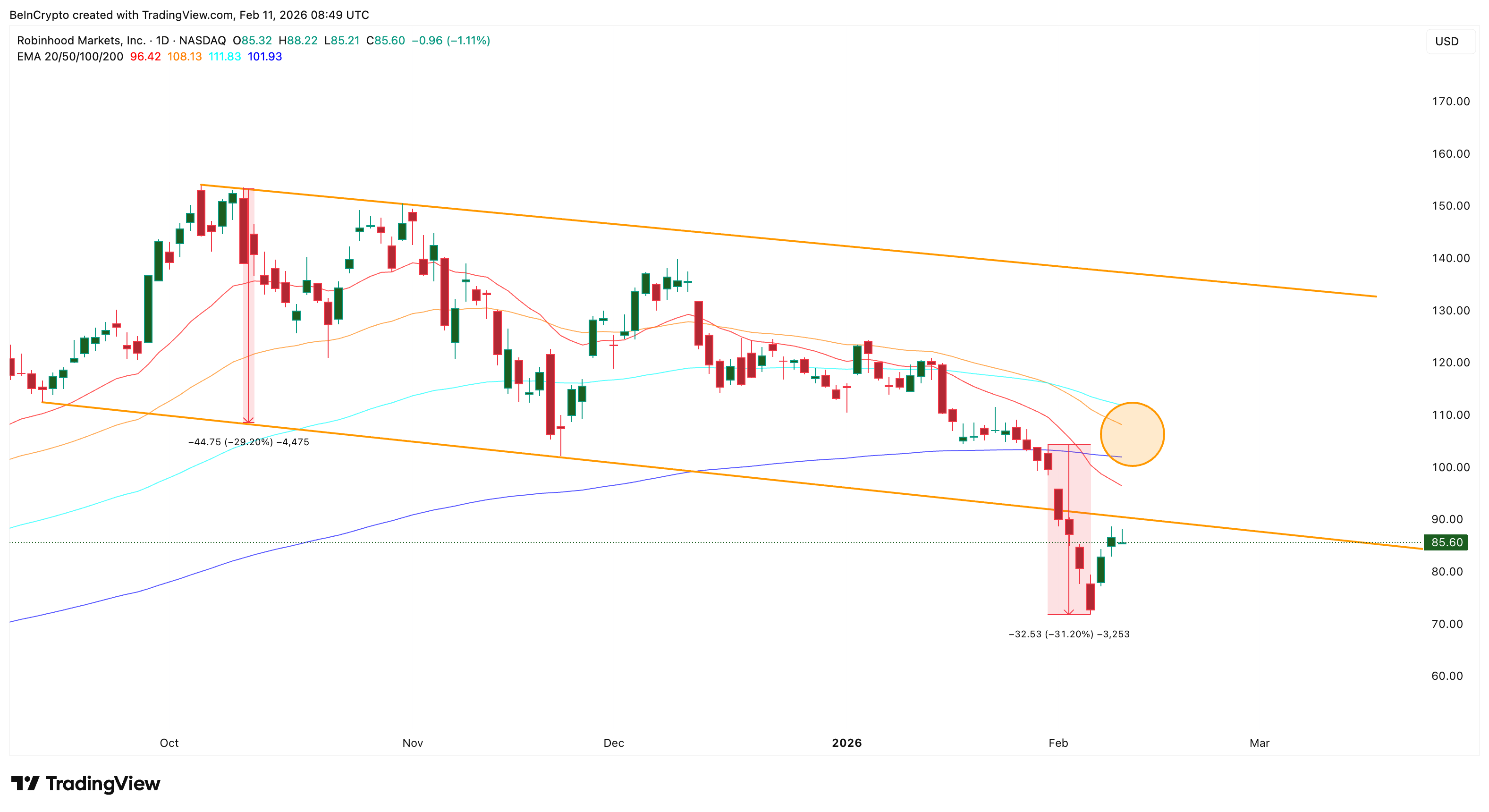
An Exponential Moving Average, or EMA, gives more weight to recent prices. Traders use them to judge trend strength. When short-term averages fall below long-term ones, momentum weakens, much like a spaceship losing thrust.
Robinhood is now facing a “death cross” risk. This happens when the 50-day EMA drops below the 200-day EMA. It often signals longer-term weakness, like a red alert on the Heart of Gold.
Two bearish crossovers already formed on January 30 and February 4. After the January signal, the stock fell nearly 30%. Now, the 50-day is again moving toward the 200-day. If this crossover confirms, downside pressure could intensify, like a black hole pulling everything in.
There is only one mild positive, like finding a working towel in a deserted spaceship.
On-Balance Volume, or OBV, compares volume on up days and down days. It shows whether buyers or sellers dominate. Between September and February, OBV formed higher lows, while HOOD made lower lows. This suggested that some retail investors were still accumulating, much like how some people still believe in the Hitchhiker’s Guide’s accuracy.
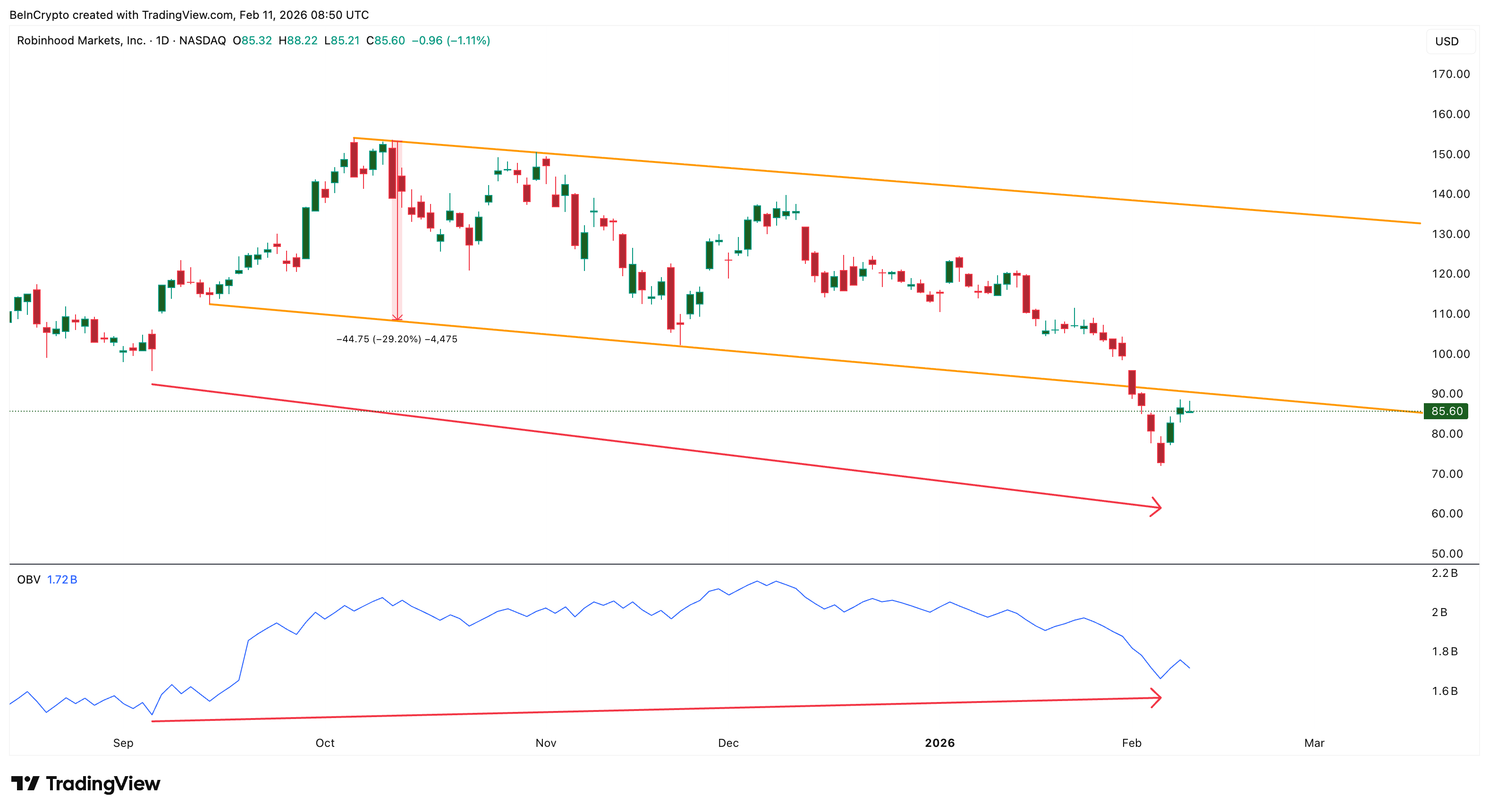
If crypto weakness continues, even this support may fade. Without strong demand from big wallets, retail buying alone is rarely enough to reverse a trend, much like how a single person can’t pilot the Heart of Gold.
New Falling Channel: A Map to the Stock’s Potential Black Hole
The chart structure remains bearish, like a Vogon captain’s mood.
Robinhood has been trading inside a falling channel since October. A falling channel forms when price makes lower highs and lower lows inside parallel trendlines. It signals controlled but persistent selling, much like a persistent Vogon trying to sell you a new spaceship.
Now, a new parallel channel is forming based on recent price action. This updated structure points to a potential downside of more than 40% if the lower trendline breaks. The first key HOOD price level is $71, the last support zone, like the last known location of a working Infinite Improbability Drive.
As long as the price stays above it, the rebound has a chance to survive despite the crypto drag. A clean break below $71 would bring lower levels into the picture. If that happens, the next major zone sits near $55, which is about as appealing as a Vogon poetry reading.
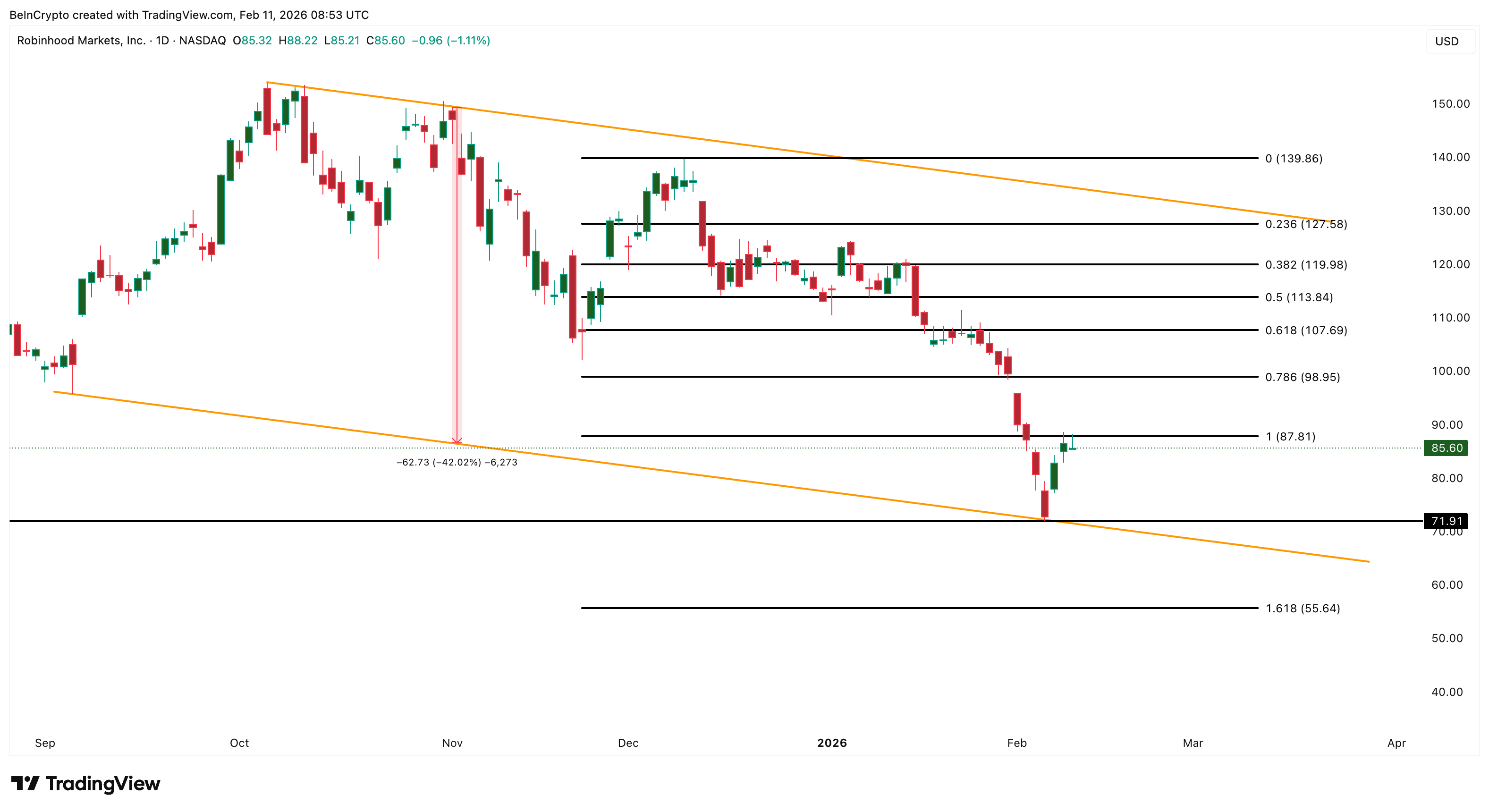
On the upside, resistance remains heavy, like a Vogon battleship. The HOOD stock price needs to reclaim $87 and then $98 to improve short-term structure. Above that, $107 and $119 act as major barriers, much like the bureaucracy of the Galactic Empire.
Read More
- BTC PREDICTION. BTC cryptocurrency
- EUR USD PREDICTION
- ENA Price Jumps 18% as December Breakout Setup Strengthens: Can It Hit $0.65 Next?
- 🔥Vienna’s Crypto Carnage: Ukrainians Burn Wallets & Souls! 💰💀
- Cardano’s Melancholy Ballet: Death Cross Dances as Markets Pause for Dramatic Effect
- Ethena’s $106M Token Unlock: Will Aave’s Liquidity Bust or Just a Bad Hair Day? 🤔
- Upbit’s Wild Goose Chase: $1.77M Frozen, Hackers on the Run 🕵️♂️💰
- Ethereum Whale’s Bold $280M Short: Is the Market on a Cliff or Just a Cliffhanger? 🤔
- SEC v Cryptos: ‘Innovation Exemption’ Will Arrive in 30 Days… Maybe? 🧨💸
- Bitcoin’s Wild Ride: Whales Strike Back, Shorts Cry 😭💰
2026-02-11 19:46