For years, the blockchain-that great ledger of the digital age-has whispered tales of a fortune untouched, a hoard of 1.1 million bitcoins, presently valued at a staggering $73 billion, slumbering in the coffers of the elusive Satoshi Nakamoto. This cryptographic Midas, the putative creator of Bitcoin, has left his treasure unmolested since 2010, a monument to either genius, negligence, or divine indifference.
-
Key Takeaways:
- Researcher Sergio Lerner, with the air of a detective unraveling a Victorian mystery, mapped the 1.1M BTC to Satoshi across 22,000 addresses, a feat of statistical near-certainty.
- Satoshi’s last recorded bitcoin transfer-a paltry 32.51 BTC to the hapless developer Mike Hearn-occurred some 16 years ago, a relic of a bygone era.
- Should Satoshi’s 5.47% share of the total BTC supply ever stir, market observers predict a cataclysm of disruption and the potential unmasking of the phantom himself.
The Numbers, Dear Boy, The Numbers
The estimates place Satoshi’s holdings at approximately 1.09 to 1.1 million BTC, a sum representing about 5.47% of bitcoin’s fixed 21 million supply cap. These coins are scattered across an estimated 22,000 distinct wallet addresses, each holding precisely 50 BTC from the halcyon days of early block rewards.
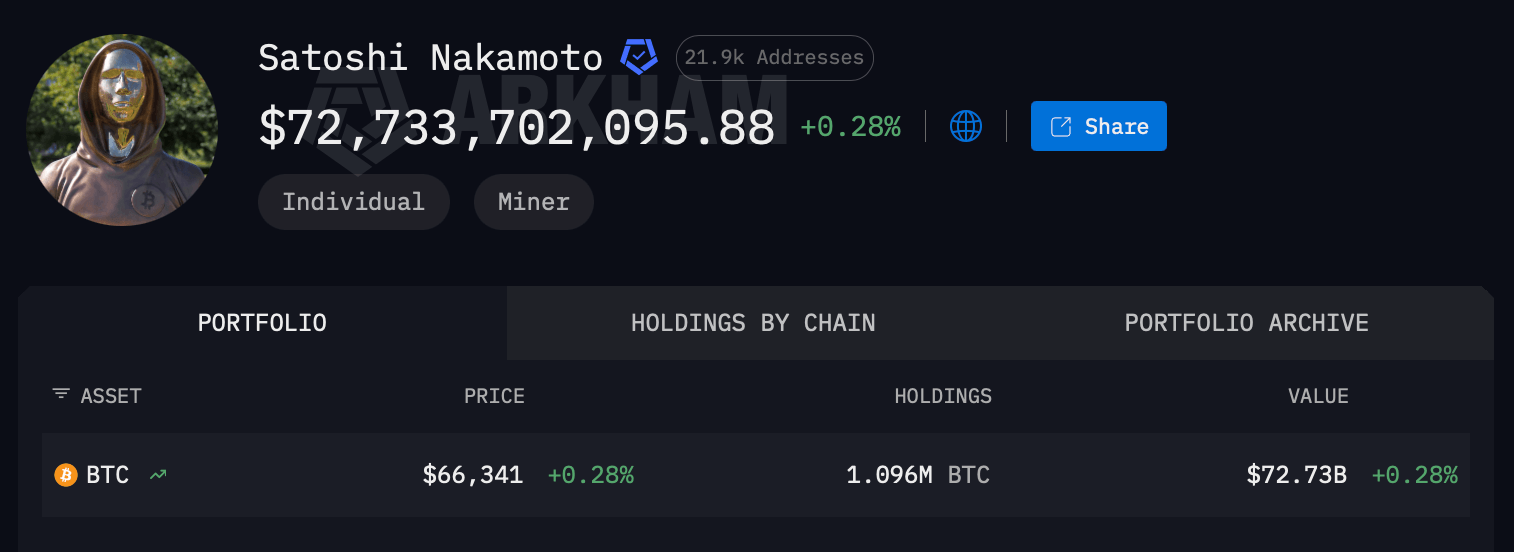
Not a single address in this cluster has recorded an outbound transaction in over 15 years, according to the indefatigable analysts at Arkham Intelligence and other independent blockchain researchers. One might imagine the coins as a digital Tutankhamun’s tomb, sealed and sacred.
The Patoshi Pattern: A Cryptographic Sonnet
These holdings were not self-reported, but rather reconstructed through cryptographic forensics, most notably by blockchain researcher Sergio Demian Lerner. Lerner, with the zeal of a Victorian naturalist, published his initial findings in 2013 and updated them in 2020, a testament to his relentless pursuit of truth.
Lerner’s method centered on an anomaly he christened the Patoshi Pattern, a name as whimsical as it is precise. In Bitcoin’s infancy, the network was so quaint that one entity accounted for roughly 22% of all blocks mined, a dominance that would make even the most audacious tycoon blush.
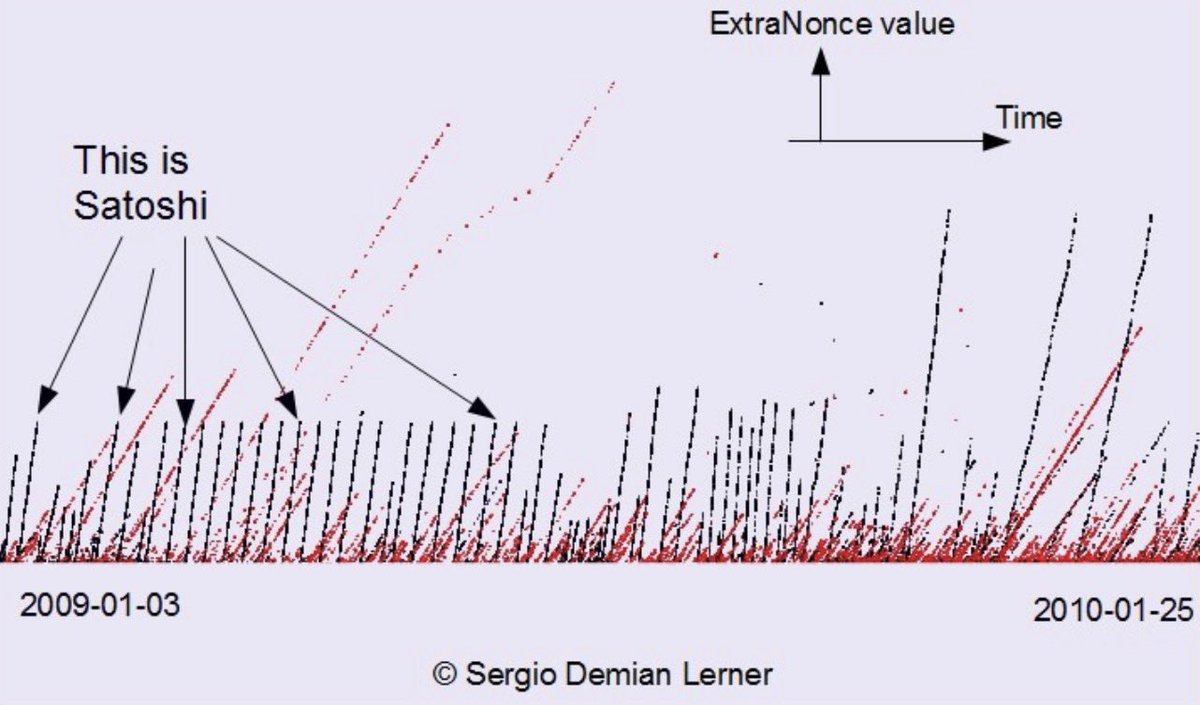
Lerner extracted the ExtraNonce field from the coinbase transaction of the first 50,000 blocks and plotted those values against block height. While most early miners produced distributions as chaotic as a Dickensian street fair, one miner left steep, contiguous linear segments, a fingerprint of exceptional speed and consistency. This pattern traces directly to Block 0, the Genesis Block mined on January 3, 2009, a date that shall live in infamy-or at least in the annals of blockchain history.
Custom Software: The Mark of a True Eccentric
Further analysis of nonce values confirmed that the dominant early miner was not running the public Bitcoin v0.1 client. No, this was no ordinary miner. Standard software scanned the 32-bit nonce space sequentially, but Patoshi’s blocks showed a constrained distribution in the Least Significant Byte (LSB) of the nonce, a telltale sign of a custom multi-threaded setup. Each thread, like a dutiful servant, was assigned a specific LSB sub-range to scan, preventing redundant work across parallel processes. This architecture left a non-random fingerprint permanently etched into the blockchain, a monument to eccentricity.
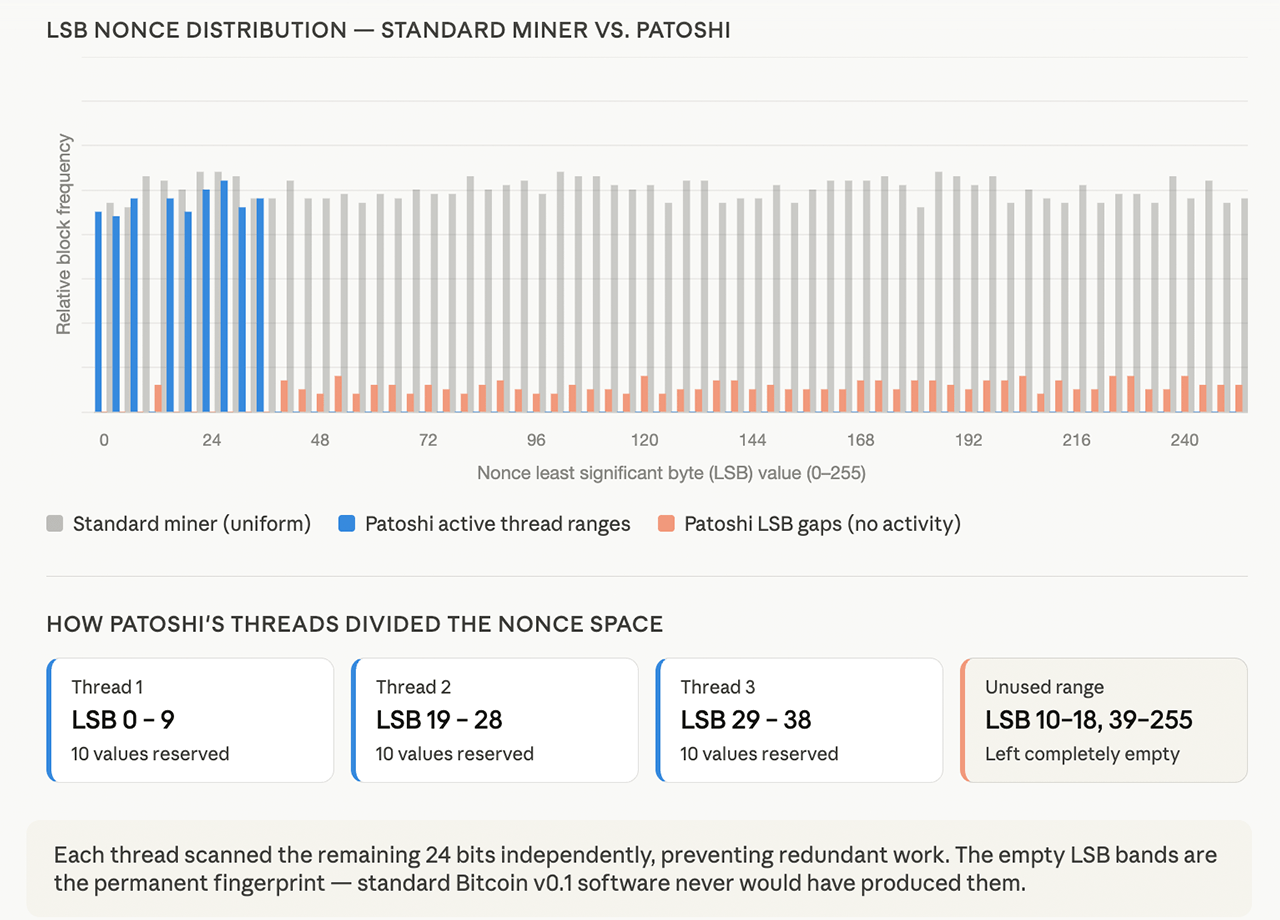
The combination of ExtraNonce slope clustering and LSB threading restrictions has led researchers to conclude, with high statistical confidence, that one entity mined approximately 1.1 million BTC during the network’s earliest phase. Around block 54,000, in late 2010, the Patoshi signature disappears entirely, aligning with Satoshi’s exit from the project, a vanishing act worthy of a stage magician.
The Genesis Address: A Digital Shrine
The most widely recognized address in the cluster is 1A1zP1eP5QGefi2DMPTfTL5SLmv7DivfNa, which received the 50 BTC reward for the Genesis block. Due to the peculiarities of how the first block was coded, those original coins cannot be spent, a quirk that has turned the address into a digital shrine. The community, ever sentimental, has since sent additional BTC to the address as a tribute. No outbound transfer has ever been recorded from it, a testament to its sacrosanct status.
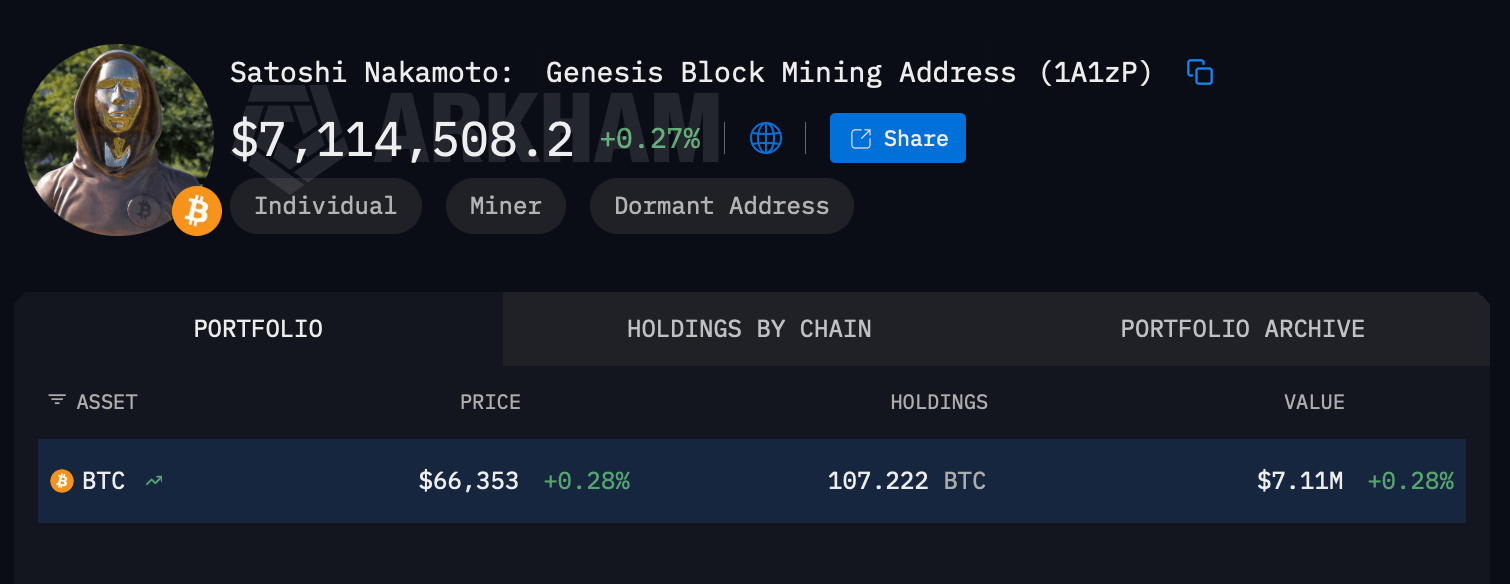
The Genesis block mining address, as of June 16, 2026, holds approximately 107.22210303 BTC, valued at $7.11 million today, a sum that would make even the most jaded aristocrat raise an eyebrow.
The Two Known Transactions: A Brief Flirtation with Mortality
Satoshi sent bitcoin on two documented occasions while still active on the network, a brief flirtation with mortality before retreating into the shadows.
On January 12, 2009, nine days after the Genesis Block, Satoshi sent 10 BTC to cryptographer Hal Finney to test the network, a transaction as quaint as a Victorian calling card. Arkham has also noted that Satoshi’s last known outflow, recorded approximately 16 years ago, involved a 32.51 BTC transfer to developer Mike Hearn.
“Hi Satoshi, I sent you 32.51 coins, my bitcoin address is 1JuEjh9znXwqsy5RrnKqgzqY4Ldg7rnj5n,” Hearn wrote on April 18, 2009, with the earnestness of a schoolboy. “I sent back 32.51 and 50.00,” Satoshi replied, with the air of a man who has more important things to attend to. “I badly wanted to find some way to include a comment with indirect transfers, but there just wasn’t a way to do it.”
Nakamoto added, with a touch of pedantry:
“Bitcoin uses EC-DSA, which was essential for making the block chain compact enough to be practical with today’s technology because its signatures are an order of magnitude smaller than RSA. But EC-DSA can’t encrypt messages like RSA, it can only be used to verify signatures.”
Satoshi sent a final email in April 2011 stating they had “moved on to other things,” a farewell as enigmatic as it is final. The coins have not moved since, a testament to either eternal rest or eternal vigilance.
Why the Coins Stay Put: A Trilogy of Speculation
Three explanations dominate the conversation among researchers and long-term bitcoin holders, each more tantalizing than the last.
- Lost keys: In 2009, bitcoin had no monetary value and no standardized key management tools. Private keys stored on a hard drive could have been deleted or lost before the network gained traction, a tragedy of Shakespearean proportions.
- Death: If Satoshi was an individual who has since died, including candidates such as Hal Finney and cypherpunk Len Sassaman, both deceased, the keys may no longer exist, a macabre end to a digital legend.
- Ideological choice: A third theory holds that Satoshi is alive and deliberately refraining from moving the coins to protect the network’s decentralization narrative, a gesture as noble as it is quixotic.
What a Move Would Mean: A Cataclysm of Speculation
Should any bitcoin from the Patoshi cluster be transferred, the market impact would be immediate and severe. The event would remove a widely held assumption that this supply is permanently out of circulation, introducing a major liquidity shock, a financial earthquake of the first order.
It would also trigger chain analysis. Any outbound transfer would expose routing data, potentially linking Satoshi’s identity to a known exchange or wallet service requiring KYC verification, a denouement as dramatic as any Victorian novel.
For now, the dormant coins remain where they have always been, mapped and visible on the public ledger, but unreachable by anyone other than whoever, if anyone, still holds the keys. A digital Fort Knox, guarded by the phantom of Satoshi Nakamoto, a figure as elusive as he is legendary.
Read More
- USD CNY PREDICTION
- Gold Rate Forecast
- USD BRL PREDICTION
- USD THB PREDICTION
- EUR HKD PREDICTION
- Silver Rate Forecast
- USD KRW PREDICTION
- GBP CNY PREDICTION
- USD VND PREDICTION
- EUR USD PREDICTION
2026-06-17 02:56