We started a new analysis of twelve years of news headlines, hoping to prove what many in the crypto world believe: that market prices react to news, and getting that news quickly can help you profit.
The research actually revealed something more concerning: often, prices change *before* news headlines are released to justify those changes. It seems price movement frequently leads, rather than follows, the news.
This isn’t to suggest news isn’t important. It’s more that we often look to news to *cause* things, when it usually just *explains* what’s already happening. And it’s understandable why we’ve thought this way for so long.
If you follow cryptocurrency for very long, you’ll quickly see a pattern: whenever there’s a significant price change or major event – like a Bitcoin price swing, a new ETF being approved, an exchange failing, or a positive legal ruling – the news coverage immediately increases. It’s easy to see how these things are connected.
The core of successfully using news for trading lies in understanding whether news *leads* price changes or *follows* them. If news drives prices, being quick to read it gives you a head start. However, if price movements generate the news, reading quickly simply means you’re better informed about past events.
The key issue wasn’t simply if news events happened during a trading period, but whether that news arrived quickly enough to actually impact traders’ decisions, as they often expect.
The part where the data got harder to argue with
This Outset Data Pulse report is based on a dataset of 63,926 news headlines from CoinDesk, covering the period from January 1, 2014, to December 30, 2025. These headlines are paired with the daily closing prices of Bitcoin, as recorded by the TradingView composite index.
We collected data for 4,381 days where we had both the closing stock price and the number of related news headlines. This allowed us to thoroughly investigate how these factors connect, looking at things like whether news causes price changes, how prices react to big news events, the positive or negative tone of headlines, and common themes in the most heavily reported days.
This system is comprehensive enough to analyze almost any significant market event, such as both rising and falling markets, the collapse of FTX, the COVID-19 pandemic’s impact, and the launch of Bitcoin exchange-traded funds.
News volume didn’t forecast price
We started by checking if the data from yesterday could predict how things would change today.
As part of my research, I analyzed Bitcoin’s price movements over a five-day period, looking at forecasts from one day ahead to five days ahead. What I consistently found was that news reports didn’t seem to reliably predict its price changes within those short timeframes.
The connection between how much news about Bitcoin changes each day and its daily price changes is incredibly weak. Statistically, it’s only 0.04%, which is so small it’s essentially nonexistent. You can safely say there’s no real relationship between daily news volume and Bitcoin’s price movements.
Over time, the amount of news coverage and Bitcoin’s price swings didn’t really connect. There wasn’t a consistent pattern showing that more articles meant bigger price changes, or vice versa – they moved independently of each other.
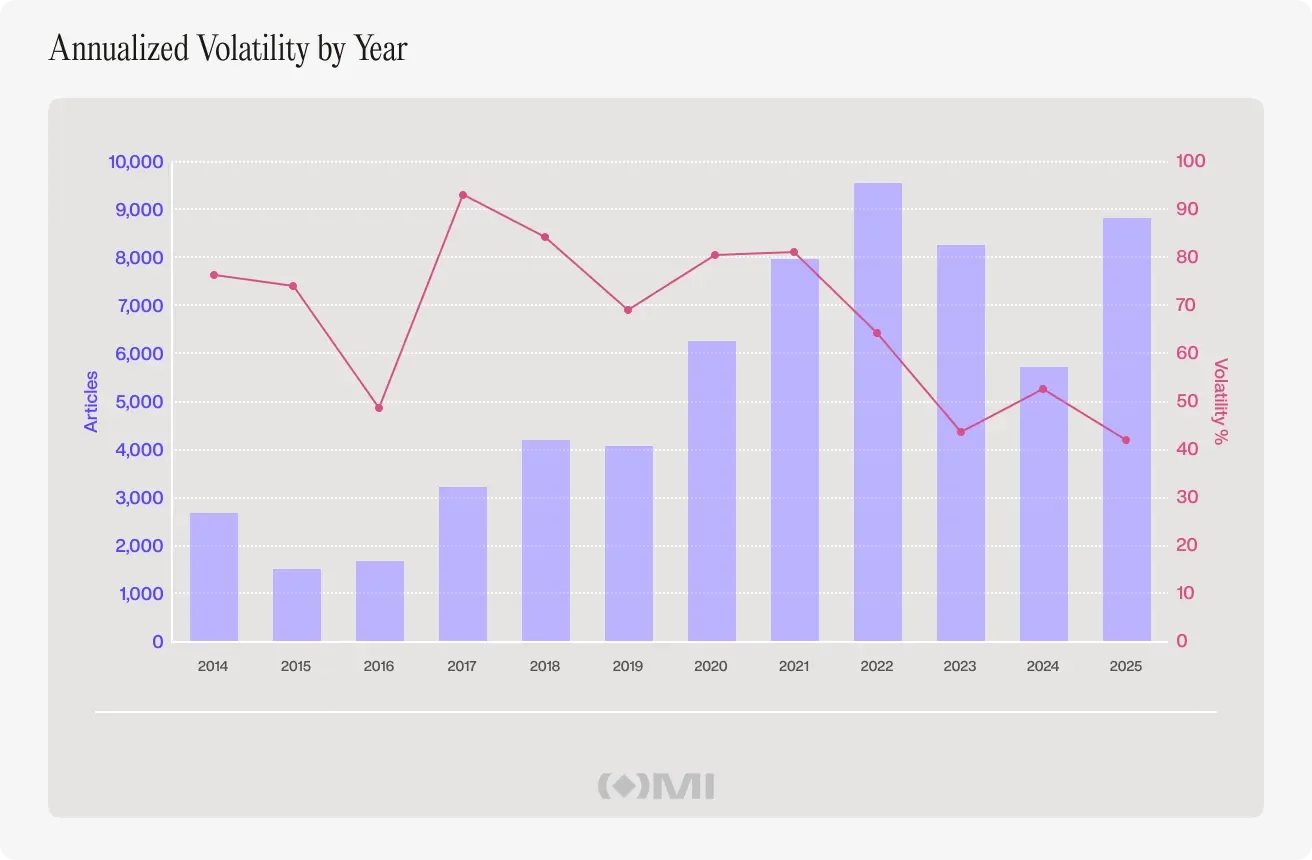
Look, news and crypto prices definitely move together sometimes. But I’ve learned that trying to trade *just* based on how many headlines are popping up isn’t a reliable strategy. It’s just too unpredictable – the connection between news volume and price movements isn’t strong enough to consistently make good decisions.
Price started showing up before the coverage
We also checked if price changes usually happened *before* a surge in news volume. Interestingly, we found a pattern where price movements often led news volume by about two days.
What really felt like real-world trading was analyzing the 50 days with the biggest news events and seeing how Bitcoin’s price changed three days before and after each one.
The price pattern was notable. Before a significant increase in attention, Bitcoin’s price was already slightly higher – about 1% above its usual level. Afterwards, the price gradually decreased by around 0.8% over the next three days.
It’s not that news causes market changes; it’s the other way around – markets often move first, and the news follows. Once you understand this pattern, you’ll realize many significant events in the crypto world seem to follow it.
Even the biggest headlines didn’t behave like clean signals
As a researcher tracking the crypto market, certain days really stand out as potentially pivotal. One such day was January 11, 2024, when the U.S. Securities and Exchange Commission approved spot Bitcoin ETFs. We saw a huge surge in coverage – my team at CoinDesk published 51 articles that day – but interestingly, Bitcoin’s price actually dipped. It fell 7.67% the day after the announcement, and continued to drop, losing 10% of its value within three days. It’s moments like these that make you really analyze what’s driving the market.
Looking back to December 4, 2023, there was a lot of buzz but no official news yet. CoinDesk released 81 articles that day, and Bitcoin’s price increased by 5% the following day.
We saw a similar pattern in other instances. For example, even though the failure of FTX caused a huge surge in news coverage, Bitcoin’s price didn’t change much. Conversely, when Bitcoin first broke above $1,000 in January 2017, it quickly dropped by 11% the next day and by almost 20% within three days.
Looking at the ten most significant news events, stock prices didn’t show any consistent behavior. Some events led to price increases, others to decreases, and in many cases, there was no noticeable change at all.
This inconsistency is important because it undermines the idea that news consistently affects market trading. If news truly drove market movements each day, we’d expect to see the strongest connection during periods of major news events – not when that connection disappears and becomes unpredictable.
We tried sentiment too
Many would argue that while trading volume can be unreliable, the overall feeling or attitude expressed in news headlines – whether positive or negative – is still a more important indicator. After all, shouldn’t optimistic versus pessimistic news stories have an impact?
We used FinBERT, a tool that analyzes the emotional tone of financial language, to assess every headline. It categorized each one as expressing a positive, negative, or neutral sentiment. We then calculated the average sentiment for each day.
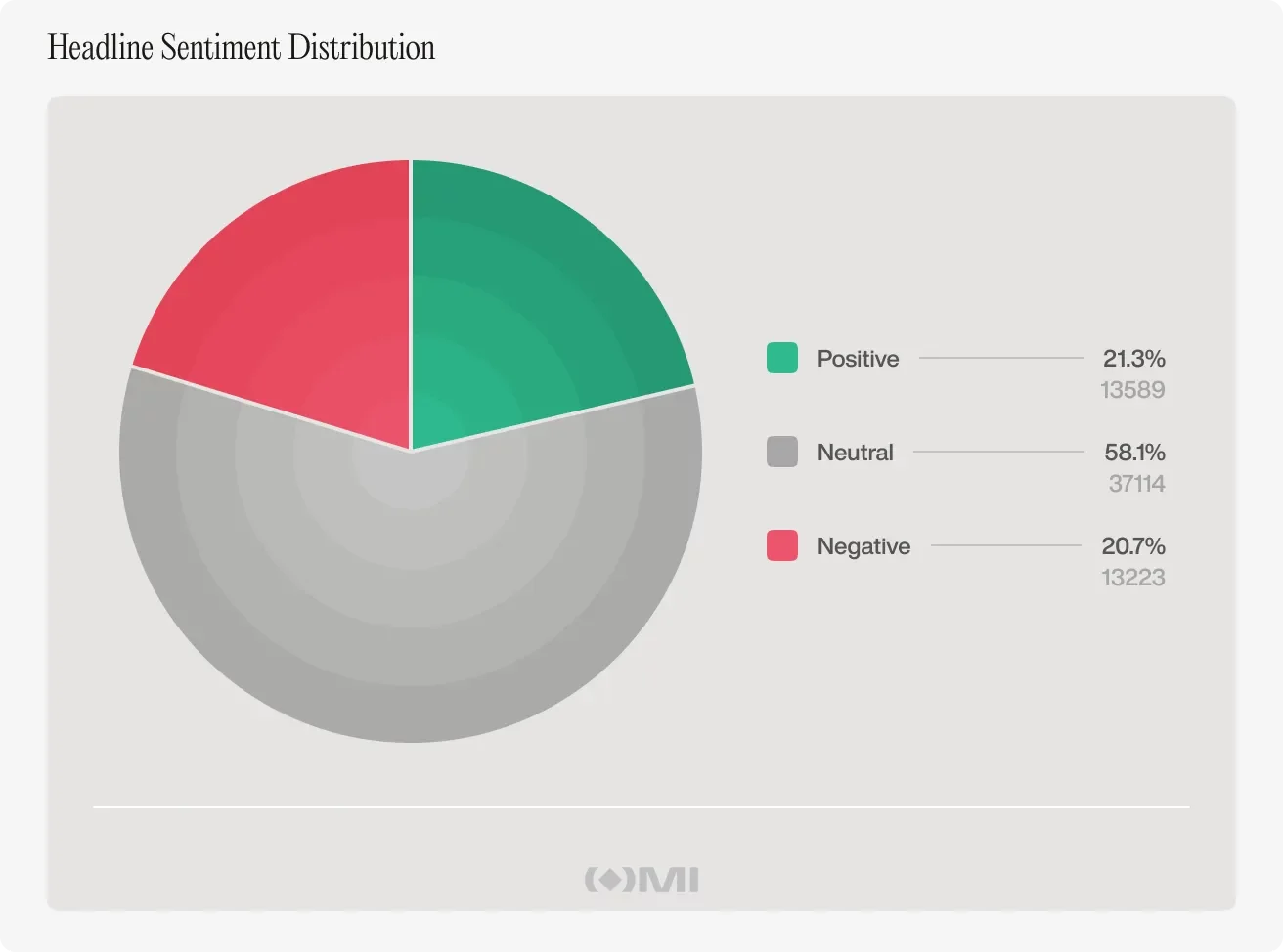
The dataset had a very balanced mix of sentiments: 58% were neutral, and 21% were either positive or negative. More importantly for trading purposes, we wanted to see if the tone of daily news headlines matched up with daily financial returns.
The connection between sentiment and price changes was very weak, with sentiment only accounting for about 0.5% of price movement – essentially negligible for anyone trying to predict market timing. Even more concerning, this connection wasn’t reliable. When looking at three-month periods, the relationship between sentiment and price frequently shifted from positive to negative, showing no predictable trend.
It’s worth pointing out that analyzing the emotional tone of headlines can sometimes feel redundant when dealing with quickly changing prices. For example, a headline stating “Bitcoin falls below $70,000” will register as negative, but that price drop is *already* reflected in the current price information.
So we’re back in the same place: the headline is describing the move, not front-running it.
The reframing that made everything make sense
Everything we’ve seen up to this point is actually important and deserves attention. Dismissing it isn’t accurate or helpful.
Increasingly, news reaches people *before* it appears in major publications. Information now travels quickly through sources like trading activity, blockchain data, social media, and private networks, allowing people to react and form opinions before traditional news outlets report it.
This is the key to understanding what’s really happening in the market. Don’t look to the media to find out *why* things are moving – they simply report on movements that have already started. Think of headlines as the final stage: they give a name and narrative to what’s already in motion, making it understandable and shareable for the public.
What this changes
Just reading the news quickly doesn’t mean you’ll be ahead of the curve. The market often reacts to information before news organizations can even fully report on it. Headlines are usually better at explaining past events than predicting the future. This isn’t a criticism of journalism, but simply a reflection of how quickly things move.
Relying on news and media to guide your investment timing can actually make you late to the game. By the time you react to something you’ve seen in the media, that information is likely already factored into market trends and investor actions.
The report itself admits that news headlines aren’t a clear indicator of what Bitcoin will do next. On days with the most news, around 61% of headlines covered general industry topics – like company partnerships, funding announcements, new products, and updates on stablecoins, NFTs, and gaming – and didn’t really suggest where Bitcoin’s price was headed. Even news about regulations, which seemed like the most promising category, wasn’t consistently helpful in predicting daily price changes.
Interestingly, even major Bitcoin events like the halving didn’t stand out during periods of intense news coverage. This implies that some of the biggest factors influencing Bitcoin aren’t directly tied to day-to-day headlines.
Where we have to be honest about the exceptions
News events can now impact markets much faster – within minutes, instead of days. While the immediate effect of a breaking news story can be significant, that impact often lessens when looking at end-of-day market summaries.
However, gradual changes in the overall story or situation, which unfold over weeks, can still affect prices in ways that this method doesn’t account for completely.
This approach also has limitations. Relying on a single source, even a reputable one, doesn’t capture all available information. Important crypto news frequently spreads quickly on social media and through private chats, which this data doesn’t cover. Additionally, certain trends might only be visible under specific circumstances, making them difficult to detect in the regular, day-to-day data we’ve analyzed.
It’s not that news is pointless, but that headlines often *reflect* market changes rather than *cause* them. In other words, the news usually explains what’s already happening, instead of predicting or triggering movement.
Read More
- Brent Oil Forecast
- Gold Rate Forecast
- Silver Rate Forecast
- EUR AUD PREDICTION
- BlackRock’s ETHB ETF: Staking Your Way to Wealth (or Figment’s Paycheck)
- TRX PREDICTION. TRX cryptocurrency
- Sonic Labs’ $150M Proposal: Will They Conquer the U.S. Market or Just Trip Over Their Own Tokens?
- 🤑 South Korea’s BTC Premium: A Gogol-esque Crypto Farce! 🌶️
- Bitcoin Tycoons Outwit Gravity, Accumulate 640k BTC – 26% Yield Magic! 🚀💸
- ENA Price Jumps 18% as December Breakout Setup Strengthens: Can It Hit $0.65 Next?
2026-03-26 22:28