It is with great optimism that Castle Labs has made a rather bold claim: the majority of crypto tokens are doomed, but don’t worry, it’s all part of the plan. According to them, the long tail of cryptocurrency is far too bloated, and most tokens will inevitably spiral towards zero unless they somehow manage to align with real business needs. So, while crypto may not be entirely on its way out, it’s certainly in the midst of a rigorous selection process-more of a cleansing than a comeback, if you will.
The crux of the argument isn’t that crypto itself is fundamentally flawed, but rather that the tokens themselves have outpaced sustainable demand. Castle Labs asserts that while a handful of dominant players continue to bask in the market spotlight, the lesser tokens are frantically squabbling over a shrinking pool of liquidity.
Too Many Crypto Tokens
To bolster their claim, Castle Labs presents some damning data. The top five crypto assets account for a whopping 84.4% of the total market capitalization, leaving the rest of the industry to share the meager 15.6%, or about $330 billion, spread across thousands of other tokens. This isn’t exactly a healthy ecosystem, but more of a lopsided pyramid.
In comparison, the US equities market has a similar concentration, where the MAG7 giants account for 31% of the market, and the S&P 500 encompasses 84.7%. But here’s the kicker-crypto’s concentration is far more extreme, with just five assets doing most of the heavy lifting.
“Over the years, so many coins have been created that 99% of them need to go to zero for the industry’s good,” the firm states, rather emphatically. And they’re not wrong. Many investors who were lured by the siren call of institutional adoption are now staring into the abyss of their alt-heavy portfolios, desperately trying to recover their losses.
Castle Labs outlines three possible scenarios for the future: major tokens lose their dominance to smaller players, external liquidity lifts the broader market, or the weaker tokens are wiped out, leaving the majors to gobble up the remaining capital. The third outcome is the most likely, despite the fact that the second would be more favorable in theory.
A key part of the argument is simple market mechanics. Castle Labs warns that token unlocks will continue to flood the market, with $8.51 billion in unlocked value this year alone, and a staggering $17.12 billion over the next five years. This, they argue, is only adding to the overhang of supply in a market where demand is selective at best.
Furthermore, the firm highlights that out of more than 5,600 protocols listed on DeFiLlama, only 76 have generated more than $1 million in revenue over the last 30 days. The rest? Not so much.
The concentration of revenue is equally telling. The top 10 protocols in 2025 will account for 80% of the total crypto revenue, with Tether alone representing a remarkable 44%. Yet, only three of these top 10 revenue generators have actually launched tokens: Hyperliquid, Pumpfun, and Jupiter. And of these, only HYPE has made a substantial impact.
This context helps explain why Castle Labs is so skeptical about new listings. In 2025 alone, there were 118 major token launches, and 84.7% of them traded below their TGE (Token Generation Event) valuation. Castle Labs sees this as clear evidence of inflated launch prices and weak post-launch structures. Not exactly a recipe for success.
The Alignment Problem
Moving on to the issue of token alignment, Castle Labs argues that the market is punishing tokens that fail to align economically with the products they represent. They point to Circle’s acquisition of Interop Labs, where Axelar’s token AXL wasn’t even part of the deal, as a glaring example of how product value and token value often fail to converge.
“Tokens are not a legal representation of the business and don’t offer any actual rights over the company’s profits, unlike equity,” the firm writes, with a touch of disdain. Investors with equity in a company have rights, but token holders? They’re at the mercy of the project, hoping that the product and the token somehow get their act together.
Castle Labs suggests that buybacks are a clear sign of alignment, with Hyperliquid and Aave leading the way. In contrast, Uniswap only aligned itself with token holders after five years of token existence. Talk about taking your sweet time.
In the end, Castle Labs’ conclusion is blunt but simple: capital should flow towards protocols that generate real revenue, align tokens with the products they represent, and implement credible mechanisms to offset dilution. Whether this thesis will hold in the next cycle depends on whether more projects adopt KPI- and revenue-led launch models, as Castle Labs predicts.
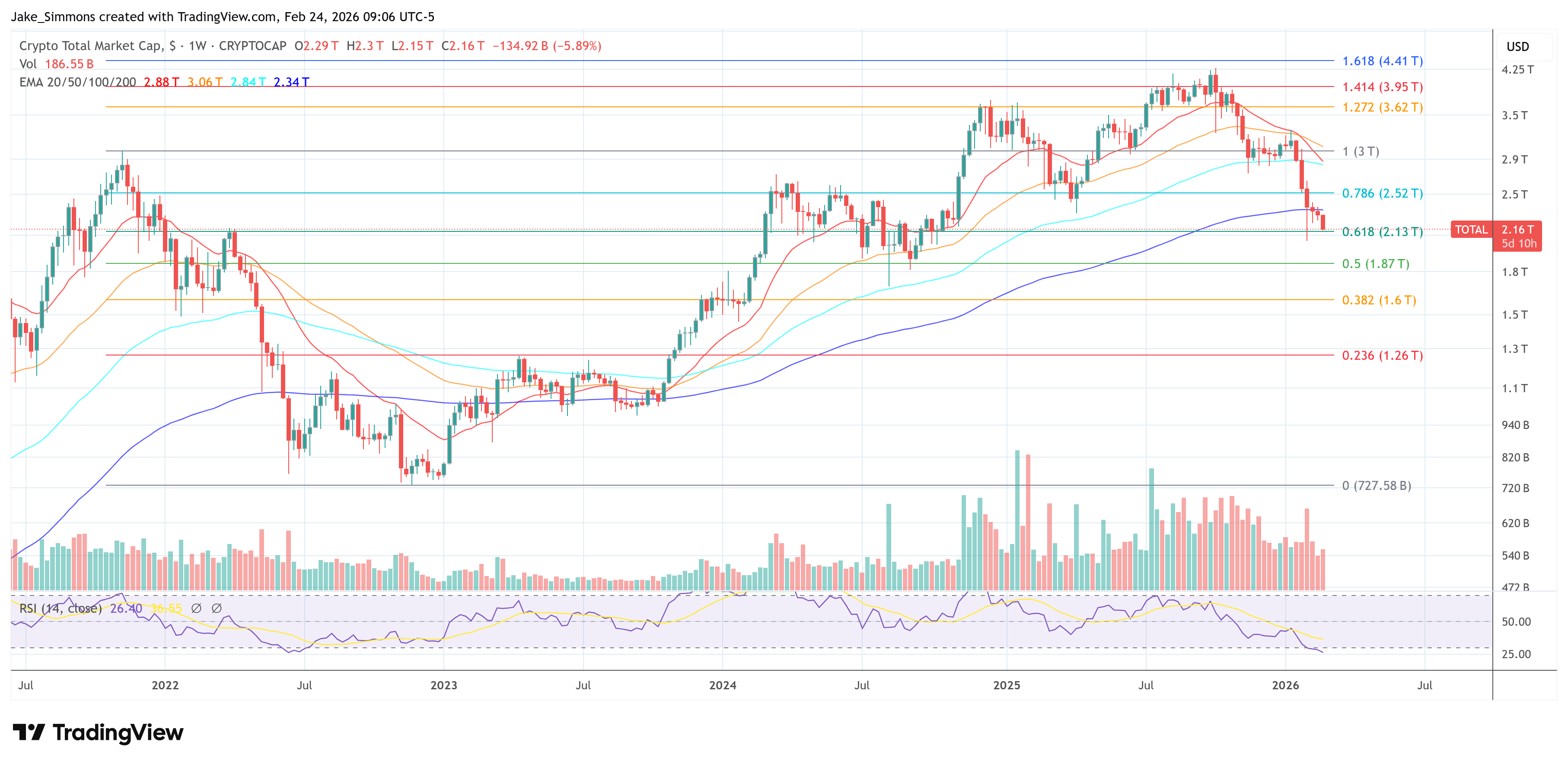
As of press time, the total crypto market cap stands at $2.16 trillion, though that number may change-or evaporate-soon enough.
Read More
- Brent Oil Forecast
- Bitcoin at Halfway Through Halving: Gains Lag Behind Previous Cycles
- Gold Rate Forecast
- Silver Rate Forecast
- USD CNY PREDICTION
- DOGE PREDICTION. DOGE cryptocurrency
- USD CLP PREDICTION
- USD MYR PREDICTION
- WLD PREDICTION. WLD cryptocurrency
- USD TRY PREDICTION
2026-02-25 09:04