Shiba Inu appears to be stabilizing after a long period of declining prices, and recent data supports this idea. A significant decrease – around 47% – in the amount of Shiba Inu being sent to exchanges suggests that selling pressure is easing up.
Donwside driver disappears
When fewer tokens are sent to exchanges, it usually suggests fewer people are looking to sell, which can help reduce downward price pressure.
Overall, the amount of SHIB moving into exchanges hasn’t increased much, but slightly more is leaving. This means more SHIB is currently being withdrawn from exchanges than deposited, which is a noteworthy shift. It suggests that, for now, people who own SHIB are less likely to sell and are instead choosing to hold onto it or adjust their holdings.
Bitcoiners Agree Satoshi’s Coins Must Remain Untouched
Ripple’s Schwartz Shuts Down Gag Order Rumors
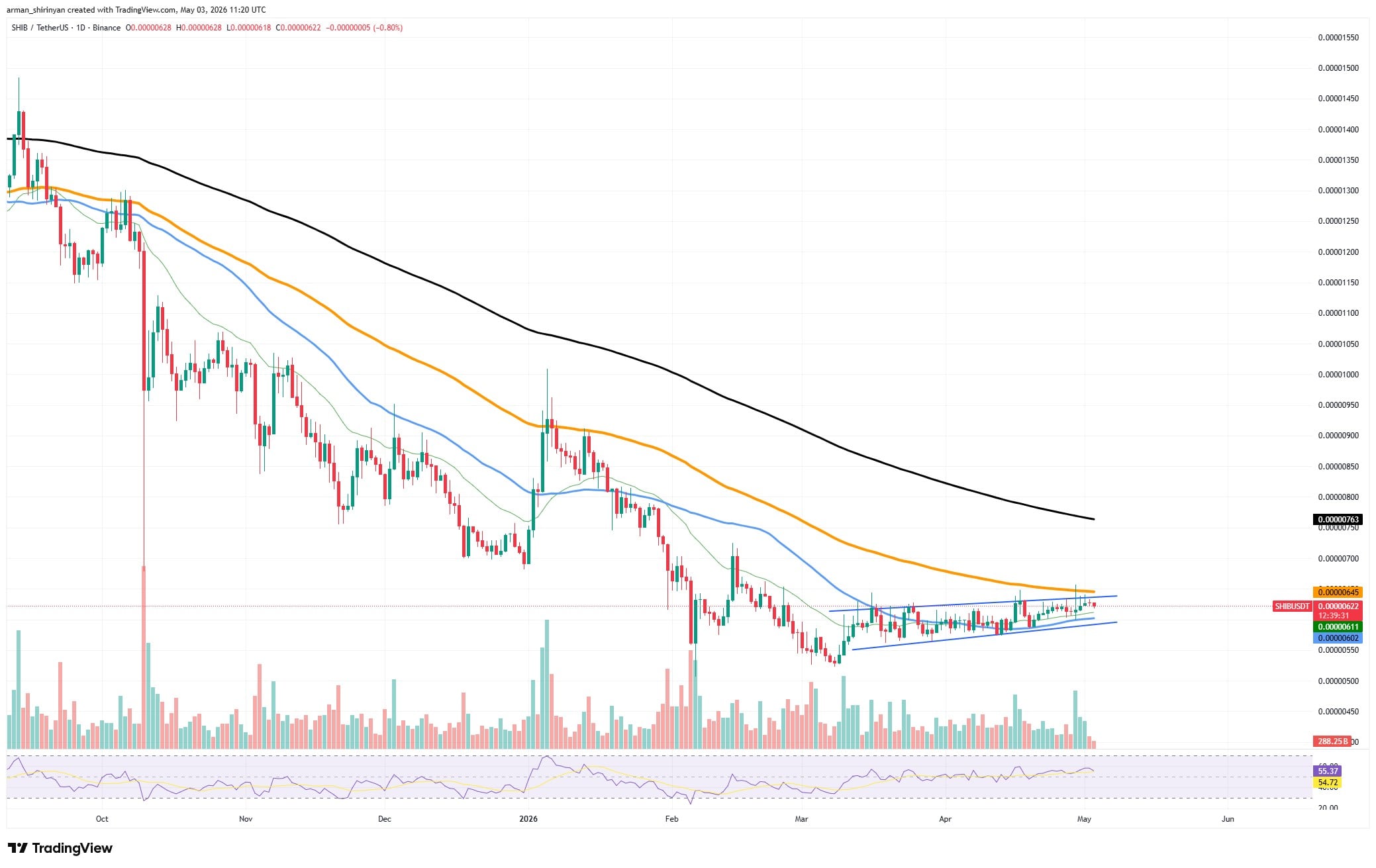
The price chart shows SHIB steadily increasing. Since February, it’s been moving upwards in a narrow, consistent pattern, with each low point slightly higher than the last. It’s now slowly approaching a key moving average (the 100 EMA), which has previously limited its upward movement during the recent overall decline.
That’s where things get tricky.
Despite some decrease in selling, SHIB is still trading below key levels that would signal a positive trend. The 50-day and 100-day moving averages remain above the current price, and the 200-day moving average is much higher, confirming that the overall trend hasn’t changed yet.
While fewer people are selling SHIB right now, which is good, it doesn’t guarantee the price will go up. For a significant price increase, we need to see more people buying, not just less selling. Currently, trading volume is low, indicating that potential buyers are hesitant and not fully convinced.
Next, SHIB is likely to encounter a challenge near a key resistance level, defined by the upper edge of its current upward trend and the 100 EMA. If it can break through this level and stay above it, the price could then rise towards the next area of resistance around the 200 EMA.
If the price doesn’t rise from here, it will likely either move sideways for a while or fall back towards the previous low. Essentially, while selling is slowing down, buyers haven’t stepped in to drive prices higher yet. This is a period of change, and it’s too early to say if the trend is definitely reversing.
Read More
- Gold Rate Forecast
- Brent Oil Forecast
- Silver Rate Forecast
- Bitcoin at Halfway Through Halving: Gains Lag Behind Previous Cycles
- DOGE PREDICTION. DOGE cryptocurrency
- USD MYR PREDICTION
- ADA PREDICTION. ADA cryptocurrency
- USD TRY PREDICTION
- USD CLP PREDICTION
- I gave up gin for this coin and made £12.42-learn the secret (you won’t believe emoji #3) 😱✨💰
2026-05-03 14:46