In the dimly lit sanctum of the Neue Nationalgalerie, a menagerie of mechanical mongrels, their visages grotesquely grafted with the likenesses of Musk, Bezos, and other titans of industry, prowl with an air of calculated nonchalance. These silicon-skinned sentinels, their eyes aglow with the cold fire of artificial intelligence, do not merely observe-they devour the souls of the onlookers, regurgitating them as ersatz art from their posterior orifices.
This carnival of the absurd, christened “Regular Animals,” is the latest confection from the digital demiurge Beeple (né Mike Winkelmann), on display until the arbitrary date of May 10, 2026. It is a tableau vivant where robotics, artificial intelligence, the cult of celebrity, and the blockchain converge in a symphony of the surreal. At first glance, it is risible; upon prolonged exposure, it becomes a mirror reflecting the grotesque contours of our digital age.
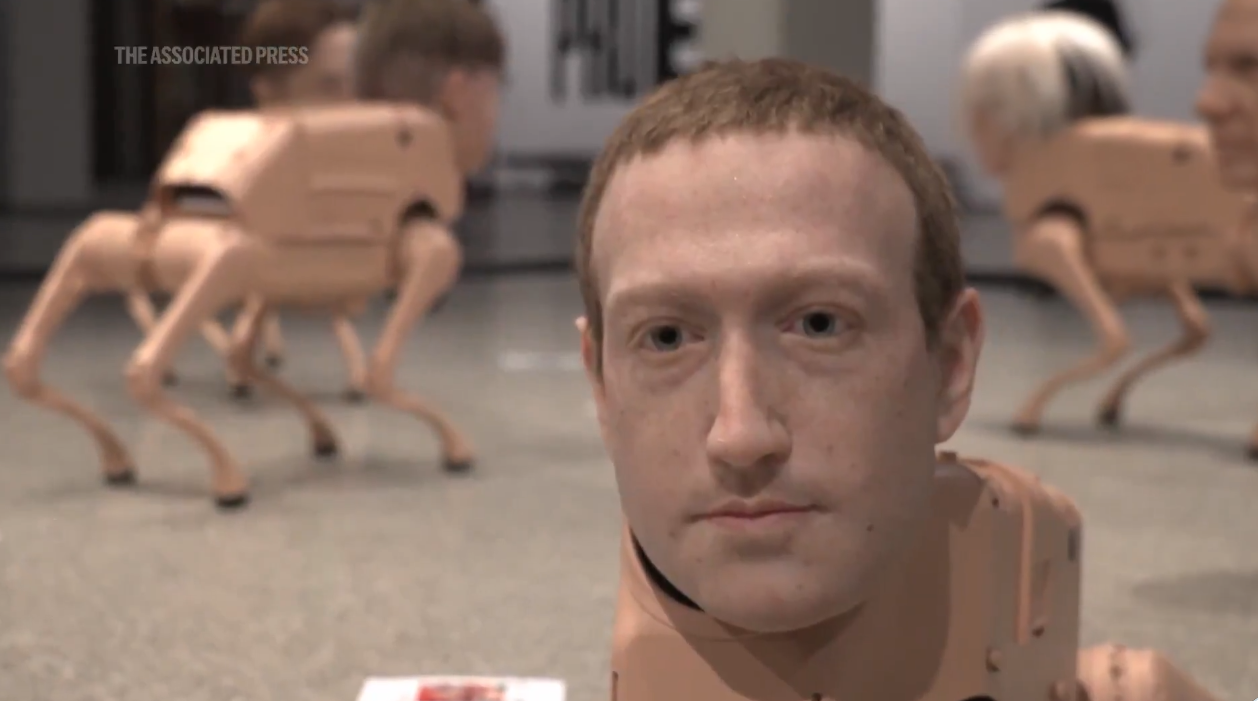
Mechanical Mongrels in the Temple of Art
The installation features a pack of autonomous canines, their silicone heads sculpted with the uncanny precision of a taxidermist’s nightmare. Among the faces are those of Musk, Bezos, Zuckerberg, Warhol, Picasso, and Beeple himself-a rogues’ gallery of influence and eccentricity. One dog, its visage a disturbingly accurate replica of Kim Jong Un, adds a note of geopolitical absurdity to the proceedings.
These creatures are not static; they roam, they scrutinize, they interact. It is as if a tech conference has mated with a museum installation, birthing a litter of dystopian curiosities.
“Robot dogs with hyper-realistic silicone heads modeled after famous figures are roaming a Berlin museum, occasionally ‘pooing’ printed images of their surroundings that they’ve captured with integrated cameras.” – The Washington Post (@washingtonpost) April 29, 2026
The Gaze of the Machine, the Bowel of the Artist
Each dog is equipped with cameras that capture the gallery and its visitors, feeding the images into an AI maw that digests and regurgitates them in the style of its assigned persona. The Picasso dog fragments the world into cubist shards; the Warhol dog drenches it in the garish hues of pop art. And then, the pièce de résistance: the dogs expel these creations from their rear ends, offering them to the public as both gift and insult.
It is a farce, yes, but one with fangs. Beeple, that wily provocateur, uses this absurd tableau to interrogate the very nature of power in the digital age. Who are the arbiters of culture now? The artist, the museum, the government-or the algorithm, the billionaire, the platform?
The Blockchain’s Phantom Limb
Lest we forget, there is a blockchain component to this circus. Visitors may claim NFTs linked to the project via QR codes, a gesture that is both a nod to Beeple’s $69 million NFT sale in 2021 and a sly commentary on the commodification of the ephemeral.
Beeple, the high priest of the NFT boom, has always danced on the razor’s edge between art and commerce. With “Regular Animals,” he transforms that dance into a grotesque ballet, a satire of the very world he helped create.
In March 2021, Beeple made history.
He sold a single NFT
“Everydays: The First 5000 Days”
For $69.3 million at Christie’s.
It was the first digital-only artwork ever auctioned there.
And the third most expensive piece by a living artist.
(5/9)
– StarPlatinum (@StarPlatinum_) June 28, 2025
From Miami’s Glare to Berlin’s Gloom
This spectacle first unfurled at Art Basel Miami Beach 2025 before migrating to Berlin for Gallery Weekend 2026. Its Berlin incarnation is particularly noteworthy, marking Beeple’s inaugural institutional exhibition in Germany. Here, the work sheds its viral skin and dons the mantle of high art, though its social media-friendly essence remains undiminished.
Yet, for all its engineered virality, the installation is more than a stunt. It is a funhouse mirror held up to our digital selves, reflecting the absurdity, the discomfort, the creeping unease of a world where machines wear the faces of our overlords and defecate our souls as art.
The Uncanny Valley of Power
What is most unsettling is not the dogs’ grotesque visages, but the way they reduce the human to raw material. The visitor enters, is consumed by the gaze of the machine, and is excreted as a print-a process that eerily mirrors our relationship with digital platforms. We post, we click, we scroll, and in return, we are fed a distorted reflection of ourselves.
Beeple has merely made this loop literal, giving it form and flesh. And in doing so, he has created a work that is at once hilarious and horrifying, a jest that cuts to the bone.
“Regular Animals” arrives at a moment when AI art is already a Rorschach test of anxieties about authorship, consent, and originality. Beeple’s installation amplifies these questions, rendering them in a grotesque, automated farce. The machines are not faceless; they wear the masks of power, and in their gaze, we see our own complicity.
So yes, AI art is getting creepy. In Berlin, it has taken the form of a four-legged, billionaire-faced, camera-eyed, art-excreting monstrosity. And we are all complicit in its creation.
Read More
- Silver Rate Forecast
- Gold Rate Forecast
- Brent Oil Forecast
- USD CNY PREDICTION
- Bitcoin at Halfway Through Halving: Gains Lag Behind Previous Cycles
- USD TRY PREDICTION
- CDC Boss Plays Keep-Away with COVID Vaccine Data – Scientists Cry Foul!
- Bitcoin’s $75K Drop: Trump vs. Iran Showdown
- DOGE PREDICTION. DOGE cryptocurrency
- I gave up gin for this coin and made £12.42-learn the secret (you won’t believe emoji #3) 😱✨💰
2026-05-02 01:56